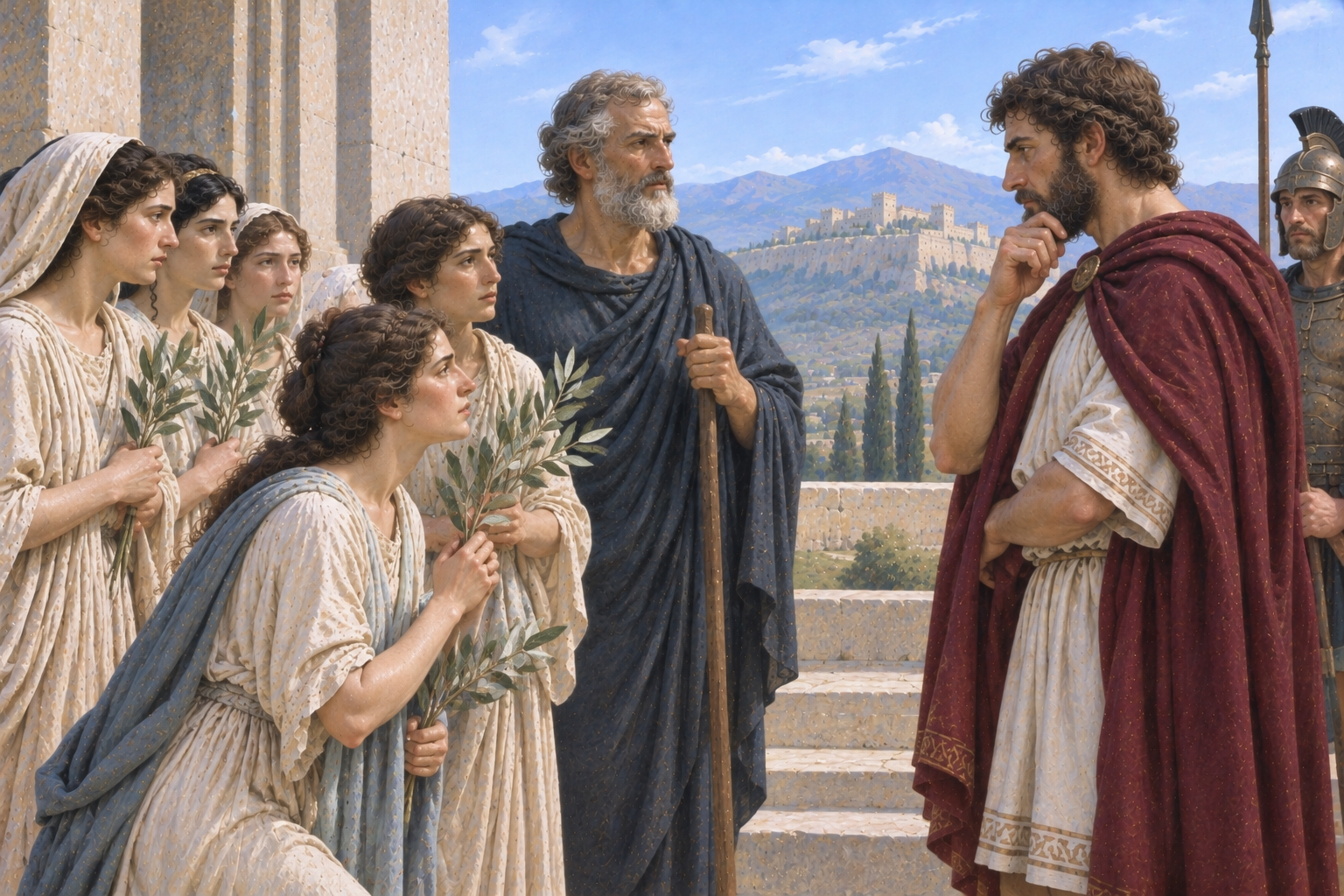
The People Behind the Plea for Sanctuary
In Aeschylus’ Suppliant Women, a group of sisters arrives in Argos seeking protection from unwanted marriages. Their request places the king and his people in a difficult position: should they defend vulnerable strangers even if doing so risks conflict? The relationships among the Danaids, their father, the Argive ruler, and their pursuers give the play its dramatic force.
The Danaids: A Collective Protagonist
The fifty daughters of Danaus form the Chorus and occupy the center of the tragedy. They have fled Egypt to escape marriage to their cousins, the sons of Aegyptus.
Unlike a Chorus that merely observes the principal characters, the Danaids speak and act as the people whose fate is being decided. They pray, plead, argue, express fear, and demand protection.
Their collective voice is one of the play's most distinctive features. Students should nevertheless consider whether speaking together always means that the sisters have identical feelings or motives.
Danaus: Father, Protector, and Adviser
Danaus accompanies his daughters to Argos and helps them seek refuge. He advises them on how to approach the sacred altars and address the people who may protect them.
His role combines paternal concern with authority over his daughters. Although he supports their flight from the proposed marriages, students can examine how much independence the women exercise within this family relationship.
Danaus also serves as a link between the sisters' immediate danger and the larger conflict between the families of Danaus and Aegyptus.
Pelasgus: A Ruler Facing Competing Duties
Pelasgus, king of Argos, must decide how to respond to the Danaids' appeal.
He recognizes the religious seriousness of their request for sanctuary, but he also understands that protecting them could expose his city to war.
Rather than making the decision entirely on his own, Pelasgus refers the matter to the Argive people. His conduct raises questions about leadership, public consent, and the responsibilities of a community toward outsiders.
The Egyptian Herald: The Threat of Coercion
The Egyptian herald represents the men pursuing the Danaids. When he arrives, he threatens to take the women away by force.
His conduct contrasts sharply with the language of supplication used by the sisters. Where they ask for protection, he asserts power and attempts to compel obedience.
The confrontation with Pelasgus turns the danger described earlier in the play into an immediate dramatic conflict.
The Sons of Aegyptus: Powerful but Absent
The sons of Aegyptus do not appear as individual speaking characters in the surviving play. Nevertheless, their pursuit of the Danaids creates the central crisis.
Their absence is significant. The audience encounters their intentions largely through the sisters' descriptions and the actions of their representative.
Students can consider how Aeschylus makes an unseen group a powerful presence throughout the drama.
The People of Argos: A Collective Decision
The Argive citizens are important even though their deliberations are not presented directly onstage.
Pelasgus brings the question of protection before them, and their decision to shelter the Danaids gives public authority to the promise of sanctuary.
The relationship between king and citizens shows that the responsibility for protecting strangers extends beyond a single ruler.
Understanding the Relationships
The central relationships can be summarized as follows:
- Danaids and Danaus: Daughters and father, united in flight but not necessarily equal in authority.
- Danaids and the sons of Aegyptus: Women resisting marriages sought by their pursuing cousins.
- Danaids and Pelasgus: Petitioners asking a ruler to recognize their claim to protection.
- Pelasgus and the Argive people: A king who shares a dangerous public decision with his community.
- Pelasgus and the Egyptian herald: Opposing representatives of protection and coercion.
These relationships connect private family conflict with public political and religious obligations.
Questions for Discussion
- Why is it important that the Danaids speak primarily as a Chorus rather than as separate named characters?
- How does Danaus support his daughters, and how does his authority shape their situation?
- Why does Pelasgus hesitate before agreeing to protect the women?
- What does the Egyptian herald reveal about the danger facing the Danaids?
- How does the Argive people's decision change the relationship between the strangers and their host community?
- Does the protection granted at the end of the surviving play resolve the central conflict completely?
Note to the Educator
Encourage students to compare the language of the Danaids' appeal with the Egyptian herald's threats and Pelasgus' careful deliberation. These contrasting voices reveal how power operates in the play. A relationship diagram can also help students distinguish family authority, religious obligation, and civic responsibility.
Remind students that the surviving tragedy belongs to a larger mythological story whose companion plays have been lost. The later events of that story should not be treated as events shown in Suppliant Women itself.
This guide accompanies the Richer Resources Publications edition of Suppliant Women, translated by Ian Johnston.
A printable PDF version of this resource is available by email.