A Royal Household Confronts Defeat
Aeschylus’ The Persians presents the aftermath of the Greek victory at Salamis from the perspective of the defeated Persian court. Rather than placing Greek heroes onstage, the tragedy follows the anxiety, grief, and judgment of those left behind. Relationships between a mother, her son, a deceased king, and the elders of Persia illuminate the responsibilities of power.
Atossa: Queen and Mother
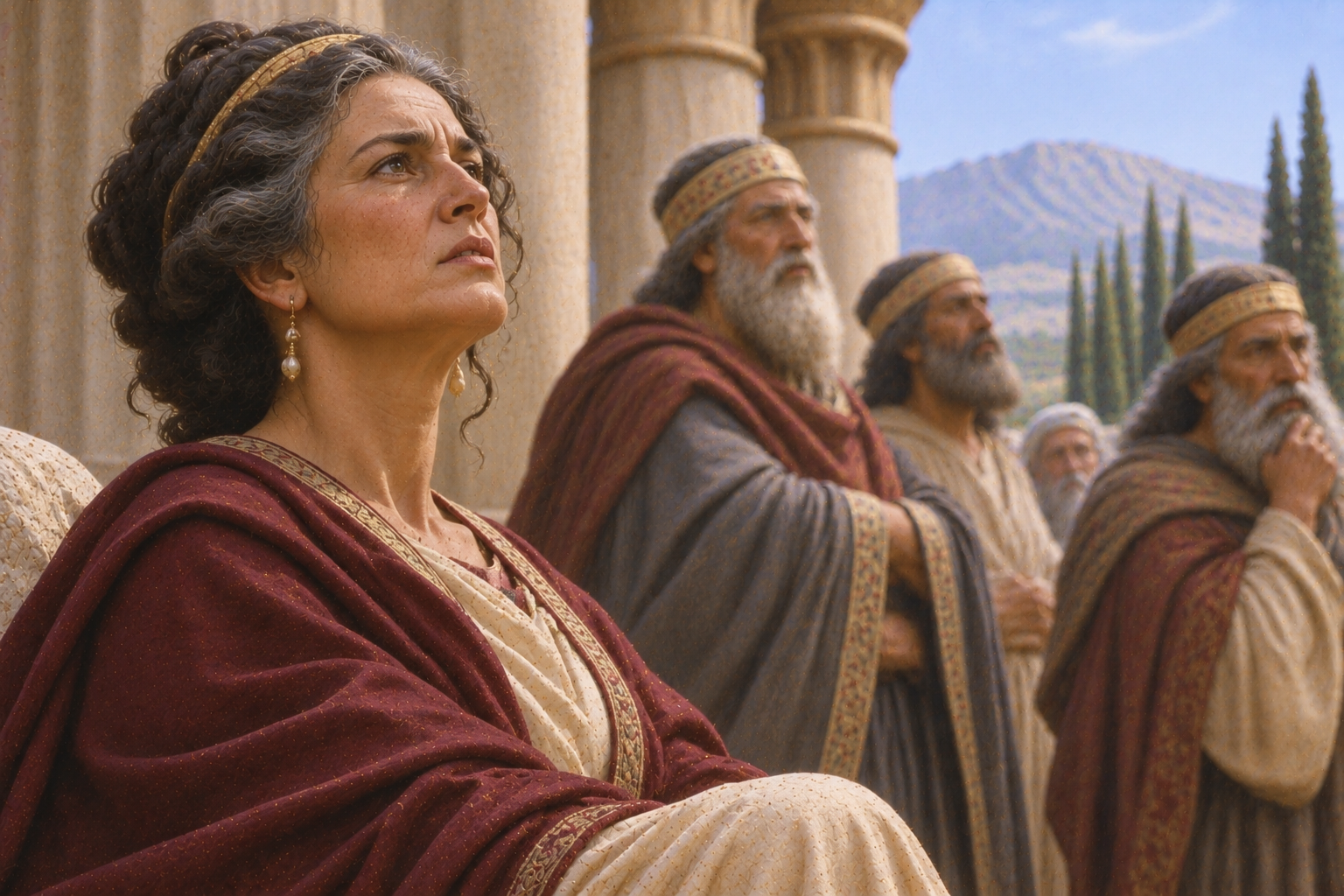
Atossa, widow of Darius and mother of Xerxes, is troubled by a dream and by the absence of news from the expedition. Her concern joins the personal fear of a mother with the political anxiety of a royal household. She asks questions, seeks counsel, and later summons the spirit of Darius. Through her, the audience experiences the disaster before Xerxes himself appears.
Xerxes: The Absent King Who Returns Defeated
Xerxes leads the Persian invasion of Greece but does not appear until the end of the play. Other characters describe the destruction of his forces and question his judgment. When he finally arrives, his exchange of laments with the Chorus reveals a ruler stripped of triumph. His relationship with Atossa and his father Darius invites discussion of inheritance, ambition, and accountability.
Darius: Father, Former King, and Voice of Warning
The ghost of Darius is summoned after news of the defeat. He represents the authority of an earlier reign and interprets the catastrophe in terms of excessive ambition and disrespect for divine limits. His assessment of Xerxes contrasts the prudence attributed to the father with the son’s disastrous decisions. Students should notice that Darius is a dramatic character, not a neutral historical narrator.
The Chorus: Persian Elders and Collective Grief
The Chorus consists of Persian elders entrusted with the affairs of the kingdom while Xerxes is away. Their anxiety becomes mourning as the scale of the defeat emerges. They speak not only as advisers to the royal family but also as representatives of a community suffering the loss of its young men. Their final lament with Xerxes brings the public cost of war into the foreground.
The Messenger: Witness to Catastrophe
The messenger reports the Persian defeat at Salamis and its aftermath in vivid detail. His testimony turns distant events into an immediate emotional experience for Atossa and the Chorus. Unlike Darius, who interprets the defeat, the messenger recounts what happened. Comparing their speeches helps students distinguish narrative evidence from moral explanation.
Key Relationships
- Atossa and Xerxes: A mother’s concern is inseparable from anxiety about her son’s rule.
- Darius and Xerxes: The former king’s authority exposes the dangers of the younger ruler’s ambition.
- Atossa and Darius: The queen seeks guidance from her deceased husband amid national crisis.
- The Chorus and Xerxes: Loyal elders share in the king’s grief while confronting the losses of the people.
- The Messenger and the Court: A witness brings knowledge that transforms uncertainty into mourning.
Questions for Discussion
- How does Atossa’s role as both mother and queen shape her response to the expedition?
- Why does Aeschylus delay Xerxes’ appearance until the final scene?
- What differences emerge between the messenger’s report and Darius’ interpretation?
- How does the Chorus represent more than the interests of the royal family?
- How does the father–son relationship contribute to the play’s criticism of overconfidence?
- What does the final lament reveal about the human cost of war?
Note to the Educator
Ask students to track what each character knows and when that knowledge becomes available. A simple chart contrasting Atossa’s fears, the messenger’s account, Darius’ judgment, and Xerxes’ lament can show how Aeschylus develops the catastrophe without staging the battle itself.
This guide accompanies the Richer Resources Publications edition of The Persians, translated by Ian Johnston.
A printable PDF version of this resource is available by email.