Defiance, Authority, and the Voices of Conscience
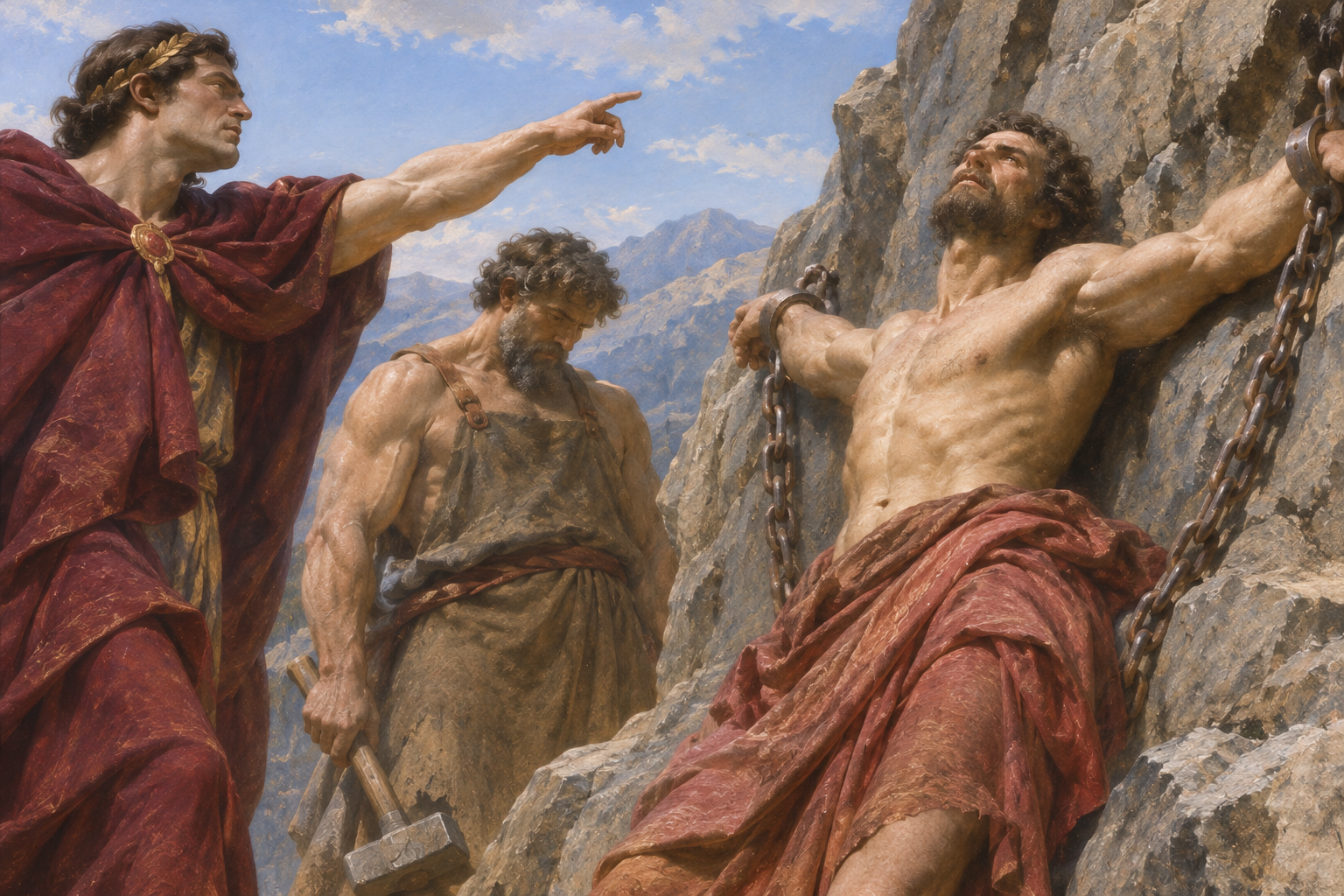
In Prometheus Bound, the central figure is physically chained throughout the drama, yet his encounters with other characters reveal a far-reaching conflict over power, justice, knowledge, and resistance. Each visitor offers a different response to the authority of Zeus, helping readers consider whether obedience, compromise, or defiance is the wisest course.
Prometheus: The Defiant Benefactor
Prometheus is a Titan punished for helping humanity and resisting Zeus. He claims to have given mortals fire and the practical knowledge needed to develop civilization. Although he suffers terribly, he refuses to surrender a prophecy that could threaten Zeus' power.
His determination may be interpreted as moral courage, stubborn pride, or a combination of both. Students should consider how his concern for humanity relates to his personal conflict with Zeus.
Zeus: The Unseen Ruler
Zeus never appears onstage, but his authority governs the action. His agents enforce his commands, and the suffering of Prometheus and Io reveals the consequences of his rule.
Because the audience encounters Zeus primarily through others' accounts, his absence becomes an important dramatic feature. Students can examine how Sophocles' fellow tragedian—or the playwright traditionally identified as Aeschylus—uses an unseen ruler to raise questions about justice and absolute power.
Hephaestus: Duty and Reluctance
Hephaestus, the divine craftsman, must fasten Prometheus to the rock. He expresses sympathy for the condemned Titan but nevertheless carries out Zeus' command.
His position raises a difficult question: does recognizing an injustice create a responsibility to resist it, even when disobedience may bring punishment?
Power and Force: Instruments of Authority
Power, often called Kratos, insists that Zeus' punishment be carried out without hesitation. Force, or Bia, accompanies him but does not speak.
Together they embody the coercive side of divine government. Their contrast with Hephaestus helps establish the conflict between obedience and compassion at the beginning of the play.
The Oceanids: Sympathy and Witness
The daughters of Oceanus form the Chorus. They listen to Prometheus, express concern for his suffering, and respond to the dangers of his defiance.
Their presence introduces a sympathetic perspective without removing the risks associated with opposing Zeus. Their decision to remain with Prometheus at the end gives their solidarity particular importance.
Oceanus: The Voice of Compromise
Oceanus advises Prometheus to moderate his speech and seek reconciliation with Zeus. His counsel reflects caution and political practicality.
Students may debate whether Oceanus offers genuine wisdom or whether his advice asks Prometheus to surrender a principle for personal safety.
Io: A Mortal Victim of Divine Power
Io is a mortal woman whose suffering is connected to Zeus' desire for her and Hera's jealousy. Driven from place to place, she encounters Prometheus and learns about her future wanderings and descendants.
Her restless movement contrasts with Prometheus' immobility. Their meeting expands the play's concern with suffering beyond a struggle among gods.
Hermes: The Messenger of Ultimatum
Hermes arrives to demand that Prometheus reveal the prophecy concerning Zeus' future. He warns of harsher punishment if Prometheus refuses.
Unlike Oceanus, who urges accommodation, Hermes speaks as an agent of authority. His confrontation with Prometheus brings the central conflict to its dramatic climax.
Questions for Discussion
- Is Prometheus' refusal to submit an act of courage, pride, or both?
- How do Hephaestus and Power differ in their responses to Zeus' command?
- Why might the playwright have chosen never to bring Zeus onstage?
- Does Oceanus offer wise advice, or does he encourage surrender to injustice?
- How does Io's suffering change our understanding of Prometheus' situation?
- What does the Chorus' final decision suggest about loyalty and solidarity?
Note to the Educator
Encourage students to compare the characters' responses to power rather than treating the conflict as a simple division between heroes and villains. Hephaestus' reluctance, Oceanus' caution, Io's suffering, and Prometheus' refusal provide contrasting perspectives on moral responsibility.
The play is traditionally attributed to Aeschylus, although its authorship remains disputed. This guide accompanies the Richer Resources Publications edition translated by Ian Johnston.
A printable PDF version of this resource is available by email.