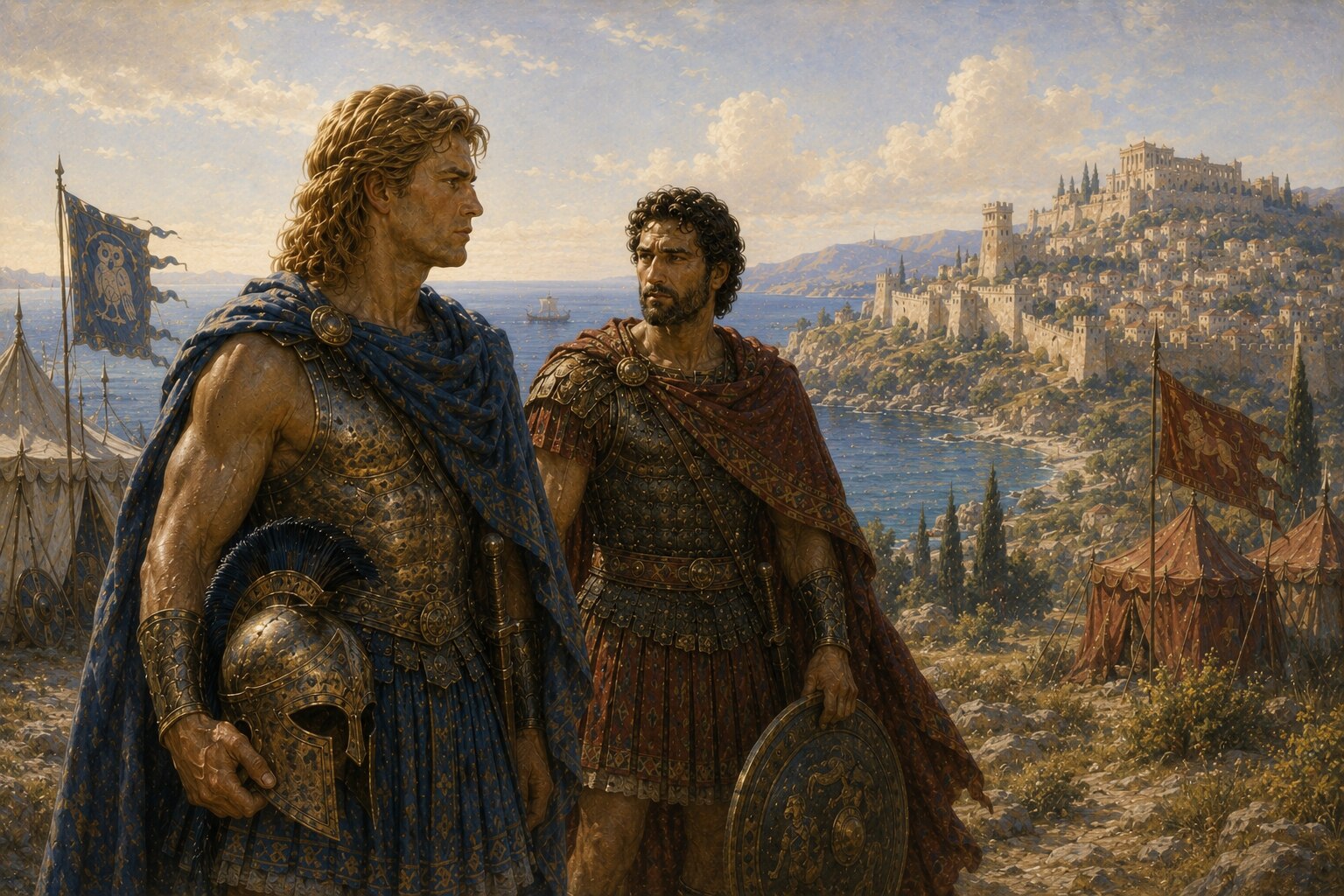
Understanding the Characters in The Iliad
The Iliad contains a very large cast of Greek and Trojan warriors, gods, rulers, family members, and figures connected with the Trojan War.
First-time readers do not need to remember every name.
A much smaller group of characters carries the poem’s central conflicts. By following Achilles, Hector, Agamemnon, Patroclus, Priam, Andromache, and several others, students can begin to understand the larger questions Homer asks about anger, honor, leadership, friendship, family, glory, death, and the cost of war.
The most useful question is often not simply “Who is this character?” but “What does this character reveal about the world of the poem?”
The Greeks
Achilles
Achilles is the greatest warrior in the Greek army and the central figure of The Iliad.
The poem begins with his anger.
When Agamemnon takes Briseis from him, Achilles sees the act as a public insult to his honor. He withdraws from the fighting even though he knows the Greeks may suffer without him.
His decision drives much of the poem.
Achilles is extraordinarily courageous, powerful, and capable of intense loyalty and love. He is also proud, stubborn, capable of terrible rage, and unwilling for much of the poem to place the needs of the Greek army above his personal grievance.
The death of Patroclus changes him profoundly.
Watch for: anger, pride, honor, friendship, grief, violence, mortality, and his changing ability to recognize the suffering of others.
Questions to consider:
Is Achilles justified in withdrawing from battle? At what point does his anger become destructive? Does Achilles become a different person by the end of the poem?
Agamemnon
Agamemnon is king of Mycenae and commander of the Greek forces.
He possesses the highest formal authority among the Greeks, but Homer repeatedly raises questions about whether authority and good leadership are the same thing.
His decision to take Briseis from Achilles begins the central conflict of the poem.
Agamemnon can be proud, defensive, and concerned with his own status. Yet he also bears responsibility for an enormous army and eventually attempts to repair his quarrel with Achilles.
Watch for: authority, pride, leadership, status, responsibility, and the difference between commanding others and persuading them.
Questions to consider:
What makes Agamemnon a weak or strong leader? Could the quarrel with Achilles have been avoided? Does his later attempt at reconciliation adequately repair the damage?
Patroclus
Patroclus is Achilles’ closest companion.
For much of the poem, he remains beside Achilles while Achilles refuses to fight.
Eventually, however, Patroclus can no longer tolerate the suffering of the Greek army. He persuades Achilles to let him enter battle wearing Achilles’ armor.
His appearance causes the Trojans to believe that Achilles has returned.
Patroclus drives them back but goes farther than Achilles instructed and is eventually killed by Hector.
His death is the event that finally brings Achilles back into the war.
Watch for: compassion, loyalty, friendship, courage, imitation, and the consequences of exceeding limits.
Questions to consider:
Why does Patroclus return to battle when Achilles will not? Why does his death affect Achilles more profoundly than all the earlier Greek losses?
Odysseus
Odysseus is one of the most intelligent and persuasive Greek leaders.
In The Iliad, he is less the wandering hero familiar from The Odyssey and more a soldier, diplomat, strategist, and speaker.
He is one of the men sent to persuade Achilles to return to battle in Book IX.
Watch for: intelligence, diplomacy, persuasion, practical judgment, and leadership.
Question to consider:
What kind of leadership does Odysseus provide that differs from the leadership of Agamemnon or Achilles?
Ajax
Ajax is one of the strongest Greek warriors after Achilles.
He is dependable, courageous, and especially important during Achilles’ absence.
Unlike Achilles, Ajax is not defined by extraordinary emotional swings. He frequently appears as a warrior who simply continues doing what is required.
Watch for: endurance, reliability, physical courage, and responsibility to the group.
Question to consider:
Does Homer suggest that steady courage may be as important as spectacular heroism?
Diomedes
Diomedes becomes one of the dominant Greek warriors during the early battle books.
With Athena’s assistance, he fights with extraordinary success and even wounds gods.
His achievements demonstrate that heroic excellence is not limited to Achilles.
Watch for: courage, divine assistance, confidence, and the relationship between mortal achievement and divine help.
Nestor
Nestor is the elderly king of Pylos.
He is no longer the warrior he once was, but he possesses experience, memory, and a strong belief in the value of advice.
He frequently recalls events from his youth and attempts to guide younger men.
Students may sometimes find his long speeches amusing, but his presence raises a serious question about the place of experience in a culture dominated by physical strength.
Watch for: memory, age, advice, experience, and the limits of wisdom when others refuse to listen.
The Trojans
Hector
Hector is the greatest Trojan warrior, son of King Priam and Queen Hecuba, husband of Andromache, and father of a young son.
He is Achilles’ principal counterpart in the poem.
Hector fights not only for personal glory but also because he believes he has a duty to defend Troy.
That duty comes at an enormous personal cost.
His meeting with Andromache in Book VI allows students to see the warrior not simply as a battlefield hero but as husband and father.
Hector knows that Troy may eventually fall. He knows that he may die. Yet he returns to battle.
Watch for: duty, honor, family, courage, leadership, fear, reputation, and responsibility to the community.
Questions to consider:
Why does Hector return to battle despite Andromache’s plea? Is he acting primarily for his family, his city, his reputation, or himself? How is his heroism different from Achilles’?
Priam
Priam is the elderly king of Troy and father of Hector, Paris, and many other children.
For much of the poem, he stands somewhat apart from the fighting.
His most important role comes near the end, after Achilles kills Hector and refuses to return the body.
Priam enters the Greek camp and personally begs Achilles to give his son back.
He asks Achilles to think of his own father.
The encounter creates one of the most remarkable moments in the poem: two enemies recognizing one another through shared grief.
Watch for: fatherhood, courage, grief, dignity, vulnerability, and the collapse of the distance between enemy and enemy.
Question to consider:
Why might Priam’s journey to Achilles require as much courage as anything done on the battlefield?
Paris
Paris is Hector’s brother and the Trojan prince whose relationship with Helen lies behind the war.
He is handsome and capable in some circumstances, but Homer frequently contrasts him unfavorably with Hector.
Paris does not consistently demonstrate the same sense of responsibility toward Troy.
Yet he is not simply useless or cowardly. He fights, and he plays a significant role in the war.
Watch for: beauty, desire, responsibility, reputation, and contrasts with Hector.
Question to consider:
Why does Homer place two such different brothers—Paris and Hector—within the same royal family?
Aeneas
Aeneas is an important Trojan warrior and son of the goddess Aphrodite.
He receives divine protection during the fighting.
Although he is not as central to The Iliad as Hector, his survival carries significance in later traditions about the aftermath of Troy.
Within the poem itself, he provides another example of a Trojan warrior whose life is intertwined with divine intervention.
The Women of Troy
Andromache
Andromache is Hector’s wife and one of the poem’s most important voices outside the battlefield.
She has already lost members of her own family to war and understands clearly what Hector’s death would mean.
When she begs Hector not to return to battle, she speaks not as someone who fails to understand heroic honor but as someone who understands its human cost.
She fears becoming a widow and seeing their son left fatherless.
Watch for: family, loss, fear, vulnerability, love, and the civilian consequences of heroic choices.
Questions to consider:
Is Andromache asking Hector to abandon his duty, or is she defining his duty differently? Whose claim upon Hector is stronger: his family’s or Troy’s?
Helen
Helen is the wife of Menelaus and the woman whose departure with Paris became the immediate cause of the Trojan War.
Homer does not present her simply as a beautiful prize being fought over.
She frequently expresses regret, shame, self-criticism, and awareness of the suffering associated with her story.
Her conversations with Priam and Hector reveal a character capable of reflecting upon her own place in events.
Watch for: responsibility, shame, memory, beauty, blame, and self-awareness.
Question to consider:
Does Homer ask us to blame Helen for the war, sympathize with her, or resist such a simple judgment?
Hecuba
Hecuba is queen of Troy and mother of Hector.
Like Andromache and Priam, she experiences the war primarily through the danger it poses to people she loves.
Her grief contributes to the poem’s repeated reminder that warriors do not die in isolation.
Briseis
Briseis is the captive woman awarded to Achilles and later taken from him by Agamemnon.
The quarrel between the two men treats her initially as a prize representing status and honor.
Yet when Patroclus dies, Briseis speaks of her own grief and losses.
For a brief moment, the poem allows someone treated as property within the heroic system to emerge as a person with her own history.
Watch for: captivity, status, loss, power, and the difference between how characters are valued by others and how Homer sometimes allows them to speak for themselves.
The Gods
Zeus
Zeus is king of the gods.
He attempts to maintain a larger divine order while also responding to competing requests from gods and mortals.
Early in the poem, he agrees to honor Achilles by allowing the Greeks to suffer during Achilles’ absence.
Yet Zeus does not simply control every event.
Fate, divine rivalry, and human choices all interact.
Watch for: authority, fate, divine justice, competing loyalties, and the limits of even supreme power.
Athena
Athena supports the Greeks, especially Achilles and several other Greek warriors.
Early in the poem, she prevents Achilles from physically attacking Agamemnon.
Her interventions often combine divine power with strategic intelligence.
Watch for: restraint, strategy, persuasion, and divine influence over human action.
Hera
Hera strongly supports the Greeks and opposes Troy.
Her hostility toward the Trojans is connected with the larger mythic tradition surrounding Paris.
She repeatedly challenges or manipulates Zeus in an effort to influence the war.
Watch for: rivalry among the gods and the ways divine conflicts mirror human ones.
Apollo
Apollo strongly supports the Trojans.
The poem begins when he sends a plague upon the Greek army because Agamemnon has insulted his priest.
Apollo also plays an important role in the death of Patroclus.
Watch for: divine anger, disease, protection of Troy, and the vulnerability of even great warriors to forces beyond themselves.
Aphrodite
Aphrodite supports Paris and the Trojans.
She protects Paris during his duel with Menelaus and is closely associated with Helen.
Her interventions provide an important contrast with the battlefield values represented by gods such as Athena.
Poseidon
Poseidon generally supports the Greeks and at times intervenes directly when Zeus restricts divine participation.
As in many scenes involving the gods, his actions show how difficult it is to separate human warfare from divine rivalry.
Characters Worth Comparing
A useful classroom approach is to assign students pairs of characters whose differences illuminate larger questions in the poem.
Achilles and Hector
What does each man believe a hero owes to himself, his family, and his community?
Achilles and Agamemnon
What is the difference between personal excellence and formal authority?
Hector and Paris
How differently do the two brothers respond to responsibility?
Achilles and Patroclus
How does friendship alter Achilles’ understanding of the war?
Priam and Achilles
How does grief allow two enemies to recognize one another as human beings?
Andromache and Hector
What happens when heroic duty conflicts with family responsibility?
Characters Worth Tracking
Teachers who want students to follow a manageable number of characters throughout the poem might assign these six:
Achilles — anger, honor, friendship, grief, mortality
Hector — duty, family, leadership, reputation
Agamemnon — authority, pride, leadership, responsibility
Patroclus — loyalty, compassion, courage, consequences
Andromache — family, vulnerability, cost of war
Priam — grief, dignity, courage, shared humanity
For each character, students can keep track of three questions:
What does the character believe is most important?
What choices does the character make because of that belief?
What does the character gain or lose as a result?
Greeks and Trojans
One of the most important things for students to notice is that Homer does not divide the poem neatly into admirable Greeks and villainous Trojans.
The greatest Greek warrior, Achilles, can behave with frightening cruelty.
The greatest Trojan warrior, Hector, can be deeply sympathetic.
Priam is treated with dignity.
Andromache’s suffering matters.
Even minor warriors on both sides are sometimes given names, families, and brief histories just before they die.
This is one reason The Iliad remains more than a story about who wins a war.
Homer repeatedly asks his audience to see humanity on both sides of the battlefield.
A Final Note for Students
Do not try to memorize every warrior named in The Iliad.
Begin with the relationships.
Who commands?
Who follows?
Who is angry?
Who is grieving?
Who fights for glory?
Who fights for family or community?
Who has authority but lacks judgment?
Who has courage without power?
And perhaps most importantly:
When enemies look at one another, do they see an opponent—or another human being?
By the end of The Iliad, that question matters more than remembering every name in the Greek and Trojan armies.