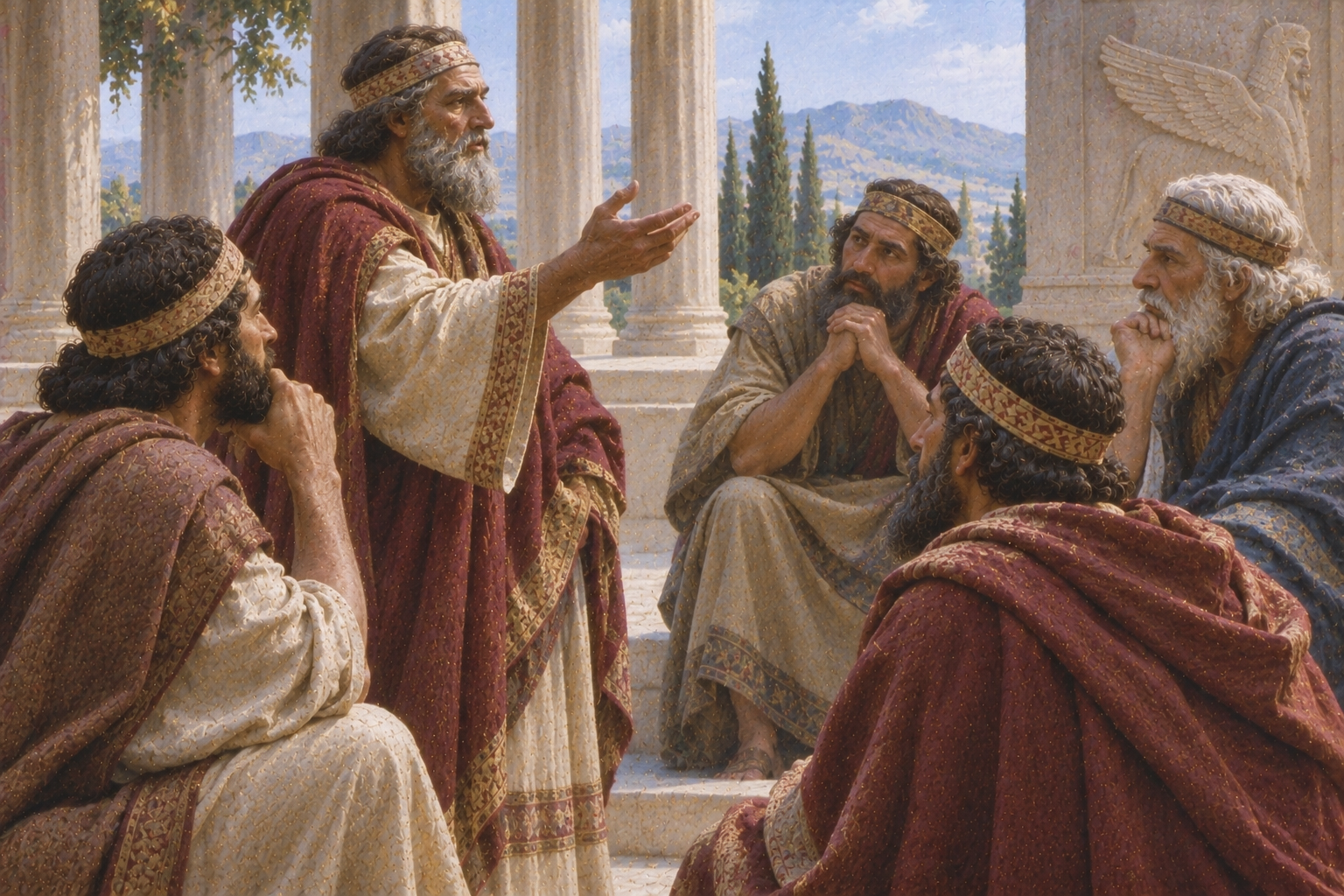
Leadership, Defeat, and Historical Perspective
Aeschylus presents the Persian defeat at Salamis through those who await news and those who survive. These questions invite students to analyze the play’s dramatic choices, competing explanations, and portrayal of suffering.
Questions for Classroom Discussion
- How does the Chorus establish both Persian military power and anxiety at the beginning of the play?
- What does Atossa’s dream of the two women reveal about the attempt to conquer Greece?
- How does Atossa’s concern as a mother differ from her responsibilities as queen?
- Why does Aeschylus describe the Battle of Salamis through a messenger rather than stage it?
- How does the messenger’s account convey the experience of Persian defeat?
- What does Darius’ ghost identify as the causes of disaster? How persuasive is his explanation?
- Why is the bridging of the Hellespont important to the play’s judgment of Xerxes?
- How does the Chorus express the losses suffered by ordinary Persians?
- What is the effect of delaying Xerxes’ entrance until the final scene?
- How do the messenger’s report and Xerxes’ lament create different responses to the same events?
- How might an Athenian audience in 472 BCE have understood the Persian court’s grief?
- Does the play chiefly celebrate Greek victory, criticize imperial ambition, or mourn war? Defend your interpretation.
Analytical Essay Prompts
1. The Defeated Enemy
Analyze how Aeschylus creates sympathy for Persians while writing for an Athenian audience familiar with the victory at Salamis.
2. Xerxes and Responsibility
Examine how Xerxes is judged by Atossa, the messenger, Darius, and the Chorus. How does his delayed appearance shape the audience’s judgment?
3. Dream, Symbol, and Power
Interpret Atossa’s dream and the image of the bridged Hellespont. How do these images develop the play’s criticism of overreaching power?
4. History as Tragedy
Explain how Aeschylus transforms a recent historical battle into drama. Distinguish historical events from prophetic dreams, ghostly judgment, and choral lament.
5. Voices of Grief
Compare the Chorus’s opening anxiety with its final lament alongside Xerxes. What changes in its understanding of Persian power and loss?
Developing an Evidence-Based Argument
Begin with a specific, debatable thesis. Use speeches, images, and dramatic choices as evidence, explaining how each supports your interpretation. Consider an alternative reading rather than simply retelling the plot. Cite the translation used in class.
Note to the Educator
Invite students to distinguish sympathy for defeated individuals from endorsement of imperial policy. The strongest responses will consider both the Athenian audience and the Persian characters’ grief, without treating the play as an impartial historical record.
This resource accompanies the Richer Resources Publications edition of The Persians, translated by Ian Johnston.
A printable PDF version of this resource is available by email.