Questions of Power, Belief, and Responsibility
Euripides’ Bacchae invites students to consider competing claims about religious devotion, political authority, human judgment, and divine justice. The following questions support close discussion, while the essay prompts encourage sustained arguments supported by evidence from the play.
Questions for Close Discussion
- Why does Dionysus return to Thebes, and how does his stated purpose influence our judgment of his actions?
- How does Pentheus define good government? Which of his concerns might initially seem reasonable?
- What do Cadmus and Tiresias understand that Pentheus refuses to consider? Are their motives identical?
- How does the audience’s knowledge of Dionysus’ identity change the meaning of his conversations with Pentheus?
- What contrasting pictures of the Bacchants emerge from the messenger’s description of Mount Cithaeron?
- Why does Pentheus become interested in watching the women he has condemned? What does this reveal about him?
- How does disguise change the balance of power between Dionysus and Pentheus?
- What functions do the Chorus’s songs serve beyond describing or celebrating Dionysian worship?
- How does the play distinguish seeing from understanding? Consider Tiresias, Pentheus, and Agave.
- Why is Pentheus’ death described by a messenger instead of shown directly onstage?
- How does Cadmus guide Agave toward recognition, and why is the scene so painful?
- At the end, whose actions deserve criticism or sympathy? Can several conflicting judgments be valid at once?
Analytical Essay Prompts
1. Power and Justice. Does the play present Dionysus as a just god, an overwhelming power, or both? Develop a thesis using his opening declaration, his treatment of Pentheus, and the ending.
2. The Failure of Pentheus. Analyze whether Pentheus falls primarily because of political rigidity, personal curiosity, failure to recognize divinity, or a combination of causes. Consider the advice he receives and the choices he makes.
3. Gender, Disguise, and Control. Examine how Euripides uses the women’s departure from Thebes and Pentheus’ disguise to question social authority and control. Avoid assuming that the play offers one uncomplicated view of women’s freedom.
4. Knowledge and Dramatic Irony. Trace the gap between what the audience knows and what key characters understand. Explain how the prologue, disguise, messenger speeches, and Agave’s recognition shape the tragedy.
5. The Human Cost of Divine Conflict. Compare the experiences of Agave and Cadmus with those of Dionysus and Pentheus. What does the ending suggest about punishment that extends beyond its intended target?
Writing Guidance
For each essay, establish a debatable claim, analyze at least three specific moments in the play, and explain how the evidence supports the argument. Students should cite the translation and line references available in their edition rather than inventing quotations.
Note to the Educator
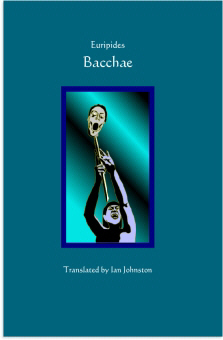
These prompts are designed to allow more than one defensible interpretation. Encourage students to distinguish the god’s power from the moral evaluation of his punishment, and to consider the play’s depiction of gender and religious experience in its ancient dramatic context. Preview references to familial violence before assigning the ending. This resource accompanies the Richer Resources Publications edition of Bacchae, translated by Ian Johnston.
A printable PDF version of this resource is available by email.