Reading Beneath the Words: Dramatic Techniques in Orestes
About This Guide
Euripides’ Orestes explores the consequences of violence through arguments, psychological suffering, public judgment, and unexpected reversals. The tragedy depends not only on what the characters do but also on how their experiences and decisions are presented to the audience.
This guide examines six important dramatic techniques and provides questions for close reading and classroom analysis.
1. Psychological Characterization: Orestes' Suffering
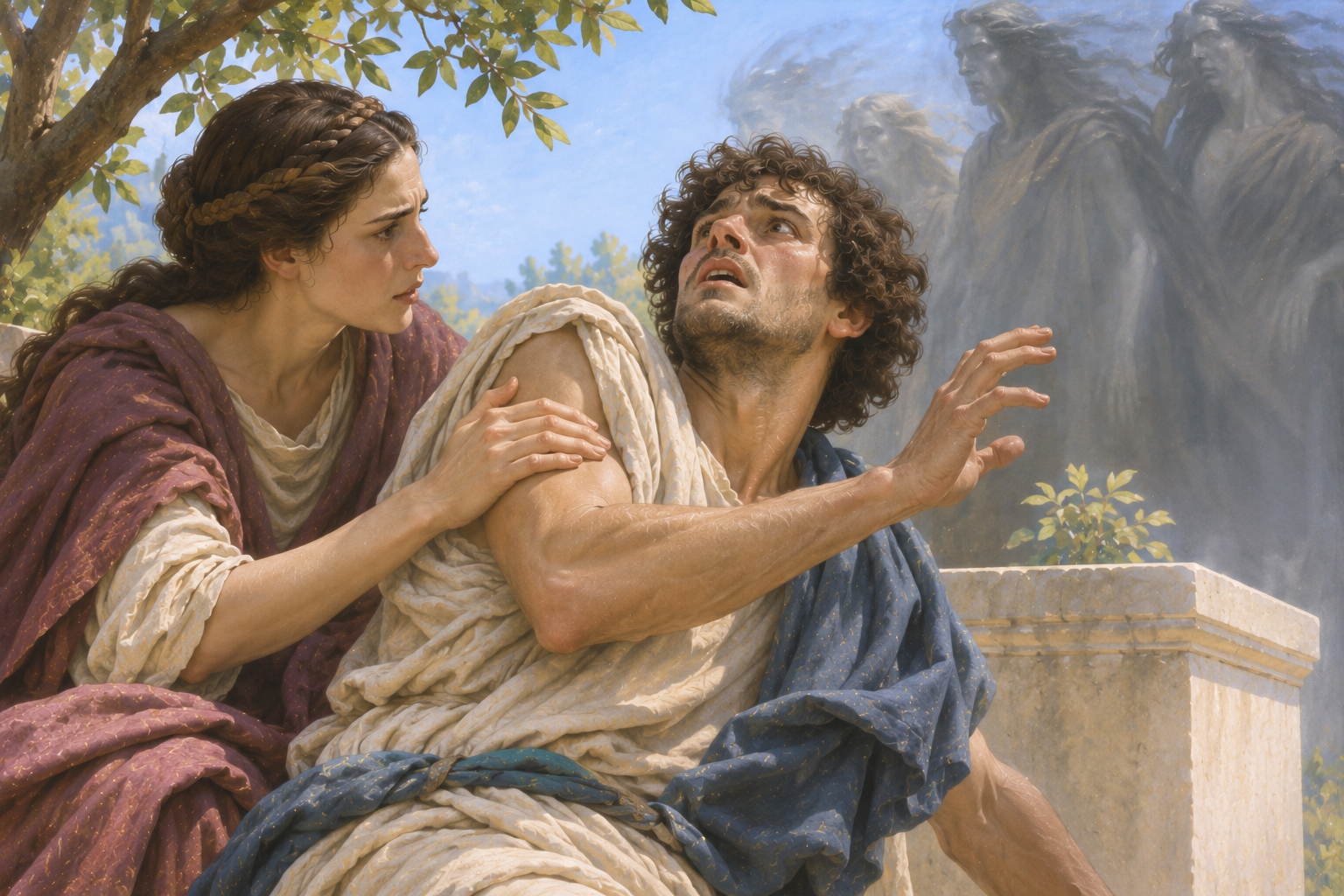
At the beginning of the play, Orestes is physically exhausted and mentally distressed after killing his mother, Clytaemnestra.
His fear of the Furies makes his suffering visible through his speech and behavior. Euripides invites the audience to consider both his responsibility for the murder and the anguish that follows it.
Close-reading questions:
- How do Electra's descriptions prepare the audience for Orestes' condition?
- What do Orestes' words and actions reveal about his fear?
- How does his suffering complicate the audience's moral judgment?
2. Persuasive Dialogue: Competing Claims of Justice
Much of the play develops through arguments about guilt, punishment, and family obligation.
Orestes defends his actions by referring to Apollo's command. Tyndareus insists that revenge does not justify the murder of one's mother. Menelaus weighs family loyalty against political danger.
Their speeches reveal that the characters disagree not merely about what happened but about the principles by which actions should be judged.
Close-reading questions:
- How does Orestes attempt to justify his actions?
- What distinguishes Tyndareus' argument from Orestes' defense?
- How does Menelaus' language reveal his reluctance to intervene?
3. Dramatic Irony and Reversal
Dramatic irony arises when the audience understands something that a character does not.
As the siblings and Pylades prepare their desperate plan against Helen and Hermione, the audience knows their intentions while the intended victims remain unaware.
The play also contains a disturbing reversal: characters threatened with execution become willing to endanger others.
Close-reading questions:
- How does the audience's knowledge of the plan create suspense?
- When do Orestes and his companions begin to resemble the people whose violence they condemn?
- How does this reversal affect our sympathy for them?
4. Messenger Speech and Reported Action
The Argive assembly's judgment reaches the audience through a messenger's report rather than a directly staged debate.
Later, the Phrygian servant describes the attack inside the palace. His frightened account brings the audience into events it has not witnessed.
These reports allow Euripides to present important actions indirectly while emphasizing the reactions and interpretations of those who describe them.
Close-reading questions:
- How does the messenger's account of the assembly shape our understanding of public judgment?
- What does the Phrygian servant's manner of speaking contribute to the palace scene?
- How might these scenes differ if the audience witnessed every event directly?
5. Choral Commentary and Emotional Response
The Chorus of Argive women responds to the suffering of Orestes and Electra and to the dangers surrounding their family.
Its songs connect the immediate events with broader ideas about inherited guilt, suffering, and the destructive consequences of violence.
The Chorus also provides a different emotional perspective from the principal characters' urgent arguments.
Close-reading questions:
- How does the Chorus respond to the siblings' suffering?
- How do its reflections broaden the meaning of individual events?
- What is the effect of alternating choral passages with intense dramatic confrontations?
6. Divine Intervention and the Unexpected Ending
At the height of the final crisis, Apollo appears and announces a settlement.
He reveals Helen's divine fate, directs Orestes toward a trial in Athens, and establishes future marriages.
This intervention, often described as a deus ex machina, resolves the immediate action through divine authority rather than through the characters' own decisions.
Close-reading questions:
- How does Apollo's appearance change the direction of the tragedy?
- Does his intervention answer the moral objections raised earlier?
- Why might Euripides choose such an abrupt resolution?
Literary Devices at a Glance
- Psychological characterization: Revealing a character's inner condition through speech, action, and behavior.
- Persuasive dialogue: Using argument and emotional appeals to influence another person.
- Dramatic irony: Giving the audience knowledge that one or more characters lack.
- Reversal: A significant change in a character's position or the direction of events.
- Messenger speech: Reporting important action that occurs away from the audience's view.
- Choral commentary: Using the Chorus to reflect upon events and their larger significance.
- Deus ex machina: A dramatic resolution brought about through the intervention of a god.
Classroom Activity: Comparing Two Accounts of Justice
Ask students to compare Orestes' defense of his actions with Tyndareus' condemnation of matricide.
For each speech, identify:
- The speaker's principal claim.
- The evidence or reasoning used.
- The assumptions about family duty and justice.
- The emotional appeals.
- The weaknesses or unanswered questions in the argument.
Conclude by discussing how Euripides uses conflicting speeches to prevent an easy judgment.
Short Analytical Writing Assignment
Choose one dramatic technique discussed in this guide and explain how Euripides uses it to develop a central conflict in Orestes.
Identify a specific scene, explain how the technique operates, and analyze its effect on the audience's understanding of guilt, loyalty, revenge, or justice.
Note to the Educator
Because students may read different translations of Orestes, wording and line numbers will vary. Encourage them to identify passages by dramatic situation and to explain how language, characterization, or staging contributes to meaning.
Strong responses should move beyond naming a literary device to explaining its effect on the play's moral and dramatic complexity.
Reading the Play
A printable PDF version of this resource is available by email.