The Religious and Theatrical World of Bacchae
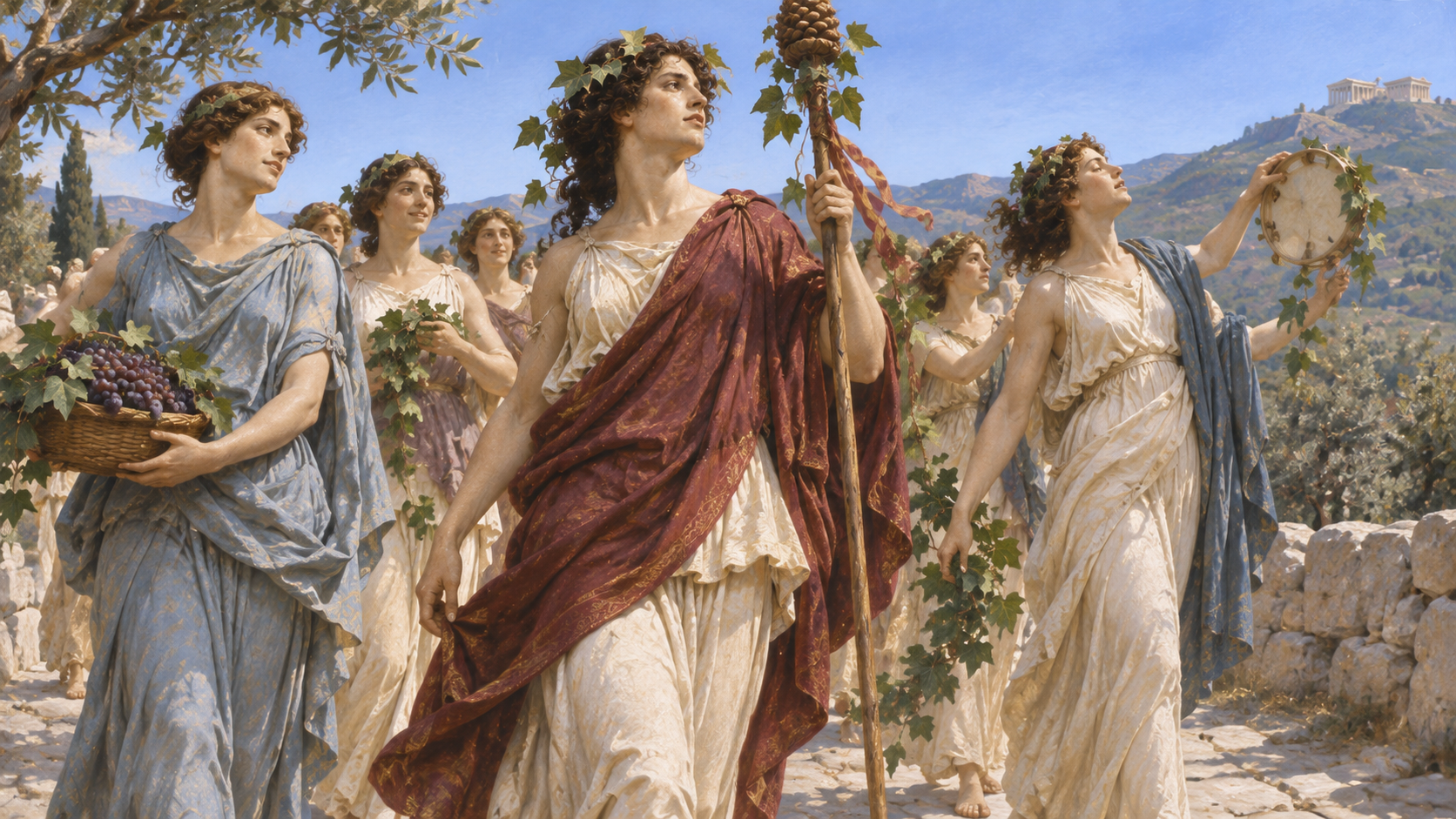
Euripides’ Bacchae draws on the worship of Dionysus, a god associated with wine, transformation, ecstatic experience, and theater. Although the play takes place in mythical Thebes, it was written for audiences familiar with Dionysian festivals and the political and religious life of classical Greece.
Dionysus and Greek Religion
Ancient Greek religion included many gods, local traditions, public festivals, and private forms of devotion. Dionysus was not simply a god of wine: his worship could involve music, dancing, processions, masks, and experiences that challenged ordinary boundaries. Greek communities honored him in different ways, and dramatic portrayals should not be mistaken for literal records of ritual practice.
The City Dionysia and Athenian Theater
Tragedies were performed in Athens during religious festivals honoring Dionysus, particularly the City Dionysia. Plays competed before large audiences in a civic setting. A chorus sang and danced, while actors performed multiple roles using masks. The combination of dialogue, choral song, and messenger speeches shaped how audiences experienced the story.
The Historical Euripides
Euripides lived in the fifth century BCE, an era marked by intellectual debate and the long Peloponnesian War between Athens and Sparta and their allies. Bacchae belongs to his final works and was produced after his death, traditionally dated to 405 BCE. His treatment of religion, authority, and suffering invites questioning, but the play should not be reduced to a simple statement of his personal beliefs.
Women, Ritual, and the Maenads
The women who follow Dionysus in the play are called maenads or Bacchants. Greek religious life did include important ritual roles for women, though those roles varied by place and cult. Euripides’ depiction of women leaving their households for Mount Cithaeron is a dramatic and mythical representation, not straightforward evidence of everyday Athenian women’s lives.
Thebes, Athens, and Myth
The action takes place in Thebes, a city familiar to Greek audiences through myths of Cadmus and his descendants. By setting the story in the heroic past and outside Athens, Euripides could explore troubling conflicts between family, kingship, and religion at a dramatic distance from his audience’s own civic institutions.
What History Can—and Cannot—Tell Us
The festival setting, theatrical conventions, and existence of Dionysian worship are historical contexts. Dionysus’ disguise, Pentheus’ fate, and Agave’s frenzy belong to the play’s mythical action. Students should distinguish evidence about ancient Greek culture from choices made by a tragic playwright.
Questions for Discussion
- How does the festival setting of Greek tragedy complicate the play’s criticism of divine power?
- What aspects of Dionysian worship appear in the play, and which are dramatized for tragic effect?
- Why might Euripides choose mythical Thebes rather than contemporary Athens?
- How do the Chorus and messenger speeches reflect ancient theatrical conventions?
- Why should we be cautious about using Agave and the Bacchants as evidence for women’s daily lives?
- How might the uncertainties of the late fifth century BCE shape an audience’s response without determining a single interpretation?
Classroom Activity: Context or Dramatic Invention?
Ask students to classify five elements of the play—choral performance, Dionysian festivals, the setting in Thebes, Pentheus’ death, and women’s ritual participation—as historical context, mythic narrative, or a mixture. Have them explain what evidence would be needed to support each classification.
Note to the Educator
Encourage students to avoid treating the play as a documentary account of Dionysian worship. Compare its religious imagery with the conventions of tragedy, and remind students that historical interpretation depends on evidence beyond a single literary text. This resource accompanies the Richer Resources Publications edition of Bacchae, translated by Ian Johnston.
A printable PDF version of this resource is available by email.