Extracted from “On Satire in Aristophanes’s Clouds”
Editorial Note: The following is Johnston’s short postscript on The Birds, separated from his longer lecture on satire and The Clouds so that it can be considered as an independent resource. The original lecture was delivered in November 1998, slightly revised in August 2003, and released into the public domain.
Short Postscript on The Birds
Given what has been said above about satire, how are we to make sense of The Birds? Part of the satiric intention is clear enough, but in some ways there are complexities in this play which might lead us to wonder about the full satiric intentions.
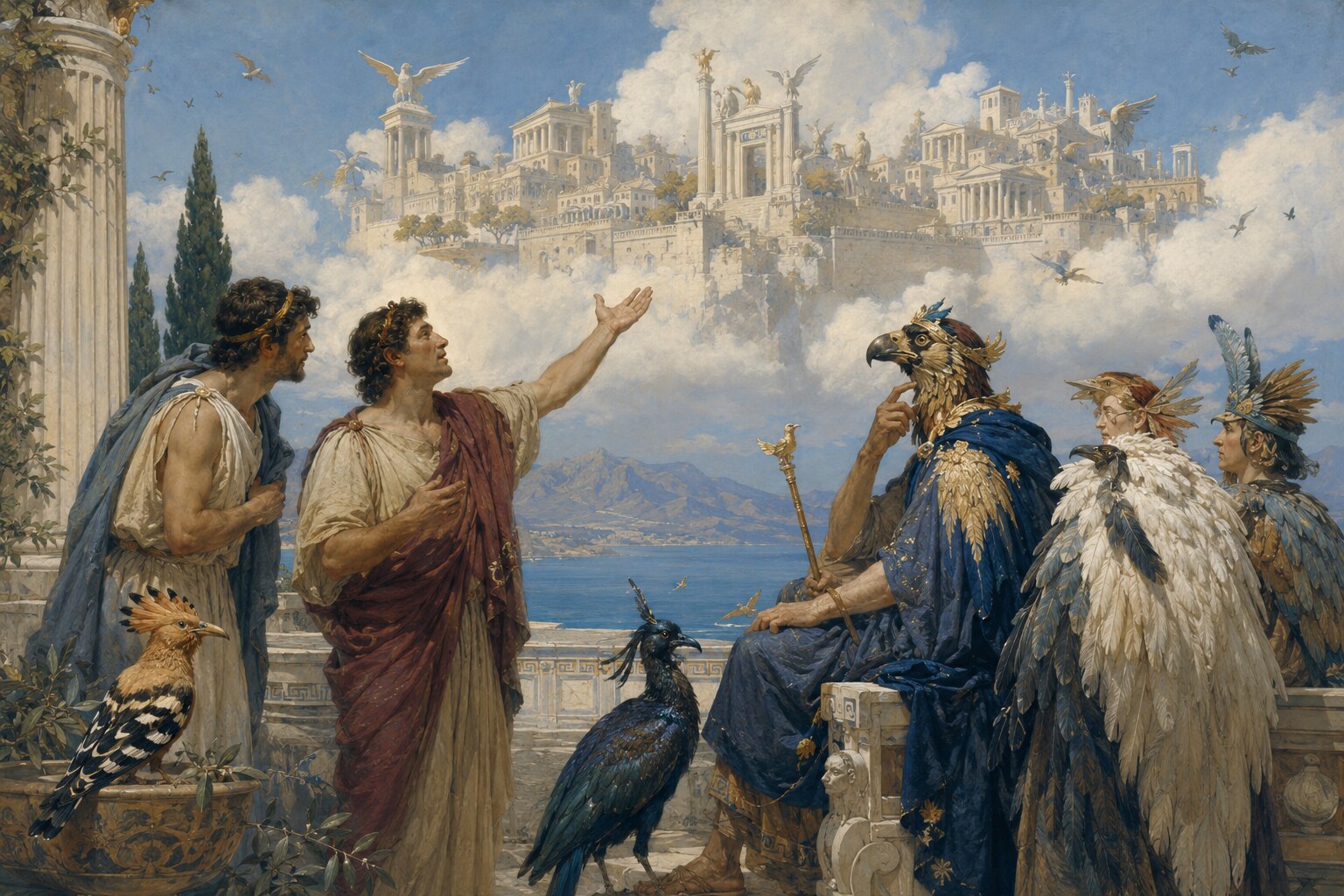
The play sets up a typical middle-aged Athenian as its main target. Pisthetairos and Euelpides have left the city ostensibly to find a better place, one free of the legal, economic, and political troubles of Athens. They are fed up with life in the city, and the birds, they think, will help them locate a more peaceful haven.
By the end of the play, of course, all this original intention has been subverted. Pisthetairos and Euelpides have become rulers of the birds and are, it seems, about to supplant the gods themselves.
In the process they have persuaded the birds to surrender their freedom in the name of increasing their power and riches, and so what started out as a quest for a peacefully independent life for two Athenians ends up with an extension of their empire, a triumph which is to be celebrated by eating a couple of birds, the very creatures to whom they came at the start for advice about how to live.
On a fairly basic level the satiric intention here is clear enough: Aristophanes wants to hold up to ridicule the Athenian habit of aggressive interference, their innate imperialistic tendencies which make it impossible for them to live life without seeking domination. It is something bred into them, no matter how much they may want to escape its consequences.
The way in which Aristophanes presents this transformation suggests that it comes almost by instinct. Pisthetairos is, it seems, genuine in his desire to escape from the corrupting world of Athens, but he is incapable of repressing his urge to take charge, to urge the Birds to use whatever tactics are in their power to increase their dominion.
He never expresses a particular reason for doing this, other than the idea that somehow power is good for its own sake--if one has an opportunity one should seize it. It is in one's self-interest to do so.
So in the play we see Pisthetairos expend a lot of energy to keep conventional civilization away from Cloudcuckooland--for his success is attracting settlers. But at the same time his very nature drives him to seek imperial control, which will, of course, threaten the very thing he originally sought to attain.
He succeeds in his imperial urges, and this is particularly significant, because of his linguistic skill, because of his ability to persuade, to use language to shape people to his own ends.
But the play invites us to contemplate, through a very exaggerated scenario, the ironic consequences of this view. How spiritually uplifted is Pisthetairos at the end? Through the most brutal tactics, which again and again remind the audience of what Athens is doing to others during the Peloponnesian War, Pisthetairos succeeds in elevating himself to god-like status, deceiving even the traditional deities and heroes.
Source Note
Ian Johnston, “On Satire in Aristophanes’s Clouds,” section K, “Short Postscript on The Birds.” Lecture delivered in November 1998 for Liberal Studies 111 at Malaspina College (now Vancouver Island University); slightly revised August 2003. The original document is in the public domain and may be used in whole or in part provided the source is acknowledged.