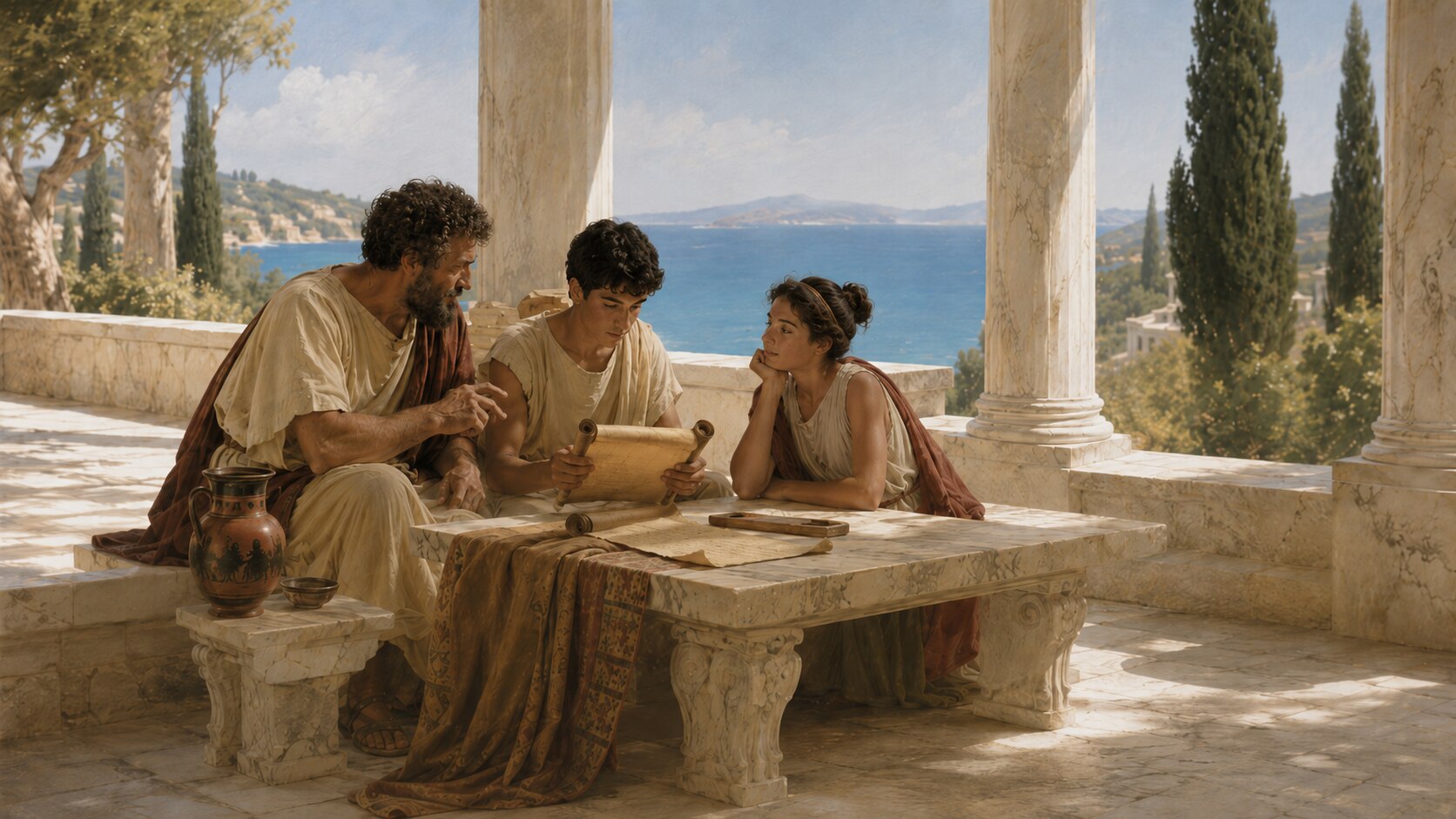
A Student’s Guide to Getting Started with Homer
You may have heard that Homer is one of the most important writers in Western literature.
That does not mean you are supposed to find him easy.
When you first open The Iliad or The Odyssey, you enter a world filled with unfamiliar names, gods who interfere in human affairs, customs that no longer exist, long speeches, repeated phrases, and ideas about honor and heroism that may seem strange.
You may also find passages that are immediately exciting, funny, moving, disturbing, or surprisingly familiar.
The trick is not to understand everything before you begin.
It is to learn what you do not need to worry about yet.
You Do Not Have to Know Greek Mythology First
Knowing some mythology helps, but you do not need to memorize the Greek gods, the entire Trojan War, or every hero’s family tree before reading Homer.
You will learn many of the important people as you go.
For a first reading, concentrate on the characters who keep returning.
In The Odyssey, begin with Odysseus, Penelope, Telemachus, Athena, Poseidon, and the suitors.
In The Iliad, begin with Achilles, Hector, Agamemnon, Patroclus, Priam, and Andromache.
Other names will become important when the story needs them.
If you encounter a name you cannot remember, look it up and continue reading. Do not let one unfamiliar name stop you.
Do Not Try to Memorize Every Name
Homer names a great many people.
Some are central characters.
Some appear for only a short time.
In The Iliad, a warrior may be introduced, identified by his father or homeland, and then killed a few lines later.
You are not expected to remember all of them.
Ask yourself instead:
Is this person important to the continuing story?
If the answer is no, keep reading.
A character list can be useful as a reference, but reading Homer should not become an exercise in memorizing a directory.
Start with the Situation, Not the Entire Myth
You do not need the whole history of the Trojan War to understand either poem.
For The Iliad, remember this:
The Greeks have been fighting the Trojans for nearly ten years. Achilles is the greatest Greek warrior. He and Agamemnon quarrel, and Achilles refuses to fight.
That is enough to get started.
For The Odyssey, remember this:
The Trojan War is over. Odysseus has been trying for years to get back to his home on Ithaca, where his wife Penelope and son Telemachus are still waiting for him.
That is enough to begin there too.
The rest can be added as you read.
Homer Does Not Always Tell the Story in Order
This is especially important in The Odyssey.
The poem does not begin with Odysseus leaving Troy and then follow every adventure in chronological order.
When the poem opens, Odysseus has already been away from home for almost twenty years.
The first four books focus largely on his son, Telemachus.
Odysseus himself does not appear directly until Book V.
Later, Odysseus tells other characters about adventures that happened earlier.
If you know this before beginning, the structure is much easier to follow.
Repetition Is Supposed to Be There
Homeric poetry grew out of an oral tradition.
These poems were composed for listeners as well as readers.
That helps explain the repeated descriptions, speeches, scenes, and familiar phrases that appear throughout the poems.
Characters may be identified repeatedly by recognizable descriptions. Similar actions—preparing a meal, receiving a guest, putting on armor—may be described in similar ways.
Modern readers sometimes assume this means the poem needs editing.
It does not.
Repetition helped an audience follow a very long story and gave the poetry recognizable patterns.
Once you stop expecting Homer to behave like a modern novelist, these repetitions become much less distracting.
Pay Attention to Speeches
Characters in Homer talk a lot.
Do not assume that a long speech is something to rush through in order to get back to the action.
Much of the real conflict occurs in conversation.
Achilles explains why he refuses to fight.
Hector explains why he returns to battle.
Penelope tests what people tell her.
Odysseus talks his way out of dangerous situations.
Priam persuades the man who killed his son to return the body.
When a character gives a long speech, ask:
What does this person want?
Who is being persuaded?
What argument is being made?
What does the speech reveal about the speaker?
The Gods Are Part of the Story
Athena, Zeus, Poseidon, Apollo, Hera, Aphrodite, and other gods intervene directly in human affairs.
At first this may seem to make human choices less important.
Usually it does the opposite.
Homer constantly places divine influence beside human decision-making.
A god may encourage someone, deceive someone, protect someone, or make circumstances more difficult.
But human beings still make choices.
Instead of asking only, “Which god caused this?” try asking:
What did the god do, and what did the human being still choose to do?
Ancient Values May Not Be Your Values
Honor, reputation, hospitality, loyalty, glory in battle, obligations to family, treatment of enemies, and revenge all matter enormously in Homer’s world.
You may not agree with the choices characters make because of those values.
That is perfectly reasonable.
Understanding a character is not the same as approving of that character.
For example, you can understand why Achilles believes Agamemnon has dishonored him without agreeing with everything Achilles does afterward.
You can understand why the punishment of the suitors is presented as justice in The Odyssey while still questioning the severity of the violence.
Good reading requires both things:
Try to understand the values of the world you are reading about.
Then decide what you think about them.
Heroes Do Not Have to Be Perfect
If you expect a hero to behave admirably at all times, Homer can be confusing.
Odysseus is intelligent, courageous, resourceful, and determined.
He is also proud, deceptive, curious to the point of recklessness, and sometimes responsible for disastrous decisions.
Achilles is extraordinarily brave and deeply devoted to Patroclus.
He is also capable of destructive anger and shocking cruelty.
Hector is brave and devoted to Troy, but his commitment to honor has consequences for his wife and child.
Homer's heroes are interesting partly because their greatest qualities can exist beside serious flaws.
Instead of asking only:
“Is this person a hero?”
try asking:
“What kind of hero is this person?”
You Do Not Have to Like Every Part
Some sections will probably interest you more than others.
You may love the Cyclops and find a long genealogy tedious.
You may be absorbed by Hector and Andromache but less interested in several pages of fighting.
You may enjoy Odysseus’ adventures more than Telemachus’ travels—or eventually discover that Telemachus is more interesting than you first thought.
That is normal.
A great work does not require every reader to enjoy every page equally.
What matters is learning why the different parts are there and how they contribute to the whole.
If the Battle Scenes Begin to Blur Together
This is a common experience when first reading The Iliad.
Do not try to remember every blow, weapon, or fallen warrior.
Look for larger patterns.
Who currently has the advantage?
Which major warrior has entered the fighting?
How are the gods affecting events?
What is happening because Achilles is absent?
When Homer pauses to tell you something personal about a warrior who is about to die, pay attention.
Those brief details are important because they remind us that a casualty is not simply another body on a battlefield.
He had a home.
He had a family.
Someone will miss him.
That is part of what The Iliad is saying about war.
If the Adventures in The Odyssey Seem Like Separate Stories
The Cyclops, Circe, the Sirens, Scylla and Charybdis, and other adventures can seem like individual tales joined together.
Try connecting them through Odysseus.
For each adventure, ask:
What is the danger?
What choice does Odysseus make?
What quality helps him?
What mistake does he make?
What does the episode teach us about him?
The monsters change.
Odysseus is the thread connecting them.
Watch for Contrasts
Homer often helps us understand one character by placing that person beside another.
In The Iliad:
Achilles and Hector offer different versions of heroism.
Hector and Paris respond differently to responsibility.
Achilles and Agamemnon show that authority and excellence are not the same thing.
In The Odyssey:
Odysseus and Penelope both rely upon intelligence and testing.
Odysseus and Telemachus are traveling toward one another while facing very different challenges.
Good hosts and bad hosts reveal what civilized behavior means in the poem.
When two characters seem very different—or surprisingly similar—Homer may be inviting you to compare them.
Ask What Keeps Reappearing
Themes become easier to recognize when you look for patterns rather than trying to “find the theme.”
In The Odyssey, keep noticing:
home
identity
hospitality
loyalty
temptation
leadership
storytelling
recognition
In The Iliad, keep noticing:
anger
honor
heroism
leadership
friendship
glory
mortality
family
grief
the cost of war
You do not need to decide immediately what Homer is saying about these ideas.
Notice them first.
Interpret them later.
Use Notes Without Letting the Notes Take Over
Explanatory notes, maps, glossaries, and character guides can make Homer much easier to read.
Use them when you need them.
But do not feel obligated to stop at every note.
If you understand enough to follow the scene, keep going.
Reading ten lines of poetry followed by ten minutes of reference checking can make even an exciting poem feel like work.
The notes are there to help you read Homer.
You are not reading Homer in order to study the notes.
Read for the Story First
On a first reading, it is perfectly reasonable to begin with:
What is happening?
Who wants what?
What decision is being made?
What happens because of it?
Once you understand the story, questions about themes, language, structure, symbolism, and character become much easier.
You do not have to perform literary analysis every moment you are reading.
Sometimes you should simply find out what happens next.
Then Ask Why It Matters
After an important episode, take a moment to go beyond plot.
After the Cyclops:
Why does Odysseus reveal his name?
After Hector leaves Andromache:
Why does he go back?
After Patroclus dies:
Why does this accomplish what an entire suffering army could not?
After Penelope tests Odysseus:
Why will she not simply believe him?
After Priam enters Achilles’ tent:
Why can these two enemies suddenly grieve together?
Those questions are where Homer begins to become more than an old adventure or war story.
Five Questions That Work Almost Anywhere
If you are unsure what to think about a scene, try one of these:
What does this character want?
What choice does the character make?
Why does the character make it?
What are the consequences?
What does this reveal about the character or the world of the poem?
You can use those five questions throughout both epics.
What If You Still Find Homer Difficult?
That does not mean you are failing.
These are ancient poems from a culture very different from your own.
They have also survived for thousands of years partly because readers continue to disagree about them.
Your first job is not to become an expert.
It is to enter the poems far enough to begin asking your own questions.
Why does Odysseus want home so badly?
Why will Achilles not let go of his anger?
Why does Hector go back to battle?
Why is Penelope so cautious?
Why does Priam forgive nothing, yet still ask Achilles for mercy?
Why does Homer make us care about people on both sides of a war?
If you reach the point where those questions interest you, you are already reading Homer successfully.
A Final Thought
You do not have to read Homer because someone has told you that Homer is “important.”
Give the poems the chance to make their own case.
Read the story.
Get to know a few characters.
Notice what keeps happening.
Question the choices people make.
Disagree when you think they are wrong.
And do not worry about understanding everything the first time.
People have been reading, arguing about, translating, teaching, and reinterpreting these poems for nearly three thousand years.
There is no reason you should be expected to finish the job on your first reading.