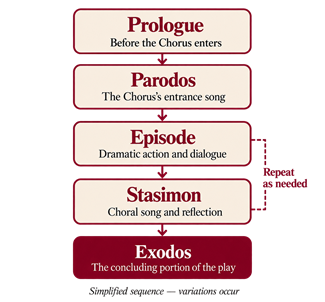
A Greek tragedy unfolds through alternating kinds of performance: actors speak and confront one another, while the Chorus enters, sings, reflects, and responds.
Recognizing this pattern helps students follow the action without assuming that every surviving play follows a rigid formula. The terms below describe common features of classical Athenian tragedy, especially as later writers classified them.
1. The Prologue
The prologue is the portion of a play before the Chorus makes its first entrance.
It may introduce the setting, establish a crisis, reveal information that some characters do not yet possess, or begin an argument already underway.
A prologue need not explain everything. Sometimes it creates questions the rest of the play must answer.
2. The Parodos
The parodos is the Chorus’s entrance song or entrance passage.
It brings a collective presence into the dramatic world. The Chorus may arrive with fear, celebration, prayer, or uncertainty; its first words often reveal what the community believes at the beginning of the story.
The same word can also refer to an entrance route in the theater, so context matters.
3. Episodes: The Action Develops
Episodes are sections of dramatic action between choral songs.
Characters argue, decide, disclose news, challenge authority, or respond to new dangers. An episode can include a messenger’s report or a rapid exchange of short speeches.
Students should watch for a change in knowledge or commitment: after this conversation, what can no longer remain as it was?
4. Stasima: The Chorus Reflects
A stasimon (plural: stasima) is a choral song that normally comes after an episode.
It can connect the immediate action to larger ideas, recall myths, appeal to the gods, or reveal the Chorus’s changing fears.
It is not necessarily a neutral summary or a moral lesson. Sometimes the Chorus’s confidence contrasts sharply with what the audience suspects will happen.
5. The Exodos
The exodos is the concluding portion of the tragedy after the last choral song.
It may contain a final confrontation, recognition, lament, decision, or reckoning.
A tragedy’s ending need not restore harmony. Instead, it often makes the consequences of earlier choices unmistakable.
6. How the Parts Work Together
Think of the structure as a movement between concentrated encounters and wider reflection.
A character acts or speaks; the Chorus reacts and enlarges the question; another encounter changes the situation.
The rhythm gives audiences time both to experience events and to consider their significance. But the Chorus also participates in the action, so the distinction is not simply “action versus commentary.”
7. A Simplified Performance Map
This is a useful reading map, not a rule that every play follows in exactly the same way. Performance Map Some tragedies begin unusually, include songs or exchanges within episodes, or organize their choral material differently. Do not force a play into the diagram when the text resists it.
8. Other Terms Students May Encounter
Kommos: A lyric lament or emotionally charged sung exchange, often between an actor and the Chorus.
Stichomythia: A rapid exchange in which speakers often alternate single lines; it can sharpen conflict or urgency.
Messenger speech: A report of important events that occur away from the audience’s view. It is a dramatic technique, not a separate structural division.
Recognition: A moment when a character comes to understand an important identity or truth. Recognition can occur within an episode or near the ending; it is not a required named section.
9. A Close-Reading Example
In Sophocles’ Antigone, the opening exchange between Antigone and Ismene establishes a conflict before the Chorus enters.
The Chorus then brings the city’s perspective into view. Later conversations and choral songs repeatedly shift attention between a ruler’s decisions, family obligations, and the consequences for Thebes.
Students can track how each transition changes what the audience knows or fears, rather than treating the choral passages as pauses to skip.
10. Questions for Students
What does the prologue reveal, and what does it leave uncertain?
How does the Chorus’s first appearance change the atmosphere?
Choose an episode: which decision, accusation, or discovery moves the action forward?
How does the following stasimon respond to that episode—and where might its view be limited?
What has changed between the opening conflict and the exodos?
Does your play depart from the simplified structural map? What effect does that departure have?
Classroom Exercise
Have students mark the Chorus’s first entrance, two major exchanges between characters, and one choral song in the play they are reading.
In the margin beside each passage, write one sentence beginning “At this point, the audience…”
Then compare the changes in knowledge, emotion, and expectation across those passages.
A Final Reading Lens
Structure is not merely a set of Greek labels. It is a way of shaping an audience’s experience: confrontation gives way to song, confidence to uncertainty, and anticipation to consequence.
Use the terms to notice those shifts, not to replace close attention to the play itself.
Note to the Educator
Introduce the five principal structural terms before students begin a tragedy, then return to them during close reading. Because performance practices and surviving texts vary, present the standard sequence as a guide rather than a universal template.
A printable PDF version of this resource is available by email.
An accessible guide to the Chorus in ancient Greek tragedy, explaining its role as a collective voice, dramatic participant, and performer of choral odes. Includes examples from Antigone, Oedipus the King, and Medea, along with reading strategies, discussion questions, and a classroom activity.
A student-friendly introduction to the ancient Greek theater and the performance traditions of tragedy. Explains the theatron, orchestra, skene, actors, masks, costumes, the Chorus, music, messenger speeches, and festival audiences, with practical questions to help students imagine how Greek tragedies were originally experienced
An accessible introduction to ancient Greek tragedy, explaining its origins, major playwrights, theatrical conventions, Chorus, dramatic structure, religious context, and central conflicts. Includes essential literary terms, reading strategies, and questions students can apply to tragedies by Aeschylus, Sophocles, and Euripides.