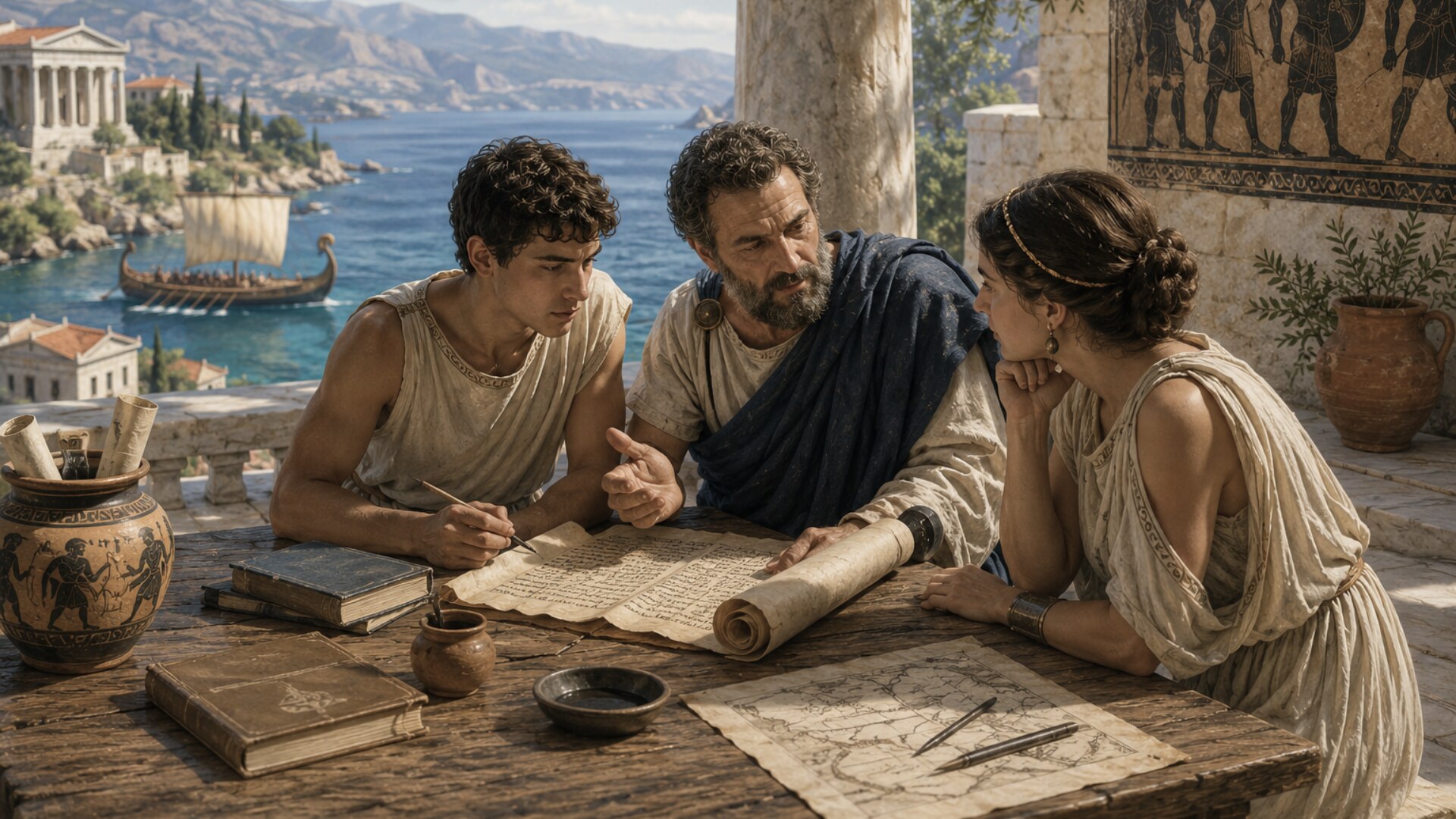
Practical Guidance for Building an Odyssey Unit That Students Can Actually Enter
Teaching The Odyssey presents an unusual opportunity.
Many students already know something about the story before they open the book. They may recognize the Cyclops, the Sirens, Circe, the Trojan Horse, or even the name Odysseus. At the same time, the poem itself can initially feel remote: unfamiliar names, an ancient social world, divine intervention, repeated language, long speeches, and a narrative that does not begin where students expect it to begin.
The challenge is therefore not simply to explain an old text.
It is to help students get far enough into the poem that its story, characters, and questions begin doing some of the teaching themselves.
A successful high school unit does not require students to master every mythological reference, read every line at the same pace, or identify a literary device on every page.
It requires thoughtful choices about what students need before they begin, what deserves close attention, what can move more quickly, and which questions are worth carrying through the entire poem.
Decide What Kind of Odyssey Unit You Are Teaching
Before choosing assignments, decide what you want students to experience.
An Odyssey unit can emphasize many things:
- the hero’s journey
- Greek mythology
- epic poetry
- character and leadership
- homecoming and identity
- hospitality
- storytelling
- family
- temptation and self-control
- justice and revenge
- the aftermath of war
- the transition from childhood to adulthood through Telemachus
Trying to teach all of these equally can produce a unit with too many objectives and too little reading.
Choose a few central questions instead.
For example:
What makes someone heroic?
What makes a place a home?
How do we know who someone really is?
What does a leader owe to other people?
When is deception justified?
Students can return to the same questions as the poem changes their understanding of them.
Give Students Only the Background They Need
It is tempting to spend several days teaching Greek mythology before beginning Homer.
Usually, less is better.
Students should understand a few essentials:
The Trojan War has ended.
Odysseus has been away from Ithaca for nearly twenty years—ten at war and almost ten trying to return.
Penelope and Telemachus remain in Ithaca.
Suitors have occupied Odysseus’ household and are pressuring Penelope to marry.
Athena generally supports Odysseus.
Poseidon opposes him.
Hospitality toward strangers is an important social and moral obligation.
That is enough to begin.
Additional mythology can be introduced when the poem requires it.
Students are more likely to remember who Poseidon is after they meet Polyphemus than after studying a pantheon chart two weeks earlier.
Explain the Structure Before Students Become Confused by It
Students often expect The Odyssey to begin with Odysseus leaving Troy and then proceed from adventure to adventure.
It does not.
Explain this before they start.
The first four books largely concern Telemachus.
Odysseus appears directly in Book V.
Many of the famous adventures occur earlier in time and are later narrated by Odysseus himself.
A simple four-part structure is usually enough:
Books I–IV: Telemachus and the troubled household at Ithaca
Books V–VIII: Odysseus re-enters the story and reaches the Phaeacians
Books IX–XII: Odysseus recounts his wanderings
Books XIII–XXIV: Odysseus returns to Ithaca and reclaims his household
Knowing that structure prevents students from assuming they have somehow missed the beginning.
Do Not Rush Through Telemachus
The temptation is understandable.
Teachers know the Cyclops is coming.
Students know the Cyclops is coming.
Everyone wants to get to the Cyclops.
But the opening books establish the problem Odysseus is actually returning to solve.
They show a household without its king, a wife living under prolonged pressure, a son who has grown up without his father, and men exploiting the absence of legitimate authority.
They also establish Telemachus as a second traveler.
Odysseus is trying to return home.
Telemachus must leave home in order to grow.
Students who understand that parallel will see much more in the eventual reunion between father and son.
You do not need to give every passage in Books I–IV equal attention. But do not reduce them to a paragraph of plot summary simply to reach the adventures.
Choose Your Close-Reading Episodes
Even in a complete-text unit, not every book needs the same amount of classroom time.
Some episodes reward close study especially well.
Book I — Athena and Telemachus
Useful for establishing the household, the suitors, Telemachus’ uncertainty, and the question of authority.
Book V — Calypso
Excellent for discussing home, mortality, desire, and why Odysseus wants to return to an imperfect human life.
Book VI — Nausicaa
A strong introduction to hospitality and to Odysseus’ ability to survive through language, judgment, and self-control.
Book IX — The Cyclops
One of the best episodes for discussing hospitality, intelligence, pride, leadership, and consequences.
Book XI — The Underworld
Useful for mortality, memory, war, family, Agamemnon’s disastrous homecoming, and Achilles’ changed view of heroic glory.
Book XII — The Sirens and Scylla and Charybdis
Excellent for temptation, curiosity, leadership, imperfect choices, and responsibility.
Book XVI — Odysseus and Telemachus
The emotional payoff of Telemachus’ development.
Book XIX — Penelope and the Disguised Odysseus
One of the richest books for identity, deception, recognition, intelligence, and testing.
Book XXI — The Bow
A natural culmination of the disguise sequence and an effective study in identity and symbolic objects.
Book XXII — The Suitors
Important precisely because students may disagree about the justice and proportionality of what occurs.
Book XXIII — Penelope’s Test
Essential for understanding Penelope and the marriage at the heart of Odysseus’ homecoming.
Teachers with limited time can concentrate classroom discussion on these episodes while assigning other books more rapidly or using an abridged edition.
Let Some Parts Move Quickly
Students do not benefit when an exciting narrative is slowed until every page feels like a worksheet.
Some portions of The Odyssey can be read more rapidly.
A useful rhythm is:
slow reading → discussion → faster narrative reading → another major scene → discussion
This preserves momentum.
If every forty lines require a vocabulary sheet, annotation exercise, literary-device hunt, and written response, students may finish knowing a great deal about individual passages while losing the experience of the story.
Homer is worth analyzing.
He is also worth reading.
Consider an Abridged Edition When Time Is the Real Constraint
An abridged edition can be a good instructional choice when the realistic alternative is assigning excerpts or abandoning much of the poem entirely.
The important distinction is between an abridged translation and a prose retelling.
Ian Johnston’s abridged Odyssey removes portions of the complete translation and uses short summaries to bridge omissions rather than rewriting the surviving passages into simplified prose.
That allows students to continue encountering Homer as poetry while reducing the reading load.
An abridged edition may be particularly useful when:
- the unit has only a few weeks
- students have widely varying reading stamina
- the course must cover several major works
- much of the reading occurs outside class
- teachers want to preserve the complete narrative arc rather than assign isolated episodes
The goal should not be to make Homer effortless.
It should be to make sustained engagement possible.
Help Students With Names Without Turning Names Into a Test
Many students become discouraged because they believe they are supposed to remember every Greek name.
Tell them explicitly that they are not.
Give them a short core list at first.
For The Odyssey, that might include:
Odysseus
Penelope
Telemachus
Athena
Poseidon
the suitors
Calypso
Then add characters as they become important.
Allow students to use a character guide.
A reference sheet reduces cognitive clutter and leaves more attention available for the poem itself.
Testing students on dozens of minor names rarely demonstrates meaningful understanding of The Odyssey.
Make Hospitality Visible Early
Hospitality is one of the easiest themes for students to track because it appears in concrete actions.
When a stranger arrives, ask:
Who welcomes the stranger?
Is food offered before questions are asked?
Is the stranger protected?
Is a gift given?
Is the guest respectful of the host?
Students can compare:
Nestor
Menelaus
the Phaeacians
Eumaeus
Polyphemus
the suitors
Soon they will begin recognizing the pattern without being prompted.
That is much more effective than giving them a definition of xenia and asking them to memorize it.
Treat the Cyclops as More Than a Monster Story
Students usually enjoy the Cyclops episode.
Use that interest.
Polyphemus is frightening, but the episode also introduces several of the poem’s most important questions.
Odysseus enters the cave partly because he wants to see who lives there.
He expects hospitality.
Polyphemus violates hospitality in the most extreme possible way.
Odysseus devises the “Nobody” trick and escapes through intelligence.
Then, after escaping, he reveals his real name.
That last decision matters enormously.
Ask students:
Why does Odysseus need Polyphemus to know who defeated him?
That question can move discussion from plot to character almost immediately.
Do Not Reduce Odysseus to “The Hero”
Students should be allowed to decide what they think of him.
Odysseus is courageous, resilient, intelligent, persuasive, and extraordinarily adaptable.
He is also proud.
He lies.
He sometimes takes unnecessary risks.
His decisions affect the lives of his men.
He conceals information.
He frequently wants to know what lies beyond the safe boundary.
Those contradictions are teaching opportunities.
Instead of asking:
How does Odysseus show that he is a hero?
try:
What qualities make Odysseus successful?
Then:
When do those same qualities become dangerous?
A much richer picture emerges.
Give Penelope More Than One Adjective
Students often encounter Penelope as “the faithful wife.”
She is faithful.
She is also intelligent, strategic, cautious, suspicious, patient, and capable of deception.
She has survived for years in a household filled with men pressuring her to act.
Her weaving scheme is a strategy.
Her conversations gather information.
Her final test of Odysseus is deliberately designed.
Ask students to compare Penelope with Odysseus.
Both delay revelation.
Both test other people.
Both manipulate information.
Both rely upon intelligence rather than simple force.
By Book XXIII, students may recognize that Penelope is not merely the person Odysseus returns to.
She is one of the few people capable of matching him.
Use the Gods to Discuss Responsibility
Students often ask a reasonable question:
If the gods control so much, how can human beings be responsible?
Do not resolve this too quickly.
Make it a recurring question.
Poseidon punishes Odysseus, but Odysseus chose to reveal his identity to Polyphemus.
Athena helps Telemachus, but Telemachus must choose to act.
The crew receives warnings about the cattle of the Sun, but chooses to ignore them.
The suitors receive repeated warnings and continue behaving as they do.
Ask students to keep separating:
What is outside the character’s control?
from:
What does the character still choose?
That tension is more interesting than simply labeling an event “fate.”
Let Students Argue About the Suitors
The destruction of the suitors should not be taught as though students are required to respond in one approved way.
The poem has established serious offenses.
The suitors have consumed Odysseus’ property.
They pressure Penelope.
They abuse hospitality.
They mistreat vulnerable people.
They plot against Telemachus.
They ignore warnings.
At the same time, modern students may find the violence severe.
That disagreement is productive.
Ask:
What does justice mean inside the moral world of the poem?
Then ask:
Do we agree with that definition?
Students can learn to distinguish historical and literary understanding from personal moral agreement.
That is an important skill far beyond Homer.
Use Discussion Before Analysis Papers
Students often write better about a text after they have heard competing interpretations.
Before assigning an essay on Odysseus’ heroism, let the class argue about whether he is a good leader.
Before assigning Penelope, discuss whether she knows more than she reveals.
Before assigning the ending, ask whether the destruction of the suitors restores justice or continues a cycle of violence.
Classroom discussion allows students to discover that reasonable readers can use the same text and reach different conclusions.
Then writing becomes an argument rather than an exercise in guessing what the teacher thinks.
Ask Questions That Have More Than One Defensible Answer
Useful questions include:
Is Odysseus a good leader?
Why does Odysseus reveal his name to Polyphemus?
Is Penelope more like Odysseus than Telemachus is?
Why does Odysseus want to hear the Sirens?
Does Odysseus change during the poem?
Which character best understands what hospitality requires?
Is the punishment of the suitors justice or revenge?
What does Odysseus recover when he comes home besides his property and position?
Questions like these require evidence.
They also allow students to disagree.
Keep Literary Terms in Service of Reading
Epic simile, epithet, invocation, in medias res, dramatic irony, symbolism, and other literary terms can all be useful.
But terminology should clarify what students are already noticing.
For example, introduce epithet when students notice recurring descriptions.
Introduce in medias res when explaining why the poem begins late in Odysseus’ journey.
Discuss dramatic irony when students know the beggar is Odysseus while other characters do not.
The term should name something meaningful.
It should not become the reason for reading the passage.
Use Short Writing Frequently
Not every response needs to become an essay.
Short prompts can prepare students for discussion:
Was Odysseus right to enter the Cyclops’ cave? Explain in three sentences.
What is the strongest evidence that Telemachus is changing?
What does Eumaeus do that makes him different from the suitors?
Why does Penelope’s test work?
Name one decision Odysseus makes that you would not have made. Why?
These responses take only a few minutes and give quieter students something to contribute when discussion begins.
Let Students Change Their Minds
Some of the strongest learning occurs when students revise an earlier judgment.
Early in the unit, ask:
Is Odysseus a hero?
Record the answers.
Ask again after the Cyclops.
Again after Scylla and Charybdis.
Again after the slaughter of the suitors.
Again after Penelope’s test.
Students may become more admiring, more critical, or simply more complicated in their judgments.
That change is evidence of reading.
Assessment Does Not Have to Mean Plot Recall
A final assessment can ask students to demonstrate interpretation rather than memory.
Possible assignments include:
Defend or Challenge Odysseus’ Heroism
Students establish criteria for heroism and test Odysseus against them.
Compare Odysseus and Penelope
Students examine intelligence, deception, patience, testing, and self-control.
Evaluate Odysseus as a Leader
Students consider several decisions affecting his crew.
Trace the Meaning of Home
Students examine how Ithaca changes from a destination into something more complicated.
Justice or Revenge?
Students evaluate the treatment of the suitors using evidence from the poem.
The Education of Telemachus
Students trace his development from the opening books through his reunion with Odysseus.
These assignments ask students to use the whole poem rather than simply remember what happened in one chapter.
Make Supporting Resources Available
Students should not have to struggle unnecessarily with information that a reference tool can answer in seconds.
Useful supports include:
- a character guide
- a map
- a brief Trojan War background
- major-theme guides
- book-by-book discussion questions
- selected quotations with line references
- a glossary of unfamiliar names and places
These resources should reduce confusion without replacing the act of reading.
The Classical Reference Library contains materials that can be used alongside the poem rather than taught as separate units.
Protect the Story
Perhaps the most important practical advice is simple:
Do not analyze The Odyssey until students can no longer feel the journey.
The poem has lasted partly because people want to know whether Odysseus will get home.
They want him to escape the Cyclops.
They want to hear what happens when he reaches Ithaca.
They want the suitors to discover who the beggar is.
They want Penelope to know whether the man standing before her is really her husband.
Literary analysis should deepen those experiences, not replace them.
Sometimes the best thing a teacher can say is:
Keep reading.
A Flexible Unit Sequence
One workable high school sequence is:
Part One: The Household Without Odysseus
Books I–IV
Focus: Telemachus, Penelope, suitors, hospitality, authority
Part Two: Meeting Odysseus
Books V–VIII
Focus: home, mortality, Nausicaa, Phaeacians, storytelling
Part Three: The Wanderings
Books IX–XII
Focus: Cyclops, Circe, underworld, Sirens, leadership, temptation
Part Four: The Return in Disguise
Books XIII–XVI
Focus: identity, loyalty, testing, Telemachus
Part Five: Inside the Palace
Books XVII–XXI
Focus: recognition, restraint, Penelope, suitors, bow
Part Six: Justice and Homecoming
Books XXII–XXIV
Focus: violence, justice, Penelope, family, restoration of order
A teacher can expand or compress each stage according to available time.
A Final Thought for Teachers
Students do not need The Odyssey made easy.
They need it made approachable.
There is a difference.
The unfamiliar names can be supported.
The historical background can be supplied.
The narrative structure can be explained.
Difficult passages can be read together.
Less central material can move more quickly.
But the poem’s difficult questions should remain difficult.
Is Odysseus a hero?
Is he a good leader?
When is deception justified?
What makes Penelope recognize her husband?
What does civilized behavior require?
Does revenge restore justice?
Why would a man choose a difficult mortal home over an easier life elsewhere?
Those are not obstacles to understanding The Odyssey.
They are the reasons for teaching it.