The Conflict Between Divine Power and Human Certainty
Euripides’ Bacchae explores what happens when a ruler attempts to deny a god whose influence reaches beyond political law. Its recurring images—ivy, ritual staffs, disguises, mountains, and altered perception—connect the struggle for authority to questions of belief, freedom, and justice.
Divine Power and Human Limits
Dionysus returns to Thebes demanding recognition as a god. Pentheus insists that royal commands can suppress his worship. Their conflict asks whether political authority can govern every part of human experience. Yet Dionysus’ devastating punishment also raises a troubling question: does superior power necessarily confer moral justice?
Reason, Certainty, and Refusal to Listen
Pentheus regards the new rites as disorderly and dangerous. His confidence prevents him from examining warnings offered by Cadmus, Tiresias, and the stranger himself. The play does not simply condemn reason; it exposes the danger of treating one’s own judgment as complete and infallible.
Ecstasy, Freedom, and Violence
Dionysian worship releases participants from ordinary social roles and restraints. A messenger describes the women living peacefully on Mount Cithaeron, in striking contrast to the violence that later erupts. This contrast prevents readers from treating ecstatic freedom as either wholly liberating or wholly destructive.
Identity, Disguise, and Transformation
Dionysus appears in human disguise, while Pentheus eventually dresses as a woman to spy on the worshippers. The audience knows the stranger’s true identity, creating dramatic irony. Pentheus’ disguise becomes a visible sign of his loss of control and of the god’s manipulation.
The Thyrsus, Ivy, and Vines
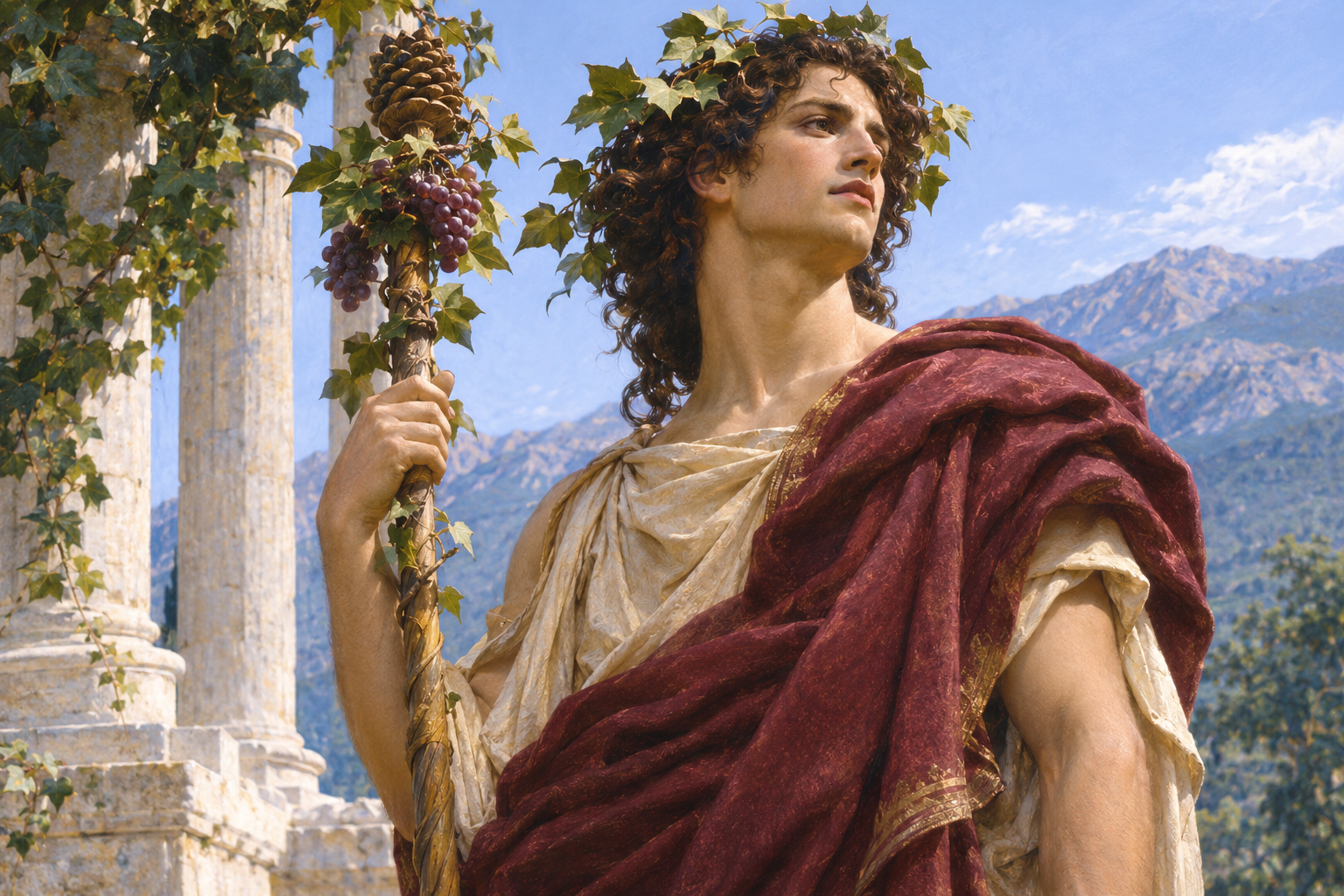
The thyrsus—a staff associated with Dionysian ritual—along with ivy and grapevines identifies the god and his followers. These objects suggest growth, fertility, celebration, and the presence of a power that resists conventional civic order. Their peaceful associations become unsettling when ritual devotion turns violent.
Mount Cithaeron: Beyond the City
The mountain lies outside the ordered space of Thebes. There the women experience a different form of community, one Pentheus cannot supervise from his palace. The movement from city to mountain marks a passage from political rules into a realm of transformation, uncertainty, and danger.
Sight, Blindness, and Recognition
Tiresias is physically blind but understands the need to respect the god. Pentheus can see, yet repeatedly misjudges what is before him. Agave’s final recognition of her son reverses her earlier delusion, turning celebration into grief. These contrasts make seeing and understanding two very different things.
The Tragic Cost of Punishment
Pentheus’ decisions help bring about his downfall, but Agave and Cadmus also suffer. The ending forces readers to weigh human stubbornness against the scale of divine revenge. Euripides leaves the audience with a disturbing gap between the god’s victory and the family’s devastation.
Questions for Discussion
- How does the play distinguish political authority from divine authority?
- What does Pentheus fail to understand, and what evidence does he reject?
- Why does Euripides place both peaceful and violent experiences on Mount Cithaeron?
- How do disguise and dramatic irony shape our judgment of Dionysus and Pentheus?
- What does Agave’s recognition reveal about knowledge and suffering?
- Does the ending present divine punishment as justified, excessive, or both? Support your view with scenes from the play.
Classroom Activity: Symbol and Theme
Ask students to select one symbol (the thyrsus, ivy, the mountain, or a disguise). Identify two scenes in which it appears or is discussed. Explain how its meaning changes, then connect that change to one major theme. Students should cite the relevant passages in their edition.
Note to the Educator
Encourage students to distinguish the play’s depiction of divine power from an endorsement of every divine action. Because the ending includes graphic violence within a family, preview the relevant passages before discussion. This resource accompanies the Richer Resources Publications edition of Bacchae, translated by Ian Johnston.
A printable PDF version of this resource is available by email.