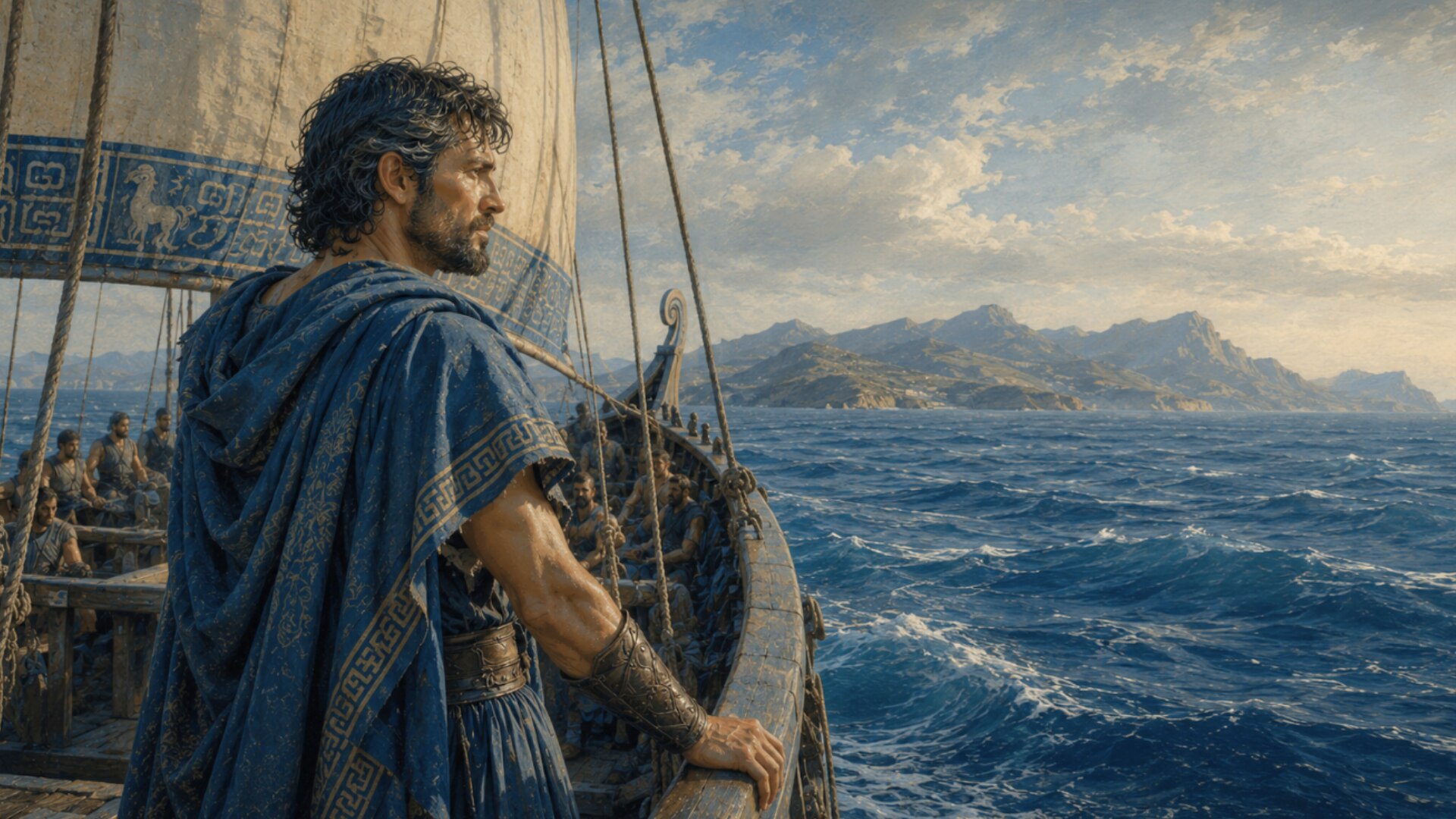
Three thousand years is a remarkably long time for an audience to remain interested in one man trying to get home.
Odysseus has outlasted empires, religions, languages, and entire civilizations. Generations that would have found almost everything about the world of Homer foreign have nevertheless recognized something in the wandering king of Ithaca: the clever man who makes terrible mistakes, survives their consequences, longs for home, resists some temptations and surrenders to others, and somehow keeps going.
Perhaps that is because Odysseus has never been an uncomplicated hero.
He is brave, but bravery alone does not save him. He is intelligent, but his intelligence frequently shades into deception. He is devoted to home, yet he repeatedly delays his return. He can be patient and calculating one moment and spectacularly reckless the next.
In other words, Odysseus is recognizably human.
A Hero Who Thinks
The heroes of ancient epic are often associated with physical strength. Achilles is the greatest warrior at Troy; Ajax is formidable in battle. Odysseus certainly knows how to fight, but his defining weapon is his mind.
When he encounters the Cyclops Polyphemus, brute force cannot save him. Odysseus survives by thinking ahead. He tells the Cyclops that his name is “Nobody,” blinds him, and then escapes by fastening his men beneath the Cyclops’s sheep.
It is one of literature’s most famous victories of intelligence over strength.
And then Odysseus nearly ruins it.
Safely aboard his ship, he cannot resist revealing his real identity to the creature he has defeated. It is an act of pride with enormous consequences. Polyphemus calls upon his father, Poseidon, to punish Odysseus, helping turn the journey home into years of suffering.
The episode captures Odysseus in miniature. The intelligence that saves him exists alongside the pride that endangers him.
That combination has kept him interesting in a way perfection never could.
The Long Pull of Home
For all its monsters and adventures, The Odyssey is fundamentally a story about home.
Odysseus has already survived ten years of the Trojan War when the poem’s great journey begins. What he wants is not another kingdom or another conquest. He wants Ithaca.
Again and again, Homer tests that desire.
Circe offers comfort and pleasure. Calypso offers something more extraordinary: a life removed from ordinary human limits. The Lotus-Eaters offer oblivion itself—the possibility of simply forgetting the obligation to return.
These temptations take different forms, but they ask essentially the same question: How badly do you want to go home?
It is a question that reaches well beyond ancient Greece.
Home can mean a physical place, but it can also mean family, identity, belonging, responsibility, or the life one recognizes as one’s own. Odysseus’s determination to return to Ithaca remains understandable because the desire to find our way back—to a person, a place, a purpose, or ourselves—has not disappeared.
Survival Has a Cost
Modern audiences sometimes expect heroes to improve steadily as a story progresses. Odysseus is more difficult than that.
He learns, but he also repeats mistakes. He suffers, but suffering does not automatically make him virtuous. He loses companions, deceives people, withholds information, takes risks, and survives circumstances in which others do not.
By the time he reaches Ithaca, survival itself has changed him.
That complexity is one reason The Odyssey continues to invite argument. Is Odysseus admirable because he endures? Is he responsible for some of the disasters that befall his men? When does cleverness become manipulation? When does justified anger become cruelty? How much should we forgive a person simply because we have followed his suffering?
Homer does not make all of those questions comfortable.
That is precisely why they remain worth asking.
Penelope and the Hero Who Comes Home
Odysseus’s return also presents a problem that many adventure stories conveniently avoid: what happens after the adventure?
Twenty years have passed since he left Ithaca. Penelope has spent those years maintaining a household under extraordinary pressure while suitors consume Odysseus’s property and demand that she choose another husband. Telemachus has grown from an infant into a young man without his father.
Odysseus cannot simply walk through the door and resume the life he left.
He returns disguised. He watches. He tests loyalties. And when he finally reveals himself to Penelope, she tests him in return.
That moment matters.
Penelope is not simply a prize waiting at the end of the journey. She has survived through intelligence of her own. Her famous deception of the suitors—promising to choose a husband after finishing Laertes’ burial shroud while secretly undoing her weaving each night—makes her, in important ways, Odysseus’s equal.
Their reunion therefore depends not merely on recognition but on knowledge: the private knowledge of the marriage bed that confirms who Odysseus is and what they once shared.
After gods, monsters, shipwrecks and war, Homer brings his story back to something remarkably intimate.
Two people must recognize each other again.
Why We Keep Returning to Odysseus
The world of The Odyssey is distant from ours. Its assumptions about warfare, slavery, women, social rank, hospitality, vengeance and the gods belong to another culture and demand serious examination rather than romanticization.
Yet distance is part of what makes the poem valuable.
Odysseus does not have to share our values in order to make us think about them. His world gives us enough distance to examine questions that remain very much our own.
What do we owe the people who depend on us?
Is intelligence a virtue if we use it to deceive?
What does prolonged hardship do to character?
When is persistence admirable, and when is it stubbornness?
Can we return to the life we left after we ourselves have changed?
And what, ultimately, makes somewhere home?
Those questions have survived because human beings have.
Christopher Nolan’s The Odyssey has now brought Homer’s wandering hero before another enormous audience. For some viewers, the film may be their first encounter with Odysseus. For others, it may send them back to a poem they last opened in school.
Either way, the remarkable thing is not that an ancient hero has suddenly become relevant again.
Odysseus never really stopped being relevant.
For nearly three thousand years, readers have watched him get lost, make mistakes, improvise, endure, and continue trying to find his way home.
We recognize the journey because, in one form or another, it is still ours.