
Secure checkout
Classics
By Immanuel Kant
Translated by Ian Johnston
$14.95
Secure checkout
Using Isaac Newton’s mathematical principles and laws of motion and taking up an idea first suggested by Emanuel Swedenborg, Immanuel Kant, the greatest philosopher of the eighteenth century, in 1755 produced a detailed account of what has come to be known as the Nebular hypothesis, still considered the most plausible explanation for the formation of the solar system: the structure of the universe develops from widely dispersed materials scattered throughout space which, under the influence of the forces of attraction and repulsion, rotate, flatten, and over time produce stars and planets. In his account, Kant also considers the rings of Saturn, the formation of moons, and other celestial phenomena (like the axial rotation of the planets and the development of comets). He also lets his imagination run rampant in a fascinating exploration of what living creatures must be like on other planets.
The extent to which Kant fully understood the mathematical complexities involved in his explanation has been strongly challenged, but, for all that, his account is an important document in the most important trend of natural science in the eighteenth century, that is, placing scientific accounts of natural phenomena on a historical basis and seeing them as the result of a process of development maintained by mechanical forces (a revolutionary trend which culminates a century later in the work of Charles Darwin). In this way, while honoring Newton’s achievement, Kant is also issuing a direct challenge to it.
Kant’s work also offers an enthusiastic defense of the design argument (that the harmonies in the design of the solar system are the best physical evidence we have for the existence of God), a claim which, ironically enough, his later philosophy would do so much to undermine.
[re Kant]I haven't read through the entire translation yet, and much less compared it to the German (anyway, my German is rusty, and at least later on, Kant seems quite consciously forging a new technical vocabulary - "Objekt" vs. "Gegenstand" and all that...). What I did read through, leads me to think this is just dandy and a real contribution.
Also from Classics
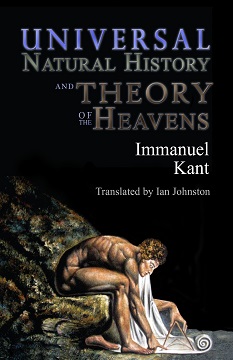
Universal Natural History and Theory of the Heavens
$14.95
Hi! 👋 How can we help you today?
We're away right now. Leave your details and a message, and we'll get back to you by email.