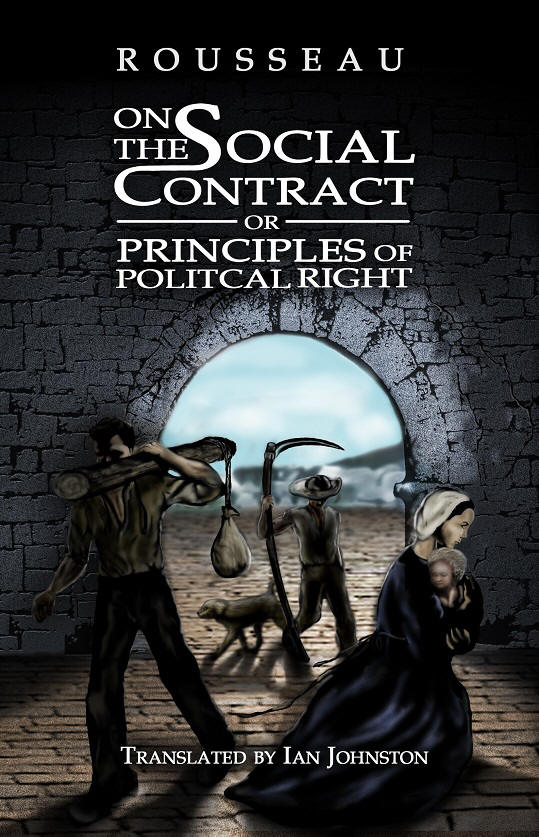
Understanding Rousseau’s On the Social Contract
What makes a government’s authority legitimate? Why should free people obey laws? Can a person be both a citizen who must follow rules and a free individual? These questions are at the center of Jean-Jacques Rousseau’s On the Social Contract, published in 1762. Rousseau is not simply asking how governments gain power. He is asking what gives them the right to exercise it.
As you read, pay attention to the difference between describing what governments do and explaining what they ought to do. Rousseau’s answer depends on a community of citizens who make laws for their common good.
Before You Read: Rousseau and His World
Jean-Jacques Rousseau (1712–1778) was a major eighteenth-century thinker associated with the Enlightenment. His political writing challenged the idea that inherited rank or superior force alone could justify rule. On the Social Contract was published in a Europe where monarchies remained powerful and questions of political authority were fiercely debated.
Rousseau’s arguments later influenced debates about citizenship and popular sovereignty. That influence does not mean every modern democratic institution follows his model: Rousseau was particularly skeptical of political representation.
The Central Question
Rousseau begins with a puzzle: people are born free, yet they live under political authority. If no person is naturally another person’s master, how can binding political laws be justified? His proposed answer is a social pact: citizens form a collective body whose laws are directed toward their shared interests.
Keep asking two questions: Who has the authority to make a law? And what makes that law legitimate?
A Guide to the Four Books
Book I — From Force to Legitimate Agreement
Rousseau rejects the “right of the strongest,” examines slavery, and describes the social pact. Read especially I.3–4 and I.6–8.
Book II — Sovereignty and the General Will
The people collectively hold sovereign authority. Laws should concern the common good rather than a particular person’s advantage. Read especially II.1–4 and II.6.
Book III — Government and Administration
Rousseau distinguishes the sovereign people from the government that carries out laws. He considers forms of government and criticizes representation of sovereignty. Read especially III.1–3 and III.15.
Book IV — Citizenship and Civic Life
Rousseau considers voting, public institutions, and civil religion, raising questions about unity and toleration. Read especially IV.1–2 and IV.8.
Key Terms to Know
Legitimacy: A justified right to exercise political authority, not merely the ability to command obedience.
Social pact: The agreement through which individuals form a collective political community.
Sovereignty: The people’s supreme collective authority to establish laws.
General will: A will directed toward the common interest; not simply the sum of private preferences.
Will of all: The collection or sum of individual preferences, which may reflect private advantage rather than the common good.
Civil freedom: Freedom within a political community under laws.
Moral freedom: Self-government rather than mere submission to appetite or impulse.
Government: The institutions that administer and execute laws; distinct from the sovereign people.
Three Arguments to Follow Closely
1. Force Is Not Right (I.3)
A stronger person can compel obedience, but compulsion does not establish a moral obligation. Explain why Rousseau thinks this difference matters.
2. The Social Pact Creates a Political Body (I.6)
Rousseau argues that people can associate while remaining free in a new civic sense. Ask what individuals surrender and what they gain.
3. The General Will Is Not the Will of All (II.3)
A majority decision may express private interests rather than the common good. Consider how citizens could recognize the difference.
Questions for Close Reading
- In Book I, Chapter 3, how does Rousseau distinguish power from legitimate authority?
- In Book I, Chapter 6, what problem is the social pact intended to solve?
- In Book I, Chapter 8, how are natural, civil, and moral freedom different?
- In Book II, Chapter 3, why is the general will not identical to the will of all?
- In Book II, Chapter 6, what makes a law general?
- In Book III, Chapter 1, what is the difference between sovereignty and government?
- In Book III, Chapter 15, why does Rousseau criticize representation?
- In Book IV, Chapter 8, what tension arises between civic unity and freedom of conscience?
Try It: A Community Decision
Imagine that a town has enough money to improve either a public park or a road used mainly by a small number of businesses. First, write down which choice you personally prefer and why. Next, write a rule or principle you believe would serve the town as a whole.
Compare your two answers. Did your view change when you considered the common interest? Does that make your second answer the general will? What further information would you need?
Think Critically
Rousseau’s ideal is appealing because it asks citizens to see themselves as participants in making the laws they obey. Yet it also raises difficult questions. Who decides what the common good is? What happens when a minority disagrees? Can a government misuse the language of the general will to silence criticism?
A strong interpretation should explain Rousseau’s argument fairly before assessing its strengths and weaknesses.
Writing and Discussion
Short Response
Explain in your own words why the “right of the strongest” cannot justify government. Refer to Book I, Chapter 3.
Paragraph Assignment
Distinguish the general will from the will of all. Use a concrete example and a reference to Book II, Chapter 3.
Essay
Does Rousseau succeed in showing that obedience to law can be compatible with freedom? Discuss at least two chapters and consider an objection.
Discussion
Would Rousseau approve of a modern representative democracy? Identify both the evidence supporting your answer and the complications.
Reading Checklist
Before finishing, make sure you can explain the social pact, distinguish sovereignty from government, define the general will without equating it with majority opinion, and identify at least one tension in Rousseau’s account of political freedom.
Use book-and-chapter citations in your answers. Exact phrasing differs among English translations, so consult the Richer Resources Publications edition for quotations.
A Final Thought
On the Social Contract asks you to think beyond the question of who rules and toward the harder question of why anyone has a right to rule. Its enduring challenge is to imagine a political community in which people are bound by laws but are not simply subjects of another person’s will.
A printable PDF version of this resource is available by email.