The Art of Comic Persuasion in Birds
How Language Creates an Impossible World
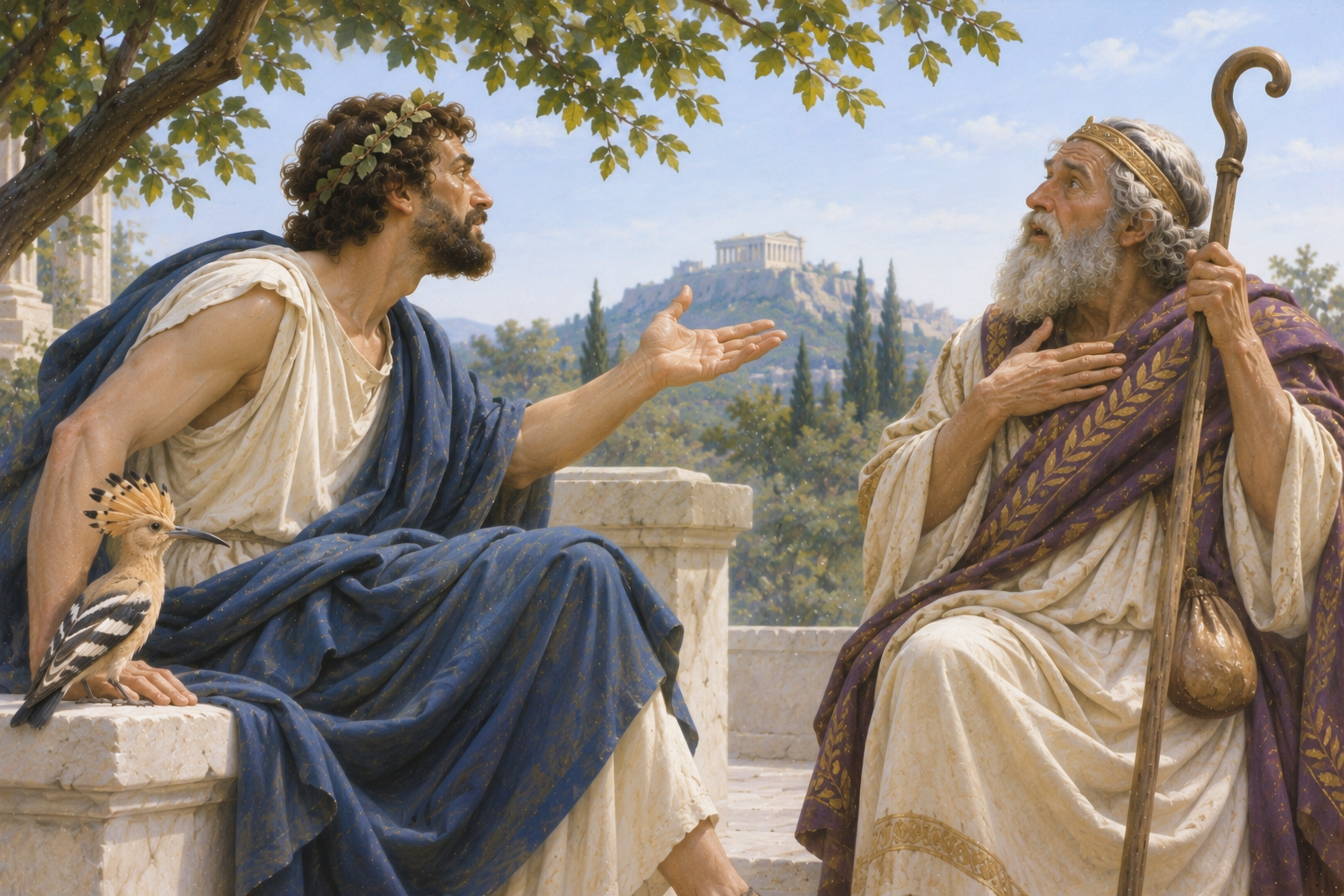
In Aristophanes’ Birds, language does more than describe events: it changes the direction of the action. Pisthetairos persuades the birds to claim supremacy, the chorus transforms an imaginary city into a world of song and beauty, and the gods are eventually forced to negotiate with a mortal.
Close reading reveals how Aristophanes combines verbal ingenuity, fantasy, irony, and dramatic structure to explore ambition and political authority.
The exercises below identify scenes rather than reproduce passages. Students should locate the relevant exchanges in their edition of the play and support their answers with textual evidence.
1. Persuasive Speech: Pisthetairos Addresses the Birds
Passage to examine: Pisthetairos’ argument that birds existed before the Olympian gods and should recover their ancient power.
Pisthetairos builds an extravagant political argument from mythology and selective claims about the past. He transforms the birds’ sense of identity into a reason for collective action.
Literary devices: Rhetoric, exaggeration, appeals to authority, and comic invention.
Close-reading questions:
- How does Pisthetairos establish the birds’ supposed claim to ancient supremacy?
- What emotions does he encourage in his audience?
- Which parts of his argument are persuasive because they are entertaining rather than demonstrably true?
- How does the birds’ response reveal the power of his speech?
2. Imagery and Song: The Chorus of Birds
Passage to examine: A choral song celebrating birds, flight, seasonal life, or the natural world.
The chorus creates a poetic alternative to the crowded civic world of Athens. Images of movement, air, song, and seasonal change give the birds’ existence a freedom that human beings envy.
Yet this imaginative freedom contrasts with the construction of a fortified city and the pursuit of political supremacy.
Literary devices: Imagery, rhythm, personification, contrast, and choral lyric.
Close-reading questions:
- What images make the birds’ world attractive?
- How does the language differ from the practical arguments of Pisthetairos?
- What contrast emerges between the chorus’ celebration of freedom and the city's political ambitions?
3. Comic Exaggeration: Building Cloudcuckooland
Passage to examine: The proposal to construct a city in the air and control the passage between earth and Olympus.
Aristophanes turns a familiar political ambition—the desire to control territory and resources—into a physically impossible project. The extraordinary setting makes the logic of power more visible by exaggerating it.
Literary devices: Fantasy, hyperbole, satire, and absurdity.
Close-reading questions:
- Which details make the proposal ridiculous?
- Why does the scheme nevertheless seem logical within the play?
- How does the fantasy expose recognizable features of human political behavior?
4. Repetition and Satire: The Unwelcome Visitors
Passage to examine: One of the encounters with a poet, prophet, surveyor, or public official after the city is established.
The arrival of successive visitors creates a repeating comic pattern. Each seeks something from the new city, and Pisthetairos must respond.
The episodes suggest that familiar human ambitions survive even in a society supposedly founded as an escape from Athens.
Literary devices: Repetition, caricature, episodic structure, and social satire.
Close-reading questions:
- What does the visitor want?
- How does Aristophanes make the visitor’s behavior comic?
- What does Pisthetairos’ response reveal about his growing authority?
- Why is the repetition of these encounters important?
5. Dramatic Reversal: Pisthetairos Confronts Iris
Passage to examine: Pisthetairos’ challenge to Iris when she attempts to pass through the birds’ territory.
A mortal addresses a divine messenger as though she were violating the rules of a human state. The humor depends upon the reversal of the normal relationship between gods and mortals.
Literary devices: Reversal, irony, parody of official authority, and verbal confrontation.
Close-reading questions:
- How does Pisthetairos speak to Iris?
- Why is his behavior surprising within traditional Greek religious expectations?
- How does the scene demonstrate the transformation of his political position?
6. Characterization Through Dialogue: The Divine Embassy
Passage to examine: The negotiations involving Poseidon, Heracles, the Triballian god, and Pisthetairos.
The gods are not presented as a unified, majestic authority. Their different interests and personalities create opportunities for manipulation and comic misunderstanding.
Literary devices: Character contrast, comic dialogue, irony, and parody.
Close-reading questions:
- How does the dialogue distinguish the three divine representatives?
- How does Pisthetairos exploit their differences?
- What makes the gods appear more human than divine?
- How does this scene prepare the audience for the final celebration?
7. Structural Irony: The Ending Reconsidered
Passages to compare: The travelers’ complaints about Athens at the beginning and Pisthetairos’ triumph at the end.
The play begins with a wish for freedom from civic complications and concludes with a remarkable concentration of political power. The contrast invites the audience to question whether the original dream has been fulfilled or transformed beyond recognition.
Literary devices: Structural irony, contrast, escalation, and ambiguous resolution.
Close-reading questions:
- What do the travelers initially want?
- What has Pisthetairos gained by the final scene?
- How does the contrast affect the meaning of the celebratory ending?
- Can the ending be both triumphant and satirical?
Classroom Activity: Follow the Language of Power
Ask students to select three speeches or exchanges from different stages of the play.
For each passage, identify:
- Who is speaking and what the speaker wants.
- The rhetorical or literary devices used.
- How the audience within the play responds.
- What the passage reveals about authority or ambition.
Students should conclude by explaining whether language in Birds primarily creates freedom, establishes power, or accomplishes both.
Note to the Educator
Because the wording and line divisions vary among translations, the exercises identify scenes rather than prescribe quotations or line numbers. Encourage students to analyze the specific language of the edition they are reading, while distinguishing Aristophanes’ dramatic methods from the translator’s individual word choices.
Reading the Play
A printable PDF version of this resource is available by email.