Between Olympus and Athens: The World Behind Birds
Fantasy Rooted in a Familiar World
First performed in 414 BCE, Aristophanes’ Birds transports its audience into an extraordinary world where birds speak, human beings dream of escape, and a city in the clouds challenges the gods themselves.
Although the setting is fantastical, the comedy draws upon mythology, religious customs, and the political experiences of fifth-century Athens. Understanding these connections helps readers recognize the satire beneath the play’s imaginative surface.
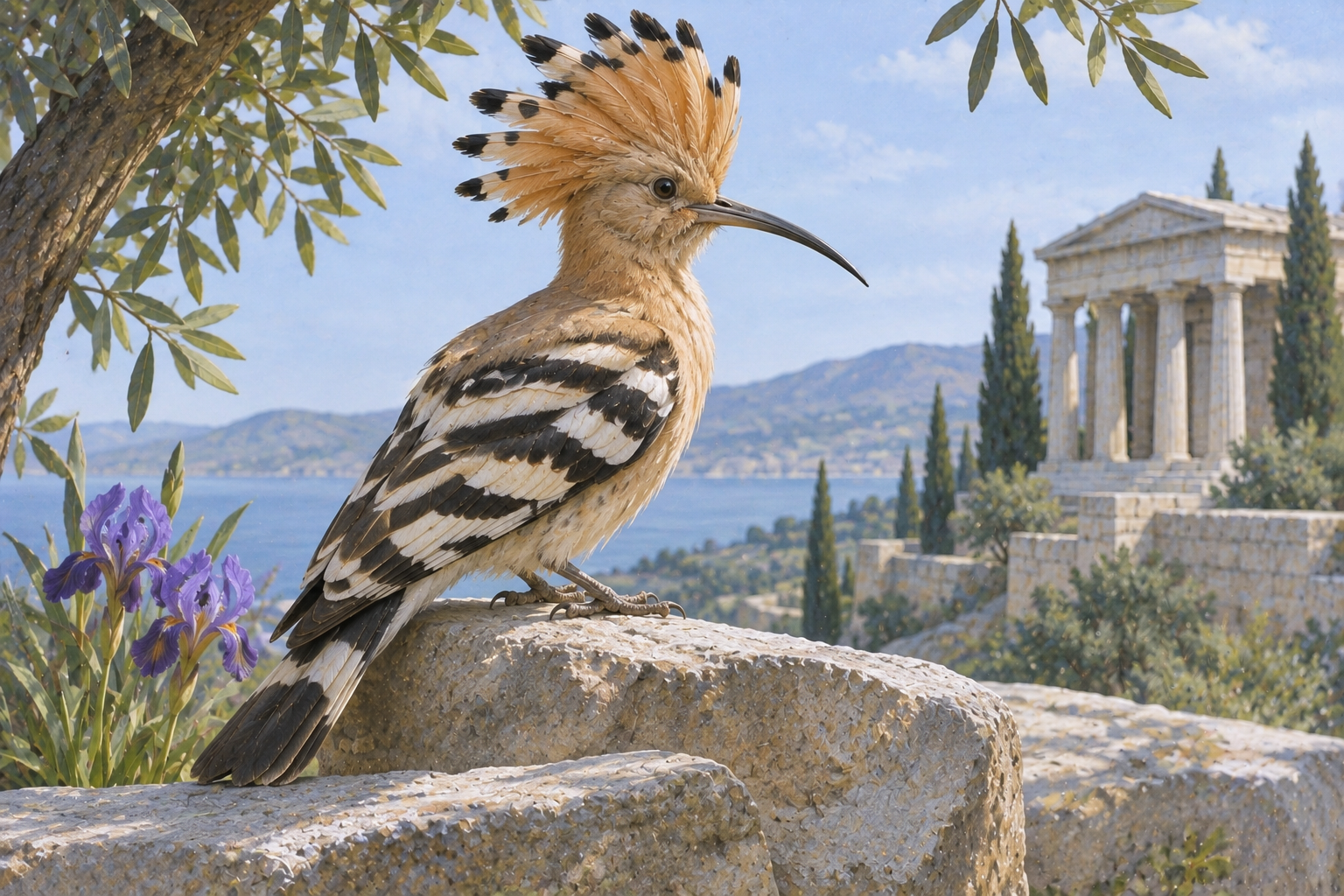
Tereus and the Hoopoe
The two Athenian travelers seek out Tereus, a legendary Thracian king who has been transformed into a hoopoe.
In Greek myth, Tereus is associated with the disturbing story of Procne and Philomela, involving betrayal, violence, and transformations into birds. Aristophanes draws upon this familiar myth but gives Tereus a different dramatic role: he becomes a helpful intermediary between human beings and the bird kingdom.
For discussion: How does the play turn a figure associated with tragic mythology into a character in a comedy?
The Birds and Their Claim to Ancient Power
Pisthetairos persuades the birds that they existed before the Olympian gods and therefore possess a superior claim to authority.
His account playfully reworks Greek ideas about the earliest generations of divine beings. It also demonstrates the power of persuasive storytelling: an imaginative version of the past becomes the justification for a new political order.
For discussion: Why might an argument about who came first be useful to someone seeking political power?
Olympus, Sacrifice, and Divine Authority
Greek religious practice included offerings and sacrifices to the gods. In the play, the birds’ city occupies the air between earth and Olympus, allowing it to interrupt the passage of sacrificial smoke.
This absurd strategy gives Pisthetairos leverage over Zeus and the other gods. Iris is challenged when she enters the new territory, Prometheus offers secret advice, and a divine embassy eventually arrives to negotiate.
The gods' vulnerability creates comedy by reversing the usual relationship between mortals and immortals.
For discussion: What happens to divine authority when the gods must bargain like human politicians?
Athens in 414 BCE
Birds was performed during the Peloponnesian War, the prolonged struggle between Athens and Sparta and their allies.
At the time of the play’s first performance, Athens was engaged in its ambitious Sicilian Expedition, launched in 415 BCE. The expedition would end disastrously in 413 BCE, but that outcome was still in the future when Birds appeared.
Athenians were familiar with debates about military expansion, public leadership, civic obligations, and the costs of political ambition. These concerns provide a historical background for a comedy in which a search for peace develops into a project of supremacy.
The play need not be interpreted as a direct allegory of the Sicilian Expedition. Its political imagination is broader and more ambiguous.
Democracy, Lawsuits, and Public Life
Pisthetairos and Euelpides begin by complaining about Athenian society, especially its disputes and legal proceedings.
Athens depended upon public participation in assemblies, courts, and civic institutions. These practices were sources of democratic identity, but they also offered abundant material for comedy.
The visitors who later appear in Cloudcuckooland—among them a prophet, a surveyor, and figures connected with public administration—bring familiar Athenian habits into the imagined new society.
For discussion: Can a community escape the problems of its old political system simply by moving somewhere else?
Old Comedy and the Freedom of Fantasy
Birds belongs to the tradition known as Old Comedy. Its characteristic features include extravagant plots, topical satire, direct argument, a prominent chorus, songs, and scenes of comic interruption.
The bird chorus is especially important. Its songs celebrate nature and freedom while its members participate in an increasingly ambitious political enterprise.
Aristophanes uses the freedom of comedy to combine beautiful imagery with pointed criticism. The audience can enjoy the fantasy without necessarily approving of every action taken by its central character.
Questions for Reading and Discussion
- What does the myth of Tereus contribute to the opening of the play?
- How does Pisthetairos use mythology to persuade the birds?
- Why does control of the air give Cloudcuckooland power over the gods?
- How might an Athenian audience in 414 BCE have responded to the play’s themes of expansion and leadership?
- What features of Athenian public life reappear in the supposedly new society?
- How does Old Comedy allow Aristophanes to explore serious political questions through impossible events?
Classroom Activity: Myth, History, or Comic Invention?
Ask students to identify six elements of the play and classify each as primarily mythological, historically grounded, or fantastical comic invention.
Suggested examples include Tereus’ transformation, the Olympian gods, Athenian lawsuits, the city in the clouds, religious sacrifice, and the divine embassy.
Students should explain how Aristophanes combines these elements rather than keeping them separate.
Note to the Educator
Encourage students to distinguish what an Athenian audience would have recognized from what Aristophanes invents for comic effect. Historical context can illuminate the play, but it should not be used to impose a single political interpretation upon its ending.
Reading the Play
A printable PDF version of this resource is available by email.