Aristophanes’ Clouds
Student’s Guide | Classical Reference Library
Richer Resources Editorial Team
About This Guide
In Aristophanes’ Clouds, a father hopes that clever lessons will help him escape his debts. Instead, his plan creates new trouble at home. This comedy asks whether being able to win an argument is the same as being right. Use this guide to follow the plot, recognize the jokes, and think about education, honesty, and responsibility.
Before You Read
Clouds was first performed in Athens in 423 BCE. It belongs to Old Comedy, a kind of Greek theater that used outrageous situations, songs, fantasy, and jokes about public life. One of its characters is Socrates, a real Athenian philosopher. But the Socrates in this play is a comic invention, not a trustworthy picture of what the historical Socrates taught. The surviving text also includes revisions made after the first performance.
The Story at a Glance
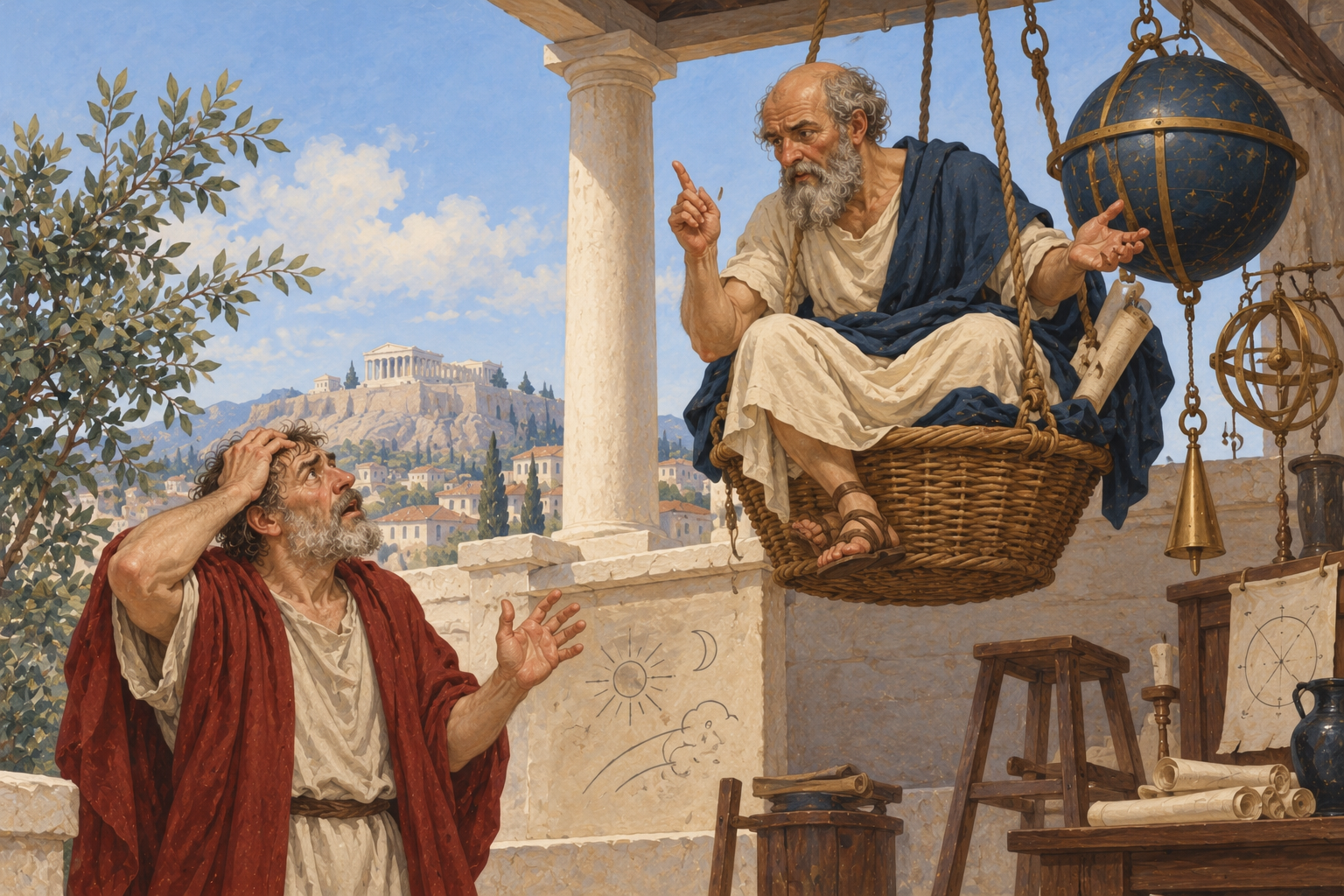
Strepsiades owes money, partly because his son Pheidippides loves expensive horses. Rather than pay his creditors, Strepsiades decides to learn how to argue his way out of debt. He visits a strange school called the Thinkery, where a comic version of Socrates studies nature and teaches unusual ideas. Strepsiades cannot master the lessons, so he sends his son instead.
At the school, two personified speakers—the Better Argument and the Worse Argument—debate how young people should be educated. The Worse Argument wins. Pheidippides returns able to defend even shocking behavior with persuasive words. When he strikes his father, he uses his new skills to argue that the beating is justified. Strepsiades realizes that the cleverness he sought has turned against him. Enraged, he sets fire to the Thinkery.
Meet the Characters
Strepsiades — An anxious, indebted father who wants to avoid paying what he owes.
Pheidippides — His son, devoted to horses and eventually skilled at arguing.
Socrates — A comic teacher at the Thinkery; not an accurate portrait of the historical philosopher.
The Better Argument — A character defending older ideas about discipline and education.
The Worse Argument — A character claiming that clever speech can defeat stronger moral claims.
The Chorus of Clouds — A group of cloud-goddesses who comment on the action and its lessons.
Important Themes
Education and Character — Does learning make someone wiser, or merely more skillful at winning?
Persuasion and Truth — A convincing argument can still be misleading or unfair.
Old and New Ideas — The play makes fun of fashionable learning, but also questions the older generation.
Debt and Dishonesty — Strepsiades’ original goal is to escape obligations rather than act responsibly.
Parents and Children — The father’s plan changes the balance of power within his household.
What to Notice as You Read
Pay attention to Strepsiades’ complaints about debt. How much responsibility does he accept?
Notice the strange activities at the Thinkery. What makes these scenes funny?
Compare what the Better and Worse Arguments say about education. Which ideas sound convincing, and why?
Watch how Pheidippides uses his education after returning home. Is he wiser—or simply better at defending himself?
Ask whether the ending criticizes only the Thinkery or Strepsiades as well.
A Literary Feature: Satire
Satire uses humor, exaggeration, and ridicule to criticize people, habits, or ideas. Aristophanes exaggerates the Thinkery’s lessons and invents an absurd version of Socrates to make audiences laugh about new intellectual fashions. But satire is not a factual report. To understand the play, ask what is being mocked and whether the joke is fair.
Questions to Think About
- Why does Strepsiades want to attend the Thinkery?
- What kinds of activities make Socrates’ school seem ridiculous?
- How are the Better and Worse Arguments different?
- Why does Strepsiades send Pheidippides to the school?
- How does Pheidippides defend striking his father?
- Is Strepsiades responsible for what happens to him?
- Does the final attack on the Thinkery solve anything?
After You Finish
Choose one argument made by Strepsiades, Pheidippides, the Better Argument, or the Worse Argument. Explain what the speaker wants the audience to believe, what makes the argument persuasive, and whether you think it is fair. Support your response with two details from the play.
A Final Thought
Clouds is funny because people use intelligence in foolish ways. It challenges us to distinguish learning from wisdom and persuasive speech from good judgment. The play also reminds us that trying to avoid responsibility can have consequences we never intended.
Note to the Reader
This guide accompanies the Richer Resources Publications edition of Aristophanes’ Clouds, translated by Ian Johnston. A printable PDF version of this resource is available by email.