Abridged for the Richer Resources Classical Reference Library
Editorial note. This abridgement preserves Ian Johnston’s wording in the passages retained. The opening discussion of laughter, humour, and jokes has been substantially shortened; dated illustrative examples and repetition have been omitted; and the concluding postscript on The Birds has been removed so that the lecture remains focused on satire and The Clouds. The original lecture was delivered in November 1998, slightly revised in August 2003, and released into the public domain.
A. Introduction
Today I want to begin by considering a curious topic: What is laughter and why do we like to experience laughter, both in ourselves and others? This will, I hope, serve as something of an entry point into a consideration of the social importance and uses of laughter in cultural experience. And this point, in turn, will assist in an introduction to the importance of humour and laughter in an important form of literature, namely, satire.
All of this, I trust, will help to illuminate what is going on in the Aristophanic comedy we are studying this week, The Clouds.
B–E. Laughter, Humour, and the Joke
Also, the best laughter appears to be a group phenomenon. That is, we laugh best when we are with others and when they are engaging in the same sort of behaviour. That which occasions laughter, the joke, is above all a social phenomenon. It requires a teller and an audience.
In other words, the group response is, I would suggest, one key to understanding why laughter matters.
When we laugh we are acknowledging that a good deal of what we do in life is rather silly, that human life is full of aspirations to be something better than we really are. A joke, and our shared response to a joke, deflates the dignity and self-control and self-imposed value that human beings place on themselves.
We talk about people having a sense of humour. What we mean, I think, by this phrase is the ability to perceive a certain discrepancy between the normal behaviour and the unexpected deflation of it.
Hence, the common observation that the most basic joke is one that contradicts our expectations (this is a standard Aristophanic device). In telling a joke, we set up certain expectations, which are then violated or altered in some unexpected way.
I have tried to stress the social basis for the humour which arises from sharing a joke in order to bring out the first key point of this lecture, that laughter and the presentations of jokes which bring it about, is above all else a social experience which has to be shared in order to be effective.
It's important to stress that not all jokes work in the same ways. There are, for example, at least two common effects of jokes--those which reinforce a group's identity by excluding others and those which educate the group into a new awareness of itself.
But humour can also be educational, that is, it can transform our understanding of the group, and by doing that in a way that we all share it can effect a pleasant, yet very effective transformation of the situation.
F. Satire: A General Definition
In other words, satire is a particular use of humour for overtly moral purposes. It seeks to use laughter, not just to remind us of our common often ridiculous humanity, but rather to expose those moral excesses, those corrigible sorts of behaviour which transgress what the writer sees as the limits of acceptable moral behaviour.
In that sense, what sets satire apart from normal comedy (and the two often shade into each other in ways which make an exact border line difficult to draw), is that in satire there is usually a clear and overt didactic intention, a clear moral lesson is the unifying power of the work.
At the basis of every good traditional satire is a sense of moral outrage or indignation: This conduct is wrong and needs to be exposed.
Satire, if you like, depends upon a shared sense of community standards, so that what is identified as contrary to it can become the butt of the jokes.
Aristophanes in the Clouds may be taking a harshly critical view of Socrates (and others, as we shall see), but there may well be an important positive moral purpose behind that.
G–H. The Range and Techniques of Satire
Satire thus can come in many forms, from savage to gentle, but it remains satire so long as we feel that the writer's main purpose is making us laugh at conduct which he believes ought to be corrected.
How does a satirist set about ridiculing the vice and folly she wants the audience to recognize as unacceptable? Remember that the challenge to the satirist is to get the moral point across with humour, so that the audience or the reader laughs in the appropriate manner.
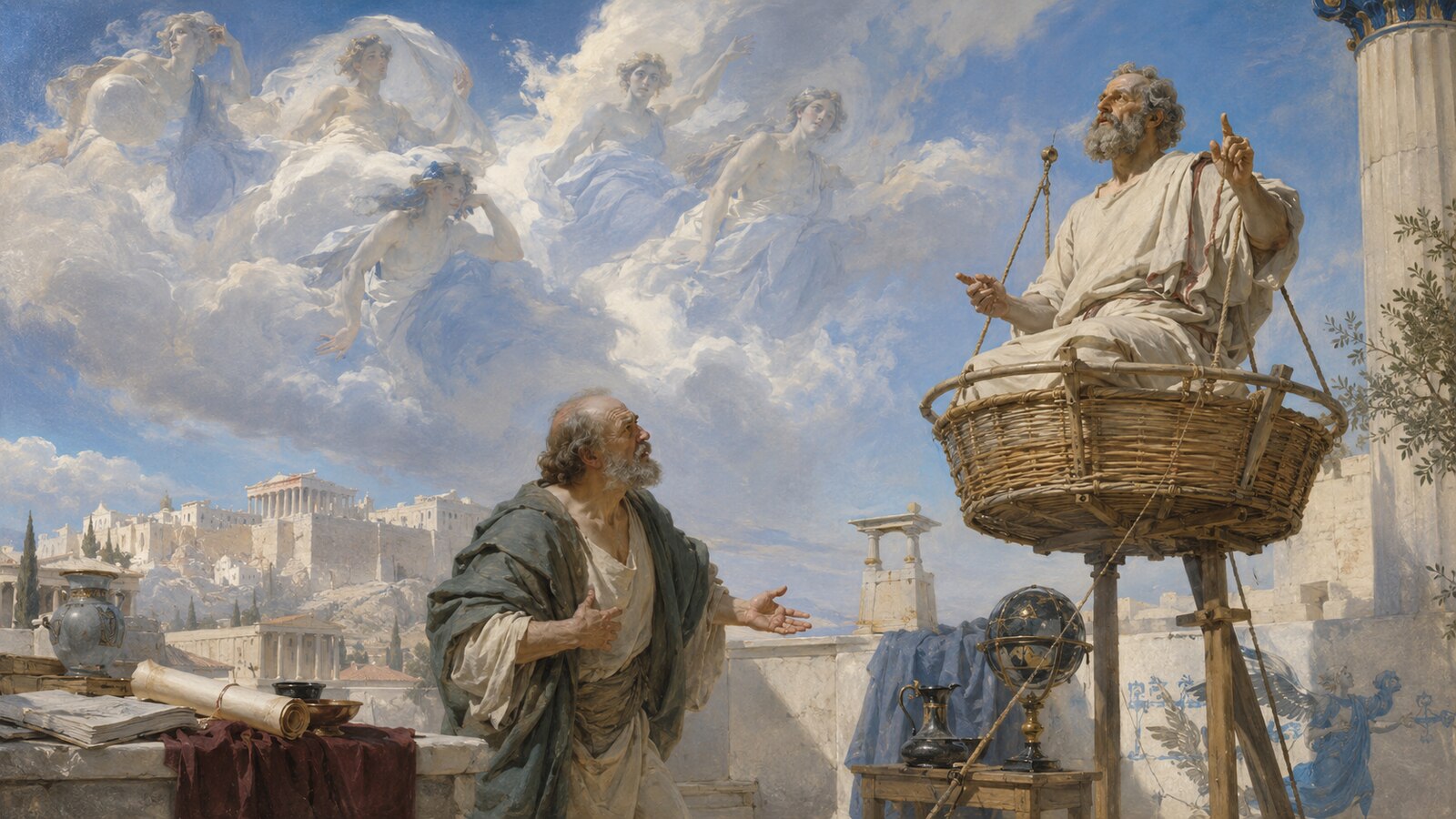
First, the satirist sets up a target--either a person like Socrates or Strepsiades or Pisthetairos or a group like the Thinkery--which will symbolize the conduct he wishes to attack. Satire, in other words, has a clear target.
But in The Clouds the target is not just Socrates. Another target is clearly the middle-aged Athenian male, Strepsiades, full of energy and crudity, desperate to sort out the difficulties of his personal life.
Second, the satirist will typically exaggerate and distort the target in certain ways in order to emphasize the characteristics he wishes to attack and, most importantly, to provide recurring sources of humour.
So to complain that Socrates in The Clouds is nothing like the real Socrates is to miss the point. Aristophanes is setting up his Socrates to symbolize in a ridiculously distorted manner certain ways of behaving which he wishes his audience to recognize as absurd.
But it's important, too, to recognize that the main satire may not be directed so much at Socrates, ridiculous as he is, but at Strepsiades for his desire to believe in Socrates for his own self-interested purposes.
The Clouds is justly famous as a very robust satire featuring a wide variety of satiric techniques, some very corny, some rude, some very physical, some sophisticated parody (in language), some pointed personal references to members of the audience, a direct address to the audience, some lyrical interludes, lots of dancing and singing and music, and a wealth of technical detail in the stage design and costumes.
In this connection, the notion and use of satiric irony is important. This is a technique which, as its name suggests, confronts the audience with the discrepancy between what characters say and do and what we fully understand by their actions.
I. Is Satire Ever Effective?
How effective is satire at realizing its objective, that is, the moral reformation of the audience? I suppose the short answer is not very often, especially nowadays, when being laughed at is often a sign of celebrity rather than something one is automatically ashamed of.
Swift observed that satire is like a mirror in which people see everyone's face except their own.
For satire is not just a matter of attacking the target; it's also a matter of attacking or at least challenging those who believe in the target, who do not see, that is, the moral imperfections at the basis of a particular social or political stance.
So it may be the case that satire works most effectively at educating an audience to see through the pretensions and folly of people whom it takes much more seriously than they ought to be taken.
Satire is one means of educating us against the practice.
J. The Clouds
If we acknowledge, then, that The Clouds is a satire, what does Aristophanes wish us to learn from witnessing the play?
I would maintain that the satire here goes through at least three distinct stages and that, in going through these stages, the tone of the satire changes from something very amusing and distant from us to something much closer to us, more potentially disturbing, and perhaps apocalyptic.
In the opening scenes of the play, the butt of the satire is clearly Socrates. This may be (indeed, is) an unfair portrait of the Socrates we know from the Gorgias and the Apology. But the satire is very vigorous and funny.
One point to stress here is that in the opening of the play, the satire is (for an audience) quite comfortable. The laughter is exclusionary. The variously silly things about the Thinkery and Socrates invite that audience to laugh at him as a charlatan and humbug.
However, Socrates does not remain the sole (or even the most important target of Aristophanes's satire), for the main aim of the satire changes somewhat when Strepsiades decides to enroll in the Thinkery himself.
At this point, Aristophanes is casting his satiric net more widely: this is no longer an attempt merely to expose Socrates to ridicule but to include the self-serving greed of Athenians, including, of course, some of those in the audience.
Thus, holding his self-interested greed up to ridicule is clearly implicating, not just one local weirdo, but a certain social type or social attitude.
A similar shift occurs soon afterwards. Once we come to the debate between the Old and the New Philosophy, the satire changes its emphasis (or, rather, enlarges its concerns). This debate makes it clear that what is at stake here is not just a silly thinker or a greedy social type. What Aristophanes is after is an indictment of an entire way of life, especially of the modern trends which are eroding traditional values.
It's clear, too, just what is eroding that tradition: the ability to manipulate language.
Now, Socrates and his Thinkery are no longer the issue. The central concern is the neglect by the Athenians themselves of their old traditions and their love of novelty in the service of self-interest.
The dramatic point is worth stressing. The play begins by inviting the audience to laugh at the ridiculousness of one particular person for his outright humbuggery. But in the course of the play, the members of the audience are pressured to extend their understanding of humbuggery so that it now includes themselves.
It's as if Aristophanes is asking very pointedly: All right, you found certain conduct in Socrates hilarious. How about that same conduct in yourselves? What's the difference?
The consequences of this attitude emerge in the quarrel between Strepsiades and his son. Again, there's a lot of humour in the exchange and the physicality of the staging, but the seriousness of the issue is made explicit. If we abandon traditions to serve only our individual self-interest, then we are left with a situation in which the only basis for human relationships is power.
At this point in the play, I am suggesting, the satire, while still very robust and funny, is a lot more uncomfortable. The action is pushing us to the recognition that the real issue here is not Socrates (silly as he may be), but rather a self-interested greed which will rebound on us.
The Chorus
That such a concern about the Athenian population generally is the major satiric thrust of the play is made more explicit by the single most important dramatic presence in the play: the Chorus of Clouds, in many ways the most ambiguous element in the play.
Hence, they are defined as the patrons of all those who manipulate others with words. And this function is mirrored in their characteristic of having no definite shape, but taking on the form in accordance with what the perceiver wishes to see.
The "meaning" of the Chorus of Clouds (if that is the right word) is as protean as their shape: like the language the Athenians use for various purposes they have no firmness, no determinate form.
That comic business about the Clouds controlling everything for which the traditional gods are given credit may be funny, but the issue lies at the heart of the play's moral indignation at what is happening in Athens, where the possibilities for a significant life are being systematically corrupted by the seductive power of words, of language itself, which is now being shaped to human beings' desires, rather than directing those desires.
The Ending of The Clouds
That irony I refer to helps to make the ending of this play potentially so ominous. Of course, a great deal is going to depend upon how the play is staged. But it's no accident that Aristophanes ends this comedy with a wanton act of destruction, the burning down of the Thinkery.
Instead of resolving the comedy in a peaceful way, with, for example, an acknowledgment of his errors and some form of reconciliation with his son, Aristophanes has him lash out with an action that indicates his loss of restraint, his decision to abandon thought, and to channel his confused feelings into violence.
The ending of Clouds is not like this. The final vision we have in this play is of destruction. The script does not move us beyond that act.
What we are seeing might be interpreted as an ominous warning: "What I have shown you is something silly and ridiculous, but the consequences of that are far from amusing."
But the fact that there is no prolonged choral closure after the burning, no final comic celebration of a reinstatement of a communal solidarity does raise the possibility that this ending is something more ironically serious than much of the rest of the comedy might suggest. It is a vision of mob violence.
But then, by bringing the satire closer and closer to us, Aristophanes, through our own laughter, brings us face to face with the recognition that what we are really laughing at is not Socrates but our own conduct, our own foolishness arising out of self-interest.
By the end of the play, we are no longer dealing with Sophists and greedy debt-ridden farmers; we are dealing with ourselves and a vision of what we may well become if we don't recognize what's at stake in the promises we make and the words we use.
This all comes about with great theatrical panache and lots of humour; but those features should not obscure the fact that Aristophanes is in deadly earnest in getting across his moral concerns about Athens.
In burning down the Thinkery, Strepsiades is pointing forward to much of the self-destructiveness which brought the Athenians, and countless other cultures proud of their values but increasingly consumed with self-interest, to grief.
Source Note
Ian Johnston, “On Satire in Aristophanes’s Clouds.” Lecture delivered in November 1998 for Liberal Studies 111 at Malaspina College (now Vancouver Island University); slightly revised August 2003. The original document is in the public domain and may be used in whole or in part provided the source is acknowledged.