Abridged from “Some Preliminary Observations on Classical Greek Literature”
Editorial note. This abridgement preserves Ian Johnston’s wording in the passages retained. Material has been omitted where the original lecture becomes especially course-specific, moves into extended comparisons with other religious traditions, repeats points already established, or enters later historical claims not necessary to Johnston’s central discussion of Greek religion, dike, heroic self-assertion, tragedy, and the beginnings of philosophical inquiry. The original lecture was released into the public domain in February 2006, provided the source is acknowledged.
Introduction
I’ve been asked today to take a few moments for some words of introduction to the ancient Greeks, to provide, that is, a necessarily cursory background for your reading of Aeschylus. To anyone with the slightest knowledge of the amazing achievements of the ancient Greeks in so many different areas, the difficulty of offering a simple introduction will be obvious enough. Where might one begin to come up with a short, coherent account of such an astonishing culture? However, in the spirit of those very Greeks, who were never ones to duck a challenge, I shall make my attempt and, in so doing, perhaps encourage others to correct, qualify, or argue about what I have to say.
Some Opening Cautions
However, before plunging into the details, I should clarify a few things for those readers who may be quite unfamiliar with ancient Greek culture or at least uncertain about what I mean by the term. I’m talking about the achievements of the various city states on mainland Greece, the islands, and the coast of Asia Minor who thought of themselves as having a shared Hellenic (or Greek) tradition, in contrast to other people around them, in a period lasting roughly four and half centuries, that is, from the time of Homer (c. 750 BC) to the deaths of Alexander the Great (323 BC) and Aristotle (322 BC). During this period the cultural developments in literature, art, philosophy, history, politics, architecture, and science were without parallel, and they later exerted a decisive and lasting influence upon the development of Western civilization.
One needs at this point also to clarify the term Greeks, because to newcomers it probably suggests a good deal more cultural and political unity than, in fact, prevailed. During this period there were hundreds of fiercely independent Greek city states distributed on mainland Greece, on the islands, and on the coast of Asia Minor (to mention the most important geographical areas).
They were all quite small, and they possessed relatively little overall unity. What these city states shared was a common language (although with significantly different dialects), a common religious and cultural tradition, a few shared festivals and religious councils, and (what is probably most important) a sense of their difference from other cultures around them.
The extraordinarily impressive cultural achievement of the Greeks invites speculation about its cause. And there has been no lack of suggestions as to why these ancient Greeks, rather than, say, the much wealthier and more powerful Persians to the east or Egyptians to the south, should have achieved so much in such a relatively short time. Like many others who have spent years reading and thinking about the Greeks, I have pondered this matter, and the occasion of this lecture prompts me to explore a tentative and inevitably somewhat reductive answer to the issue of what underlying characteristic was so special about the Greeks that it launched and sustained this marvelous moment of cultural history.
Such speculation invites one inevitably to ruminate about how the Greeks saw the world, about how their understanding of things was shaped by some distinctive factors which, for all the obvious differences between those writers listed above, gave them a certain commonality and set them apart from other cultures. And that road leads directly to some general reflections on how the Greeks interpreted the relationship between themselves and the forces which rule the world, between, that is, their human communities and the divine.
The Greek Vision of the Divine
Like virtually every other culture, the ancient Greeks developed a religious understanding of the world based on divine presences and traditional stories. This aspect of their achievement is probably the most widely known element in their culture, for almost everyone in the West still remembers something about the Greek gods and goddesses and about a few of the more important legends associated with them (e.g., the Trojan War). What may be less obvious is how the particular forms of these divinities and their interrelationships with each other and with human beings made the ancient Greek vision of experience decisively different from many other apparently similar belief systems.
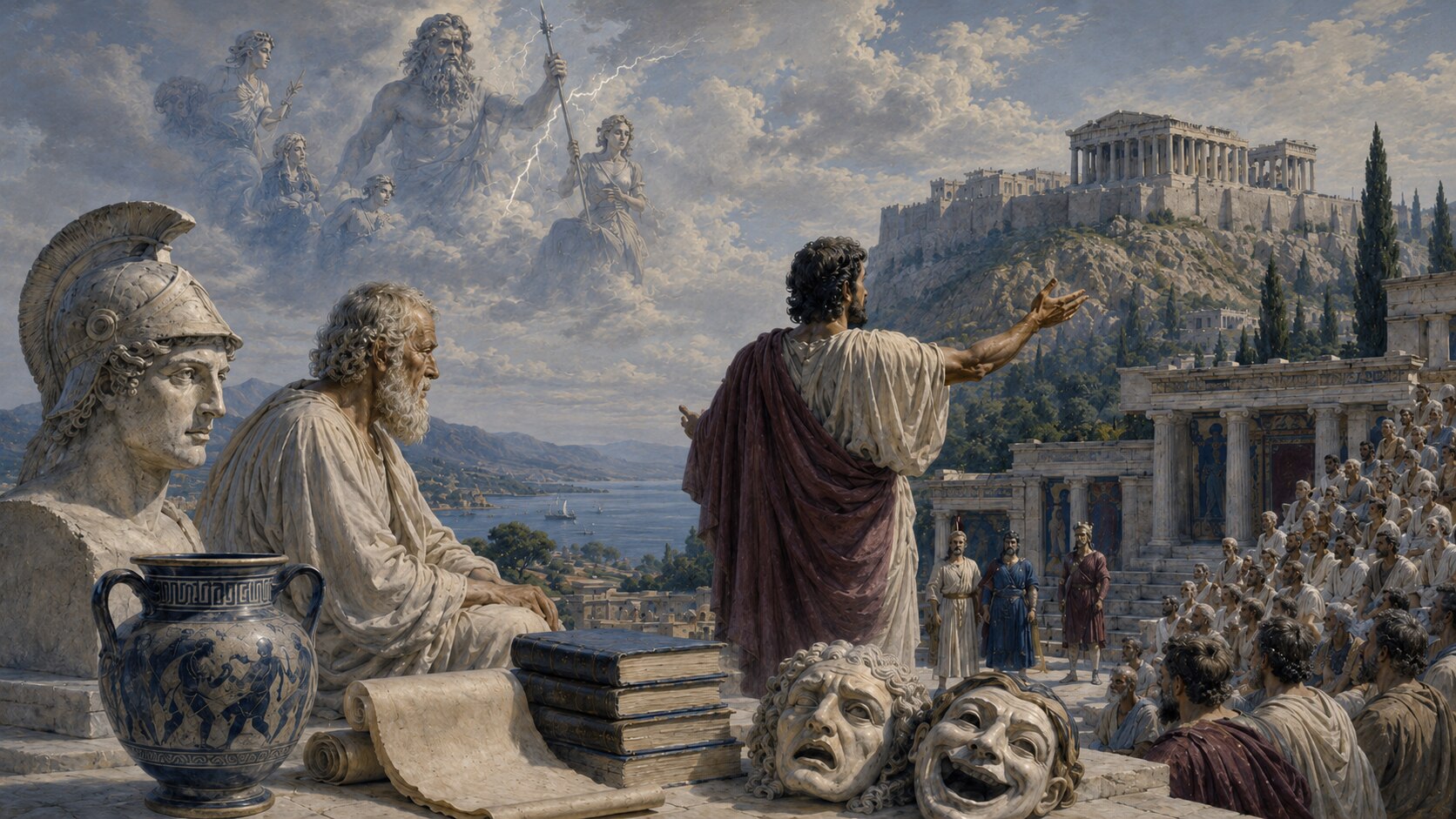
The first important (and most frequently noted) characteristic of the Greek gods is their human form. Their gods have human shapes and exist within the context of an extended family recognizably similar to human families. Hence, in the Greek religious imagination, the highest and most perfect manifestations of existence have forms and attributes exactly like those of their human worshippers. Indeed, except for their power, beauty, and immortality, the Greek gods are exactly like human beings in the way they look, feel, talk, and behave.
And much of the time, their actions within the context of the huge divine family are recognizably human—they fight with each other, make up, have illicit affairs, deceive each other, try to subvert the authority of the powerful father, argue, laugh at each other’s distress, and so on, activities all perfectly comprehensible to anyone with some experience of family life among human beings. Divine motivation is thus linked directly to the constantly shifting and frequently irrational feelings within the human family, and the forces which rule the world are made instantly recognizable and emotionally intelligible because they have such a familiar form.
Such family affairs (in heaven as on earth) have a dynamic and dramatic quality, since the more important events almost invariably involve conflict of some kind, everything from a mild spat to a bitter and long-lasting feud, from an amusing tale of infidelity to stories of extraordinary suffering and cruelty. So it’s not surprising perhaps that this religious vision became such a rich source of intriguing and entertaining stories. More that that, this view of the cosmos enshrines conflict as the heart of divine and natural processes. And such conflicts are not, as in other religions, allegorized pictures of the forces of good fighting the forces of evil, but much more unpredictable and morally ambiguous stories, often without any clear “lesson” for human beings, other than the repeated emphasis that the gods are powerful and inconsistent.
The vision of the divine presences is for the ancient Greeks extremely visual and sharply focused and accompanied by countless familiar stories about the adventures of the gods and goddesses, both in their dealings with each other and in their interactions with human beings. The Greeks never tired of depicting these deities or telling stories about them, and their freedom to do so is astonishing to those raised in cultures with a much sterner attitude towards artistic interpretations of the divine. Greek religion was a serious matter, and penalties for flouting religious practices could be very severe. Nonetheless, there was a freedom to express oneself about the gods, and the range of those responses is remarkable.
Such freedom in the artistic treatment of a religious vision is hard to explain. Perhaps it has something to do with the fact that there was no official holy book which codified the stories into official versions. Nor was there a huge, suffocating, bureaucratic, and politically significant priesthood to enforce uniformity of interpretation. Whatever the reason, the result is well known, an amazing stimulus to the production of works of art celebrating and exploring the nature of the divine in all sorts of ways.
More important than this point, perhaps, is the fact that, although the physical features of and stories about the gods are well known and celebrated, the gods’ wishes are far from clear, especially their intentions regarding human beings. The gods frequently interfere physically and psychically in human affairs, but there is nothing consistent about these interactions, and they may or may not take place, no matter how many times the human beings offer sacrifices or prayers. Throughout Greek literature the relationship of the gods to human beings is ambiguous.
Another way of making the same point is to mention how the gods provide no clear instructions about how human beings were to behave towards them or towards each other. Yes, there are some important divinely sanctioned basic principles, like observing the appropriate attitudes towards guests in one’s home or towards those offering hospitality (a view emphatically brought out in the Odyssey, for example), and it is important to pay one’s respects by appropriate sacrifices and prayers. But such communications or readings are notoriously ambiguous and, as often as not, rebound on the person seeking advice. What is missing is a clear and consistent sense of what the relationship between the gods and human beings ought to be.
In Oedipus the King, even the finest of all men, who strives to do the right thing, suffers horribly for some divine reason which is never provided. In Aeschylus’ Agamemnon, the chorus believes there is a divine purpose guiding events but is filled with an anxious uncertainty about what that might be and can cope with their distress only with a repetitive formulaic “All may be well.” Again and again, Greek literature draws attention to a radical uncertainty about divine purposes.
The confusion and ambiguity of many of the accounts of the gods’ actions appear to have led others to seek explanations for natural events without reference to the old stories. This latter response gave birth to what we recognize as the beginning of science and philosophy.
Such a faith, it strikes me, for all its beauty, energy, and artistic fertility, is, as Nietzsche realized, a very tough religious vision sustained in the harshest conditions without any reliable hope that things will work out all right eventually. In a number of the Greek tragedies, one of main functions of the chorus seems to be to provide a sense of this uncertainty. The gods are in control, but what are their plans? What do they intend for us? Where are we going next? Will they assist us, or are their wishes on this occasion more malicious or uncaring? Such questions often generate an ominously ironic mood.
The Oresteia and the Bacchae
The trilogy opens with a community in crisis. Its traditional understanding of justice is failing, since it seems to lead to an unending sequence of revenge killings which threaten the survival of the state. By the end of the trilogy, the gods have, in effect, transferred some responsibilities for justice onto the human community and have reconciled the divine forces of blood revenge with the human powers of rational persuasion. Hence, there exists here (in this aesthetic vision) a happy fusion of divine and human power, under which the state will thrive.
The most pessimistic of all Greek plays is Euripides’ Bacchae, which exposes the divine forces as mindlessly irrational, absurdly cruel, and fatally destructive to the human community and which explodes any notion that a harmonious reconciliation between the human powers of reason and the divine force is possible.
Dike and the Tragic Experience
These common observations about the Greeks bring me to what is probably the central point of these remarks. For in Greek literature the most distinctive characteristic arising out of this vision of experience is a passionate and ceaseless concern for Justice, a constant exploration seeking clarification about these questions of divine purpose and the appropriate response to an often cruel and always ambiguous relationship between the human and the divine. The term Justice here (in Greek Dike, pronounced to rhyme with dee-kay), one needs to add, is a very wide-ranging concept having to do with a great deal more than fair judicial processes. In Greek mythology Dike was a goddess, a daughter of Zeus, responsible for maintaining moral order on earth, but the term refers also to something much wider than a single personality, a concept we might call “the arrangement,” something analogous to a structural principle by which things work or ought to work and which might guide human beings to a better understanding of the world and their role in it.
Given that cosmic order is mysterious and that there is no authoritative description of or shared agreement about it, the choice is either to accept the mystery and celebrate it in various ways, in the hope that Justice, however it worked, might guide one’s behaviour, or else to challenge it, that is, to see what human beings might be able to learn about divine justice by pushing human striving to the limit, by directly confronting the unknown given conditions of the world. This latter response seems to have been one which the Greeks, for some reason, especially favoured. In fact, this restless search for dike may well be the decisive characteristic of their culture.
And so many of their greatest human heroes are those who embark upon a battle against those fatal conditions (fatal in the sense that they lie outside human control) in an attempt to impose their own will upon the world.
The Greeks developed a particular interest in the hero who is killed or who self-destructs in his quest, the person who, having launched himself against Fate, continues his fight against the unknown well beyond the limits of human prudence or communal restraint until the ironic mystery and power of what he is up against destroys him. In short, the Greek preoccupation with dike leads them to a celebration of the tragic vision of experience.
I don’t propose to offer here a lengthy description of the terms tragedy or the tragic vision of experience, other than to observe that this uniquely Greek vision arises from the desire of some extraordinarily self-assertive personalities to live life entirely on their own terms, no matter what the cost. Their sense of their own rightness is so strong that they push their fierce demands on life well beyond all conventional communal standards to the point where the consequences of their actions lead to their own destruction. In other words, they take human experience (and especially human freedom to act) to the utter limit, and, in so doing, temporarily expose social conventions (including conventional religious belief) as consoling illusions and reveal something about the way the cosmos really works. While such a vision is profoundly fatalistic and almost always deeply pessimistic, it affirms the ability of individual human beings to assert their heroic willingness to confront the mysteries of dike and to accept in full the horrific consequences of that stance.
The Greek fascination with the tragic hero undoubtedly stems from their pre-occupation with competitive displays of excellence. Homer established for the Greeks a standard of virtuous conduct based on competition. The most important goal of the best warriors is always to strive to be the best, not simply in battle, but in athletic games, public speaking, possessions, personal appearance, and so on. If the universe does not give me a coherent and consistent moral standard or rules, then I derive a sense of my excellence and purpose, my value as a human being, from where I stand in relation to my peers, from the way in which my community (as well as other communities) recognizes and celebrates my individual pre-eminence. Even in a life away from the battlefield, as Odysseus demonstrates in the Odyssey, the highest purpose of human life is to demonstrate one’s heroic qualities in competitive actions and (equally important) to make sure such achievements are known and recognized by others.
Of course, not all Greek heroes push their self-assertiveness to the limit. In the Iliad, for example, there are clearly understood unwritten rules about just how far one has to exert oneself in a battle, and in dramatic tragedies it is common for someone to urge the hero to relent. But the tragic hero is clearly one who acknowledges no such unwritten rules and who thus defies the social conventions which urge him to exhibit some restraint, as we see from following the careers of the greatest of them: Achilles (in the Iliad) and Oedipus (in Oedipus the King), among others.
It seems highly probable (although there is no direct evidence for this) that tragic drama began as a celebration of such a hero. Legends have it that the first actor was a man called Thespis and that originally a tragic drama consisted of a huge chorus and a single actor who took on the role of the hero in the choral celebrations of his memory and acted out his greatest exploit. The development of tragic drama saw an increase in the number of actors on stage at any one time and a diminishing importance for the chorus. Moreover, it’s significant that such dramatic presentations of tragic heroes took place in a competition which was a central feature of an important annual religious festival, so that the celebration of heroic self-assertiveness was also an integral part of religious worship.
History and the Tragic Imagination
It is tempting to link this self-assertive spirit and tragic vision of life to both the high and low points of Greek history. The most triumphant moments were undoubtedly the two defeats of the Persian invaders, one at Marathon in 490 and the other at Salamis and Plataea in 480. Faced with what looked like impossible odds the Greeks set aside their frequently quarrelsome differences and marched out to confront a foreign enemy. Thanks to the heroic conduct of particular individuals and the bravery of the citizens, the Persians were defeated, and Greece was saved.
The lowest point of Greek history was the Peloponnesian War, in effect, a savage conflict between groups of Greek states who could or would not reconcile their differences more peacefully because their shared traditions were insufficient to check their fear of each other and their leaders’ quests for power. The war ruined Athens, and the victorious power, Sparta, soon went into a permanent decline.
Many of the great works we read now were written in the light of these events. Aeschylus fought at the Battle of Marathon, and the great optimism of his Oresteia may well be a product of his sense of the astonishing achievements of the united Greeks. Sophocles, Euripides, and Aristophanes wrote during various stages of the war, and their treatments of the old stories and traditional customs are decisively shaped by that event.
By a curious and (perhaps) significant irony, the conquest of the Greeks by Philip of Macedon was consolidated by his son, Alexander the Great, the most self-assertive warrior of all time, who saw himself as the reincarnation of Achilles and who carried with him on his campaigns a copy of the most influential shaping work of traditional Greek culture, Homer’s Iliad.
A Note on the Philosophers
Given the importance and nature of Greek religion, one is entitled to wonder how the Greeks could provide such an incredibly rich collection of myths, stories, and artistic celebrations of irrational faith and at the same time establish the origins (and some of the highest points) of philosophical enquiry. How could these different approaches to understanding dike arise and flourish in the same communities?
To answer such a complex question very briefly, I can refer to my previous remark about how the very richness and complexity of Greek religion prompted a reaction against it. We have no accurate knowledge of how this reaction began, although traditionally the first important philosophers are associated with Miletus, a city in Asia Minor. Philosophy seems to have started with a few citizens of Miletus who asked a question which to us may seems very obvious but which for most cultures is very strange: Can we explain how things work, without calling in divine forces or personalities as causes in natural events? Can we, in other words, find a natural explanation for natural events? Alternatively put, can we banish our traditional gods and goddesses from our understanding of dike?
The significance of this question cannot be overestimated. It’s important because it asks the thinker to abandon traditional stories and find some reasonable way to account for the ways things are on earth, a human account which relies on natural events. The search for some essential and universal material stuff quickly ran into difficulties, and so some of these thinkers turned their attention to another approach: what mattered in explanations was not the stuff itself, but the arrangement of material, the formal structure of matter. One could explain the variety of things in the natural world by speculating about the fundamental properties of matter, especially the mathematical properties of its constituents.
Now, this wedding of mathematics to explanations of nature is of enormous importance. It is, in effect, the start of science and a major advance for philosophical speculation. For example, using geometry to plot the movements of the heavens makes modern astronomy possible; it enables one to move beyond observation into precise modeling of the cosmos on mathematical principles.
To put mathematics at the heart of one’s understanding of dike is to demand a fundamentally different form of reasoning, and some of the philosophers were clearly seeking to do this as a way of countering the frequently irrational behaviour associated with traditional rituals, cults, sacrifices, and so on. However, it is not necessarily demanding the abandonment of a religious sensibility. For mathematics came to be seen in many quarters as a spiritual training, a way to discipline the mind, so that knowledge of the higher order of things might be attained through geometry. Plato (in the Republic) gives the greatest importance to an understanding of geometry as a spiritual training and is deliberately subverting the tradition in order to insist that we can only arrive at an understanding of dike by thinking in a new way.
It’s probably fair to say that rational philosophy (or rational enquiry generally) tends to flourish, if at all, at critical periods when the traditional religion is failing in some important ways. So it’s no accident that the greatest surviving works of Greek philosophy come, like Thucydides’ great work which marks the emergence of a historical enquiry based on thoroughly rational principles, after the Peloponnesian War, by which time many of the most important social organizations responsible for traditional religious faith and communal customs had been badly discredited and traditional Greek society was in shambles.
Source Note
Original source: Ian Johnston, “Some Preliminary Observations on Classical Greek Literature.” Lecture to first-year literature students at Malaspina University-College (now Vancouver Island University), released February 2006. Johnston states that the text is in the public domain and may be used for any purpose without permission or charge, provided the source is acknowledged.