An original reference guide for the Richer Resources Classical Reference Library
HISTORY & CULTURE
Introduction. Ancient Greece was never a single, unchanging society. Across more than a thousand years, communities around the Aegean developed, traded, fought, founded colonies, experimented with political forms, created literature and art, and asked questions that still shape Western thought. This guide provides a concise framework for understanding that world and for placing Homer, Greek tragedy and comedy, and the major philosophers in their historical setting.
A useful starting point: “Greece” in antiquity usually meant a shared language, religious traditions, myths, and cultural practices spread among many independent communities—not a unified nation-state with one government.
1. What Do We Mean by “Ancient Greece”?
The phrase ancient Greece covers a long span of time and a broad geographic world. It includes the Greek mainland, the islands of the Aegean, Crete, communities along the coast of Asia Minor, and—during the great age of colonization—Greek settlements around the Black Sea and across the Mediterranean, especially in southern Italy and Sicily.
Historians usually divide this long history into broad periods. The Bronze Age includes the Minoan civilization of Crete and the Mycenaean palace societies of mainland Greece. After the collapse of the Mycenaean palaces around 1200 BCE came several centuries now often called the Early Iron Age; the older label “Greek Dark Age” is still encountered, but it can misleadingly suggest that the period was uniformly poor or culturally empty. The Archaic period, roughly the eighth through early fifth centuries BCE, saw the rise of the polis, renewed long-distance trade, colonization, monumental temples, the Greek alphabet, and the formation of the Homeric epics.
The Classical period, conventionally dated from the Persian Wars to the death of Alexander the Great (480–323 BCE), includes the great age of Athenian drama, democracy, history, philosophy, and art. The Hellenistic period followed Alexander’s death, when Greek language and culture spread through large kingdoms across the eastern Mediterranean and Near East.
2. Geography and the Mediterranean World
Geography mattered profoundly. Mainland Greece is broken by mountains and valleys, while the Aegean is filled with islands and narrow sea routes. Fertile plains exist, but much of the landscape favors smaller regional communities rather than a single great river-based kingdom. The sea therefore connected Greek communities as much as the mountains separated them.
Athens stood in Attica, a peninsula in central Greece with access to the Aegean and the excellent harbor of Piraeus. Sparta dominated Laconia and later much of the Peloponnese, the large southern peninsula linked to central Greece by the narrow Isthmus of Corinth. Corinth itself occupied a strategically important position at that isthmus. Across the Aegean, Greek-speaking communities flourished on the western coast of Asia Minor in regions such as Ionia. Farther north, the Hellespont—the narrow passage now called the Dardanelles—connected the Aegean with the Propontis and Black Sea; Troy stood near this strategically important route.
From the eighth century BCE onward, Greek communities established independent settlements around the Mediterranean and Black Sea. These were not simply overseas provinces controlled from a Greek capital. Many developed into independent poleis with their own political institutions. Trade and colonization brought Greeks into sustained contact with Phoenicians, Egyptians, Anatolians, Etruscans, and many other peoples, and those contacts helped shape Greek writing, art, technology, religion, and thought.
3. The Polis: A World of Independent Communities
The characteristic political unit of Archaic and Classical Greece was the polis, commonly translated as “city-state.” A polis was more than an urban center. It was a community of citizens with its own laws, religious cults, public spaces, political institutions, territory, and sense of identity. Athens, Sparta, Corinth, Thebes, Argos, and hundreds of smaller communities were separate political societies.
Greek poleis could cooperate when their interests aligned, but rivalry was persistent. Alliances changed, border disputes were frequent, and wars among Greek states were common. At the same time, Greeks recognized important cultural bonds across political boundaries: language, shared gods and sanctuaries, athletic festivals such as the Olympic Games, and a common body of myths and heroic traditions.
Political systems varied widely. Some poleis were ruled by oligarchies, some experienced periods of tyranny, and others developed broader citizen participation. Athens became famous for democracy, but its democracy was direct rather than representative and was limited to adult male citizens; women, enslaved people, and resident foreigners were excluded from citizenship. Sparta developed a distinctive mixed system with two kings, a council of elders, magistrates known as ephors, and a citizen assembly, supported by the labor of a large unfree helot population.
4. Before Classical Greece: Minoans and Mycenaeans
Minoan Crete
During the Bronze Age, Crete supported a wealthy palace-centered civilization conventionally called Minoan, after the legendary King Minos. Major palace centers included Knossos, Phaistos, Malia, and Zakros. Minoan society participated in wide networks of Aegean and eastern Mediterranean trade and produced distinctive architecture, wall painting, pottery, metalwork, and writing.
The script known as Linear A, used on Crete and elsewhere in the Aegean, remains undeciphered. Because the language represented by Linear A is not securely understood, scholars must reconstruct much of Minoan society through archaeology rather than readable historical records.
Mycenaean Greece
By the later Bronze Age, powerful palace centers flourished on the Greek mainland at places such as Mycenae, Tiryns, Pylos, and Thebes. This culture is called Mycenaean after Mycenae, one of its best-known centers. Mycenaean influence extended across much of the Aegean and eventually into Crete.
The Mycenaeans used Linear B, a script adapted from the Minoan writing tradition. Linear B was deciphered in the twentieth century and records an early form of Greek, making the Mycenaean period the earliest securely documented stage of the Greek language. The surviving tablets are largely administrative records: inventories, allocations, personnel lists, offerings, and other documents of palace management.
The world remembered in later Greek heroic poetry is not a straightforward record of Mycenaean life, but the Late Bronze Age supplied an important imaginative background for stories about Agamemnon, Achilles, Odysseus, Troy, and the great heroic families.
5. The Bronze Age Collapse and the Early Greek World
Around 1200 BCE, the Mycenaean palace system collapsed amid a much wider period of disruption across the eastern Mediterranean. Palaces were destroyed or abandoned, long-distance networks changed, population patterns shifted, and the Linear B administrative system disappeared. There is no single accepted explanation for this transformation. Warfare, internal political instability, migration, environmental pressures, disruption of trade, and cascading failures within interconnected palace economies have all been considered.
Older accounts often explained the collapse through a single “Dorian invasion.” Modern scholarship is much more cautious. Later Greek traditions about Dorians are historically important, but archaeology does not support a simple picture in which one invading people can be identified as the sole cause of Mycenaean collapse.
The centuries after the palaces fell were not uniform. Some regions became poorer and less connected, while others maintained or recovered substantial exchange networks. By the eighth century BCE, a broad cultural and political revival was unmistakable: population grew, trade expanded, sanctuaries became major centers, new forms of art appeared, the alphabet was adopted and adapted from Phoenician writing, and the polis emerged as a central institution.
6. Homer and the Archaic Age
The Iliad and the Odyssey took shape within this Archaic Greek world, probably through a long oral tradition before reaching the forms in which they were eventually written down. They look backward to an age of heroic kings and warfare associated with the Late Bronze Age, but they also contain institutions, customs, and objects reflecting later centuries. They are therefore not simple historical documents for either period.
The epics became foundational works for Greek education and cultural memory. Characters such as Achilles, Hector, Agamemnon, Helen, Odysseus, Penelope, and Telemachus provided later poets, dramatists, historians, philosophers, and artists with a shared imaginative vocabulary. Greek tragedy in particular repeatedly returned to stories that lie before, during, and after the Trojan War.
The Archaic period also saw rapid expansion of Greek settlements around the Mediterranean and Black Sea, the growth of Panhellenic sanctuaries and festivals, the development of monumental architecture and sculpture, and the emergence of early natural philosophy in the Greek cities of Ionia.
7. Athens and Sparta
Athens and Sparta became the two most influential Greek powers of the Classical age, but their societies were very different. Athens developed into a major maritime, commercial, and cultural center. Its political institutions evolved through conflict and reform into a direct democracy in which eligible male citizens debated and voted in the Assembly, served on juries, and held public offices. Athenian wealth and naval power also rested heavily on an empire of allied states and on enslaved labor.
Sparta organized itself around a highly disciplined citizen body and a powerful land army. Spartan male citizens underwent a state-directed system of education and military training, while much agricultural labor was performed by helots, an unfree population subjected to Spartan control. Spartan institutions emphasized stability, discipline, and collective military readiness, although the reality of Spartan society was more complex than the austere image later writers often created.
The contrast between Athens and Sparta should not be reduced to a simple opposition between “freedom” and “militarism.” Both societies were hierarchical, both depended on excluded or unfree populations, and both pursued power. Their rivalry nevertheless became one of the defining forces of fifth-century Greek history.
8. The Persian Wars and the Rise of Athens
In the early fifth century BCE, conflict between the Persian Empire and Greek communities drew many poleis into a common struggle. The Persian Wars included the Athenian victory at Marathon in 490 BCE and the massive invasion of Greece by Xerxes in 480 BCE, remembered for battles at Thermopylae, Salamis, and Plataea. Persian forces withdrew after the Greek victories of 480–479 BCE.
The wars did not create lasting Greek unity. Athens soon became the dominant naval power in the Aegean and led the Delian League, originally organized as an alliance against Persia. Over time Athens increasingly controlled allied contributions, imposed its authority on members, and transformed the league into an empire.
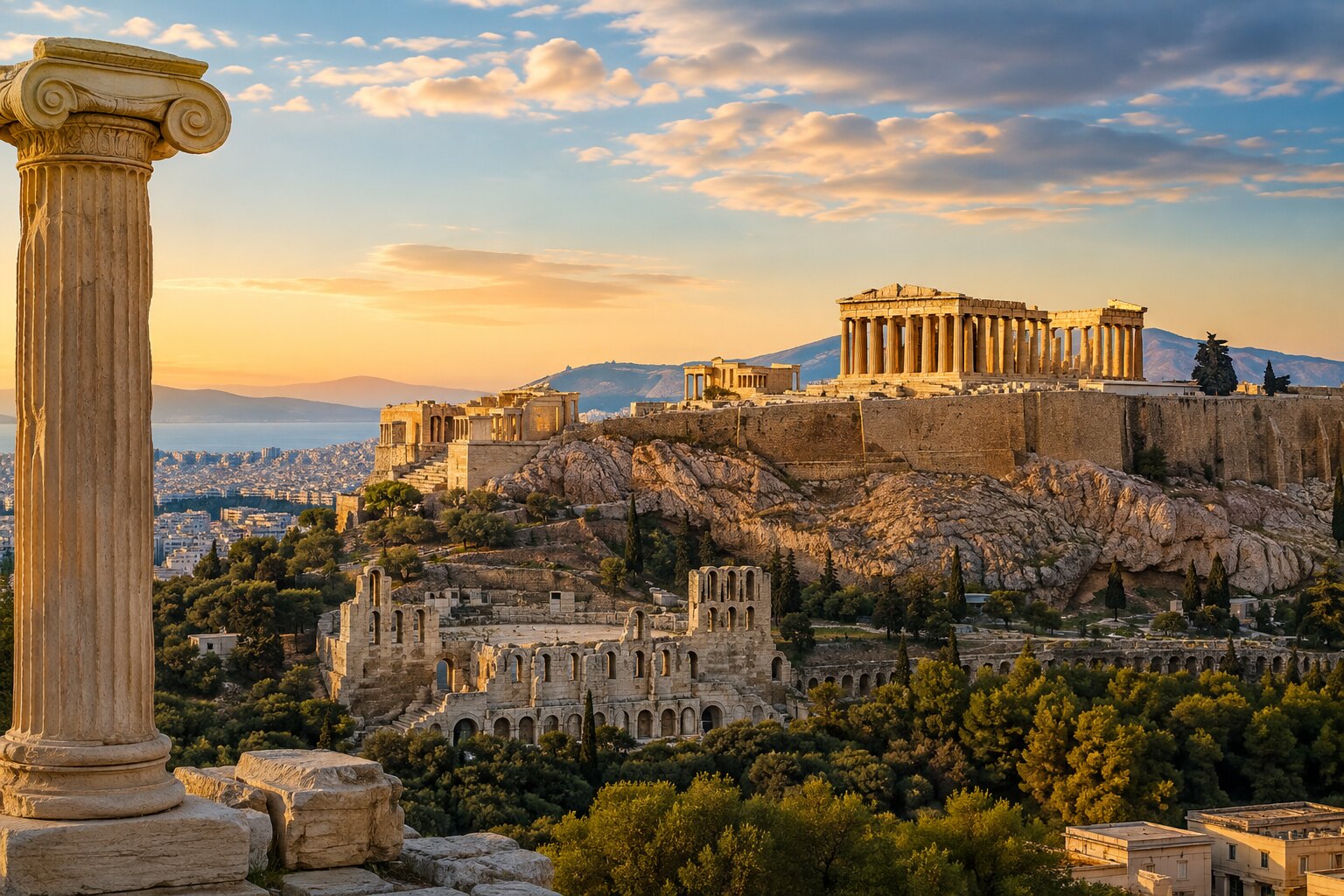
The decades after the Persian Wars were also the great age of the Athenian Acropolis building program, including the Parthenon. Athenian drama flourished in this same political environment: Aeschylus, Sophocles, Euripides, and Aristophanes wrote for a citizen community that was democratic at home, imperial abroad, and frequently at war.
9. Classical Athens: Drama, History, and Philosophy
Fifth-century Athens created institutions in which literature, religion, and civic life intersected. Tragedies and comedies were performed at public religious festivals before large audiences. The plays were entertainment, competition, ritual, and civic reflection at once. They explored war, justice, family obligation, political judgment, persuasion, gender, divine authority, and the consequences of human choices.
The tragedies of Aeschylus, Sophocles, and Euripides usually drew on inherited myth rather than contemporary plots, yet those myths could speak powerfully to current concerns. Aristophanic comedy was more openly topical, mocking politicians, intellectual fashions, military policy, literary rivals, and the Athenian public itself.
The same period produced new forms of historical writing associated especially with Herodotus and Thucydides. Philosophy also became increasingly central to Athenian intellectual life. Socrates left no writings of his own, but his questioning method and execution in 399 BCE became defining events for later philosophy. Plato, his student, developed dialogues exploring ethics, knowledge, politics, education, metaphysics, and the nature of philosophical inquiry.
10. The Peloponnesian War
Tension between Athenian power and Sparta and its allies culminated in the Peloponnesian War, traditionally dated 431–404 BCE. The conflict was prolonged, destructive, and politically destabilizing. Athens endured a devastating plague early in the war, suffered catastrophic losses during the Sicilian Expedition, and finally surrendered to Sparta in 404 BCE.
The war is essential background for much late fifth-century literature. Euripides and Aristophanes wrote during decades in which Athenians experienced repeated military campaigns, political crises, casualties, shortages, and arguments over empire and peace. Thucydides’ History of the Peloponnesian War remains one of the most influential works of political and military history ever written.
Spartan victory did not produce lasting stability. The fourth century BCE saw continued competition among Sparta, Athens, Thebes, and other Greek states, creating the conditions in which Macedonia could become the dominant power.
11. Macedonia and Alexander the Great
In the mid-fourth century BCE, Philip II transformed Macedonia into a formidable military and political power. In 338 BCE his victory at Chaeronea established Macedonian dominance over most of the Greek mainland. Philip was assassinated in 336 BCE and was succeeded by his son Alexander III, known as Alexander the Great.
Alexander invaded the Persian Empire, defeated its armies, took control of Egypt and the great Persian capitals, and campaigned eastward into Central and South Asia. He died in Babylon in 323 BCE at the age of thirty-two. His empire did not remain unified, but successor kingdoms carried Greek language, institutions, art, and intellectual traditions into a much wider geographic world.
Alexander’s death conventionally marks the end of the Classical period and the beginning of the Hellenistic age. Greek culture did not end; rather, it entered a new phase in which cities such as Alexandria, Pergamon, and Antioch became major centers of learning and power.
Where the Literature Fits
Late Bronze Age (c. 1600–1200 BCE)
Mycenaean palace world; traditional heroic setting behind the Trojan War legends. Later background for the Iliad, Odyssey, and much Greek tragedy.
Early Iron Age / Geometric Period (c. 1050–700 BCE)
Post-palatial societies; renewed trade; development of the alphabet and the polis. The oral epic tradition develops, and Homeric poetry takes recognizable form by the late eighth or early seventh century.
Archaic Period (c. 700–480 BCE)
Colonization, developing polis institutions, major sanctuaries, lyric poetry, and early philosophy. This is the world of Hesiod, the lyric poets, and the early Ionian thinkers.
Classical Period (480–323 BCE)
The Persian Wars, Athenian empire and democracy, the Peloponnesian War, and the rise of Macedonia. This period includes Aeschylus, Sophocles, Euripides, Aristophanes, Herodotus, Thucydides, Socrates, Plato, and Aristotle.
Hellenistic Period (323–31 BCE)
The successor kingdoms of Alexander and a much wider Greek-speaking world. New centers of scholarship and literature developed, while earlier Greek texts were preserved, edited, studied, and interpreted.
13. Concise Timeline
c. 2000 BCE — Major Minoan palace centers develop on Crete.
c. 1600–1200 BCE — Mycenaean palace civilization flourishes on the Greek mainland and across the Aegean.
c. 1200 BCE — Collapse of the Mycenaean palace system amid wider eastern Mediterranean disruption.
c. 1050–700 BCE — Early Iron Age / Geometric period; gradual recovery, expanding trade, and new institutions.
8th century BCE — Greek alphabet develops; polis institutions and Panhellenic sanctuaries expand; Homeric epic takes shape.
7th–6th centuries BCE — Greek settlements spread widely around the Mediterranean and Black Sea; lyric poetry and early philosophy flourish.
490 BCE — Battle of Marathon.
480–479 BCE — Xerxes invades Greece; Thermopylae, Salamis, and Plataea.
5th century BCE — Height of Classical Athens; democracy, empire, tragedy, comedy, history, art, and philosophy flourish.
431–404 BCE — Peloponnesian War between Athens and Sparta and their allies.
399 BCE — Trial and execution of Socrates.
338 BCE — Philip II of Macedonia defeats a coalition of Greek states at Chaeronea.
336–323 BCE — Reign and conquests of Alexander the Great.
323 BCE — Death of Alexander; conventional beginning of the Hellenistic period.
Why This Background Matters
Greek literature assumes a world of shared myths but competing communities, inherited traditions but rapid intellectual change. The Iliad and Odyssey look back toward a heroic age while speaking to later Greek audiences. Tragedy reworks inherited stories in the civic setting of Classical Athens. Comedy turns contemporary politics and cultural anxieties into public laughter. Philosophers ask what justice, knowledge, nature, virtue, and political order might mean in societies where inherited answers were increasingly open to argument.
Understanding that historical setting does not reduce the literature to politics or dates. It does the opposite: it helps explain why works created in very particular communities could address questions broad enough to remain alive for readers thousands of years later.
Sources and Editorial Note
Editorial note. This is an original Richer Resources Classical Reference Library guide, prepared from current museum, scholarly, and reference materials. Where historical interpretations remain uncertain or disputed, the guide reflects current scholarship and identifies older explanations with appropriate caution.
• British Museum: “Greece: Minoans and Mycenaeans,” “Greece 1050–520 BC,” and “Who was Homer?”
• The Metropolitan Museum of Art, Heilbrunn Timeline of Art History: essays on Geometric Greece, Greek colonization and trade, Classical Greece, and the rise of Macedonia and Alexander the Great.
• Recent Cambridge scholarship on the end of the Aegean Bronze Age, consulted for current caution regarding older single-cause “Dorian invasion” explanations.