Aristophanes’ Knights
Student’s Guide | Classical Reference Library
Richer Resources Editorial Team
About This Guide
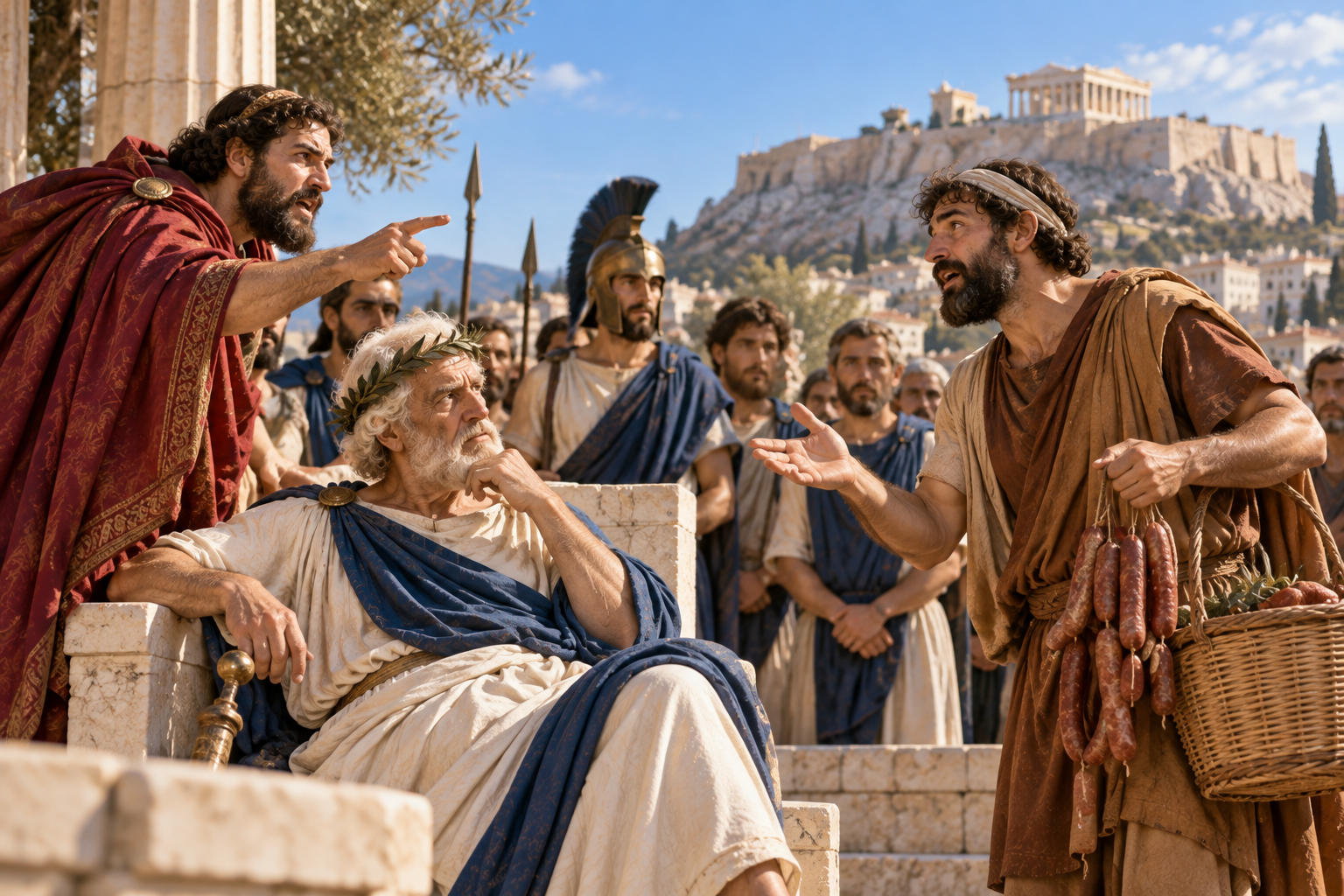
In Knights, Aristophanes imagines the citizens of Athens as one elderly man, Demos, surrounded by servants who want to control him. The most powerful servant, Paphlagon, faces a surprising challenger: a sausage seller. Their ridiculous contest asks serious questions about politics. How do people decide whom to trust? Why might flattery be more successful than honesty? And can a community recover when its leaders compete to manipulate it?
Before You Read
Knights was first performed in Athens in 424 BCE, during the Peloponnesian War. Athens was a democracy in which male citizens could participate directly in public decisions, but politicians still struggled to influence the assembly. The play attacks Cleon, a prominent Athenian politician, through the comic character Paphlagon. Remember that Aristophanes is writing satire, not a neutral historical report. His purpose is to make audiences laugh, recognize familiar behavior, and question what they see.
The play belongs to Old Comedy, a theatrical form known for outrageous insults, topical jokes, songs, choruses, and impossible situations. Some references may be unfamiliar without notes. Focus first on what each character wants and how each tries to get it.
The Story at a Glance
Two unhappy servants complain that Paphlagon has become their master Demos’s favorite by flattering him and taking credit for others’ work. They discover a prophecy suggesting that a sausage seller will replace him. The sausage seller seems completely unqualified for leadership—but the servants insist that his loud voice, dishonesty, and experience selling goods make him perfect for the job.
With the support of the chorus of Knights, the sausage seller competes against Paphlagon in boasting, insults, promises, and gifts. Each tries to persuade Demos that he is the more devoted servant. Eventually the sausage seller, later named Agoracritus, defeats Paphlagon. He then presents a transformed Demos, supposedly restored to the virtues of an earlier Athens. The ending is cheerful, but it also invites us to ask whether the problems of political manipulation have truly disappeared.
Meet the Characters
Demos — An elderly master who represents the Athenian people. He has power, but others know how to flatter him.
Paphlagon — A loud, aggressive servant who represents the politician Cleon in exaggerated comic form.
The Sausage Seller (Agoracritus) — Paphlagon’s rival. His supposed lack of education becomes an advantage in the contest.
The Two Servants — Workers who are tired of Paphlagon’s behavior and recruit the sausage seller.
The Chorus of Knights — A group that opposes Paphlagon and helps his challenger.
Important Ideas
Flattery versus service. A leader may claim to serve the people while actually seeking personal advantage. Watch for moments when gifts and compliments replace genuine arguments.
The power of the audience. Demos is the master of the household, yet he is repeatedly deceived. Does Aristophanes blame leaders, citizens, or both?
A competition to be worse. The sausage seller succeeds partly because he can outdo Paphlagon’s shameless tactics. Winning an election-like contest does not necessarily mean being the better person.
Political satire. The play exaggerates behavior to expose weaknesses in public life. A comic portrait can reveal an important concern without being an accurate portrait of a real individual.
The promise of renewal. At the end, Demos appears restored. Decide whether this is a hopeful resolution or a fantasy too convenient to trust.
A Literary Feature: The Household as a City
The central joke of Knights is an extended allegory: a household stands for Athens. Demos is both an individual character and the collective citizen body. His servants resemble political leaders competing to gain influence. This arrangement makes abstract questions about democratic power visible onstage. Ask yourself who is actually in charge when the master depends on servants for information, food, and advice.
What to Notice While Reading
Pay attention to how Paphlagon and the sausage seller speak to Demos. Do they provide evidence, appeal to his fears, offer him treats, or attack one another? Notice how the chorus shapes your response to the rivalry. Also watch for moments when a character’s apparent weakness becomes a strength in the comic world. Finally, compare Demos at the beginning and end: what has changed, and what has not been explained?
Questions to Think About
- Why does Aristophanes turn the Athenian people into one elderly man?
- What makes the sausage seller a believable challenger within the play’s strange logic?
- How are the two rivals alike, even though they claim to be enemies?
- Which techniques of persuasion seem most effective on Demos?
- Is the chorus a reliable guide to what is right, or does it have interests of its own?
- How does satire differ from a historical account of Cleon?
- Does the final transformation of Demos make you hopeful or skeptical? Explain why?
Try This
Choose one exchange in which Paphlagon and the sausage seller compete for Demos’s approval. Make two short lists: what each promises and how each tries to win trust. Then rewrite one promise as a clear, testable public proposal. What information would Demos need in order to judge it fairly? Discuss whether the play suggests that good judgment can be learned.
A Final Thought
Knights is funny because its politicians are so outrageously eager to please. It is unsettling because their behavior works. As you finish, consider whether the play is chiefly warning against corrupt leaders, careless audiences, or the dangerous relationship between them.
Note to the Reader
This guide accompanies the Richer Resources Publications edition of Aristophanes’ Knights, translated by Ian Johnston. It is designed to support thoughtful reading and discussion, not to replace the play itself.