Aristophanes’ Peace
Student’s Guide | Classical Reference Library
Richer Resources Editorial Team
About This Guide
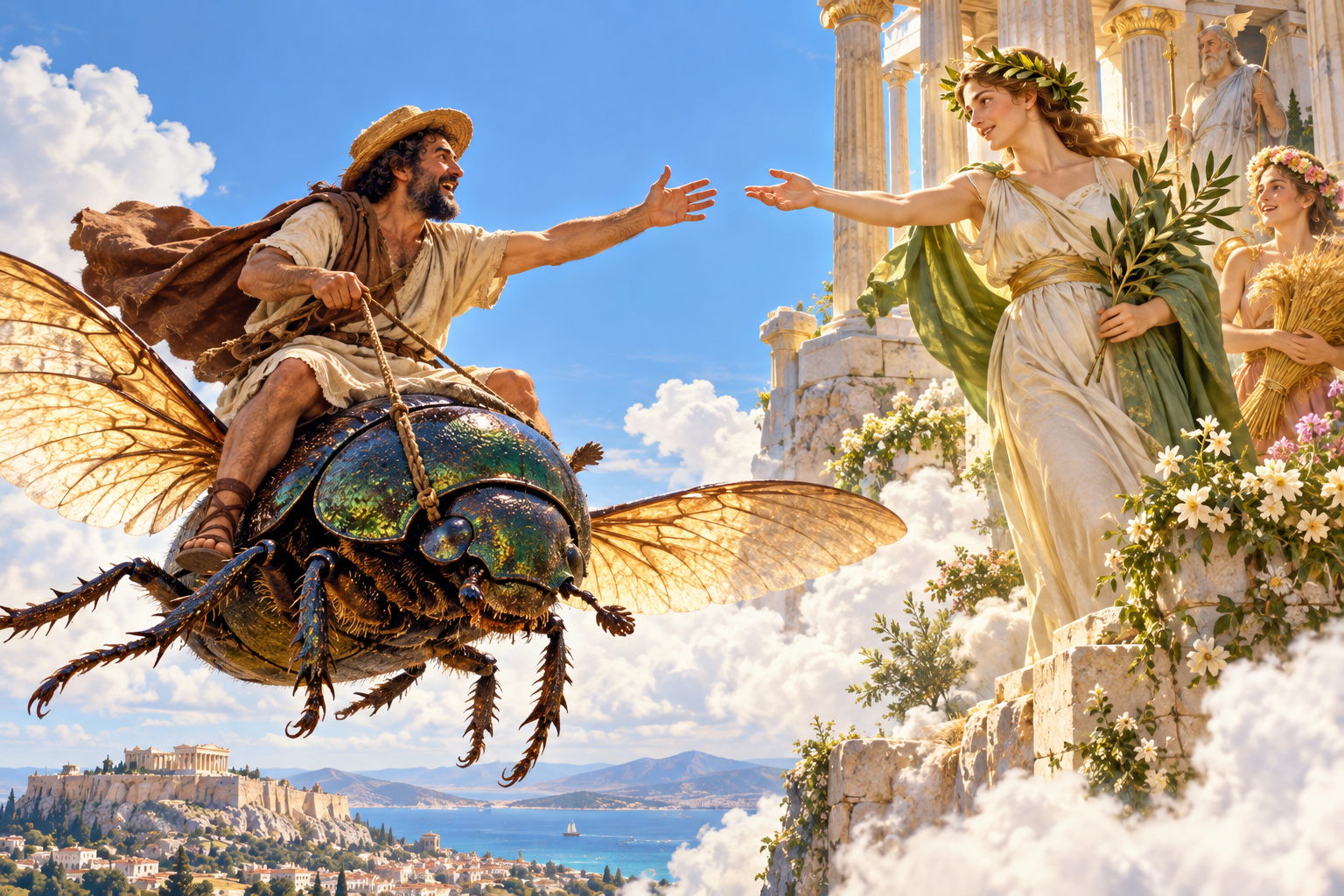
Imagine being so tired of war that you decide to fly to the home of the gods on a giant dung beetle. That is how Aristophanes begins Peace. His hero, an Athenian farmer named Trygaeus, sets out to bring the goddess Peace back to the Greek world. The adventure is ridiculous, but the question behind it is serious: what does war take away from ordinary people, and what might life look like if fighting stopped?
Before You Read
Peace was first performed in Athens in 421 BCE, during the Peloponnesian War, a long conflict involving Athens, Sparta, and their allies. Its performance came at a moment when the Greek cities were negotiating a settlement now known as the Peace of Nicias. Aristophanes was writing for an audience that had experienced years of uncertainty, destruction, and loss. The play expresses hope for an end to the conflict, but it is a comedy, not a factual report of negotiations.
The play belongs to Old Comedy, a form of Greek theater filled with wild inventions, topical jokes, songs, a chorus, and sometimes coarse language. You do not need to recognize every ancient political reference to understand its central concerns. Notice what the characters miss about peaceful life—and who seems less eager to see war end.
The Story at a Glance
Trygaeus, a farmer, decides that someone must persuade the gods to stop the war. He rides a giant dung beetle up to Olympus and discovers that the gods have left. War has taken control and shut the goddess Peace away in a cave. With help from Hermes, Trygaeus calls on people from different Greek communities to pull Peace free. The effort is difficult because they do not all cooperate equally.
At last Peace is rescued, along with her companions Harvest and Festival. Trygaeus returns to earth, where preparations for celebration replace preparations for battle. Farmers welcome the possibility of working their land again, while merchants who sell weapons discover that peace is bad for their business. The play ends in a joyful vision of abundance and marriage, though its happiness depends on an imagined solution to a very real conflict.
Meet the Characters
Trygaeus — An Athenian farmer who takes extraordinary action because he wants ordinary life restored.
Peace — A goddess whose imprisonment represents the loss of peaceful relations among Greek communities.
War — A threatening figure who plans further destruction.
Hermes — The messenger god who tells Trygaeus what has happened on Olympus.
Harvest and Festival — Companions of Peace who represent farming, celebration, and the pleasures of life without war.
The Chorus — A group that helps express the longing for peace and the need for people to work together.
Important Ideas
The cost of war. The play emphasizes disrupted farms, lost pleasures, and exhausted communities rather than military glory. Consider whose experiences receive the most attention.
Cooperation. Peace cannot be rescued by one person alone. The struggle to free her suggests that ending conflict requires people with different interests to act together.
Who benefits? Farmers and families may welcome peace, while sellers of military equipment fear losing their livelihoods. Aristophanes uses comedy to reveal competing interests.
Peace as everyday life. Harvests, meals, music, festivals, and marriage are not minor details. They show what people hope to regain.
Hope and reality. A happy theatrical ending can express a powerful wish without proving that lasting peace will be easy to achieve.
A Literary Feature: Making Ideas Visible
Aristophanes turns abstract ideas into things an audience can see. War becomes a threatening character; Peace is a goddess locked away; the effort to restore her becomes a physical rescue. Even the dung beetle makes a serious political desire into an outrageous stage action. This technique is called personification when an idea is represented as a person. Ask what these images make easier to understand—and what they simplify.
What to Notice While Reading
Look for contrasts between images of destruction and images of growth. Pay attention to the different reactions when Peace is freed. Who helps, who hesitates, and who complains? Notice also how the play changes its mood: from frustration and danger to songs, food, and celebration. Think about why Aristophanes makes a farmer, rather than a famous general, the person who saves the day.
Questions to Think About
- Why does Trygaeus choose such an absurd way to reach the gods?
- What does Peace’s imprisonment suggest about the condition of the Greek world?
- Why must people from different communities work together to free her?
- How does the play show the difference between the costs and profits of war?
- Why are farming, food, and festivals so important to its vision of peace?
- What does personification allow Aristophanes to show onstage?
- Is the ending meant to convince us that peace is simple, or to remind us why it matters?
Try This
Choose one image from the play—the flying beetle, War’s destructive plans, Peace trapped in a cave, or weapons that nobody wants to buy. Write a short paragraph explaining what the image represents and why a comic playwright might choose it instead of a straightforward speech. Then identify one question the image leaves unanswered.
A Final Thought
Peace asks us to imagine a world in which the ordinary work of living becomes possible again. Its wild comedy is part of its argument: the longing for peace is so strong that a farmer will attempt the impossible to bring it home. As you finish, consider both the hope of the ending and the difficult cooperation needed to make such hope real.
Note to the Reader
This guide accompanies the Richer Resources Publications edition of Aristophanes’ Peace, translated by Ian Johnston. It supports close reading and discussion and is not a substitute for the play itself.