Aristophanes’ Lysistrata
Student’s Guide | Classical Reference Library
Richer Resources Editorial Team
About This Guide
What can people do when their leaders cannot end a war? In Aristophanes’ Lysistrata, women from rival Greek cities organize an extraordinary protest: they refuse sexual relations with their husbands and take control of the public treasury. The result is a comedy full of arguments, exaggeration, and outrageous jokes. This guide will help you follow the action and consider how the play connects private life with public decisions.
Before You Read
Lysistrata was first performed in Athens in 411 BCE, during the Peloponnesian War between Athens and Sparta and their allies. Athens had recently suffered a devastating defeat in Sicily. Women had little formal political authority in classical Athens, so the idea of women directing peace negotiations would have surprised the original audience. Aristophanes wrote Old Comedy, which used fantasy, satire, songs, costumes, and sexual humor to question the behavior of individuals and communities. Satire uses humor to criticize familiar attitudes or institutions.
The Story at a Glance
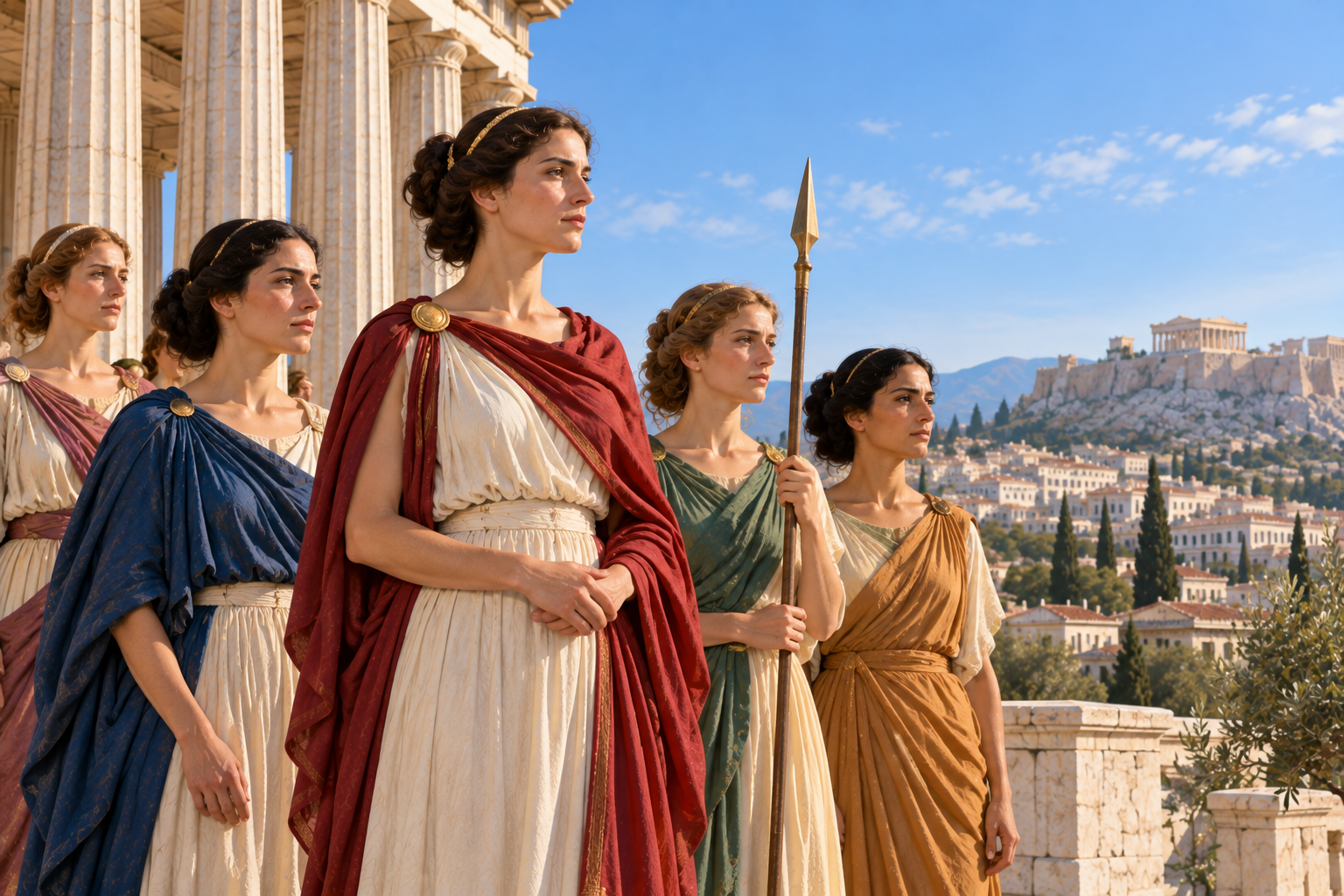
Lysistrata calls together women from Athens and other Greek cities, including Sparta. She proposes that they refuse sexual intimacy until their husbands agree to make peace. Although some women hesitate, they swear to support the plan. At the same time, older women occupy the Acropolis, where Athens keeps its public funds, to prevent money from being used for war.
A group of old men tries to remove the women, but the women stand their ground. When a magistrate arrives, Lysistrata challenges the assumption that only men can manage the city. She argues that women know how to organize complicated affairs and can apply that knowledge to public problems. Keeping the protest together proves difficult: some participants are tempted to return home. Myrrhine, however, refuses the pleas of her husband Cinesias, turning his frustration into an extended comic scene. Eventually, representatives of Athens and Sparta come to negotiate. Lysistrata urges them to end their conflict, and the play closes with reconciliation and celebration.
Meet the Characters
Lysistrata — The organizer who brings women from opposing cities together and insists on peace.
Calonice — An Athenian woman whose doubts and jokes help establish the play’s comic tone.
Lampito — A Spartan woman who joins the plan, showing that cooperation can cross enemy lines.
Myrrhine — A participant who refuses to give in when her husband asks her to come home.
Cinesias — Myrrhine’s husband, whose frustration becomes a comic example of the protest’s effects.
The Magistrate — A public official who objects to women taking political action.
The Choruses of Old Men and Old Women — Groups whose rivalry turns the struggle over the Acropolis into a lively theatrical contest.
Important Ideas
Peace and the cost of war — The fighting affects families and communities, not just armies.
Working together — Women from enemy cities must cooperate to make their protest effective.
Who gets to govern? — Lysistrata challenges the idea that political judgment belongs only to men.
Money and power — By holding the treasury, the women interfere with the resources needed to continue the war.
Comedy and contradiction — The play gives women political intelligence while also making jokes based on stereotypes about them.
A Literary Feature: Comic Reversal
A comic reversal turns an expected arrangement upside down. In Lysistrata, women take control of decisions normally made by men, and a government official finds himself unable to command them. The reversal creates laughter, but it also allows the audience to imagine a different distribution of power. Ask whether the play takes that possibility seriously, treats it as a joke, or does both at once.
What to Notice While Reading
Notice why Lysistrata needs allies from both Athens and Sparta. Watch how difficult it is for her to persuade the women to join the protest and remain committed. Pay attention to the two parts of the plan: refusing intimacy and controlling public money. When Lysistrata argues with the magistrate, identify the examples she uses to defend women’s judgment. Finally, consider whether the ending solves the causes of the war or simply gives the comedy a joyful conclusion.
Questions to Think About
- Why does Lysistrata invite women from cities that are fighting one another?
- Why do the women occupy the Acropolis as well as refuse sexual intimacy?
- What objections do the women raise when Lysistrata first proposes her plan?
- How does the confrontation with the magistrate challenge ideas about political authority?
- What makes the scene between Myrrhine and Cinesias comic?
- Does the play challenge stereotypes about women, repeat them, or both?
- How convincing is the peace agreement at the end of the play?
Try This
Imagine you are a citizen of Athens who has just heard about the women’s occupation of the Acropolis. Write a short public speech either supporting or opposing their actions. Explain your position using at least two events or arguments from the play. Then add one sentence describing what someone on the other side might say in response.
A Final Thought
Lysistrata uses an unlikely scheme to ask a serious question: when war continues despite its terrible costs, who has the right to demand change? Its jokes may feel very different to modern readers, but its concerns about peace, leadership, cooperation, and political power remain worth discussing. A thoughtful reading can recognize both the play’s imaginative challenge to authority and the limitations of its assumptions about gender.
Note to the Reader
This guide accompanies the Richer Resources Publications edition of Aristophanes’ Lysistrata, translated by Ian Johnston. The play contains explicit sexual humor and situations that may require classroom discussion. A printable PDF version of this guide is available for classroom use.