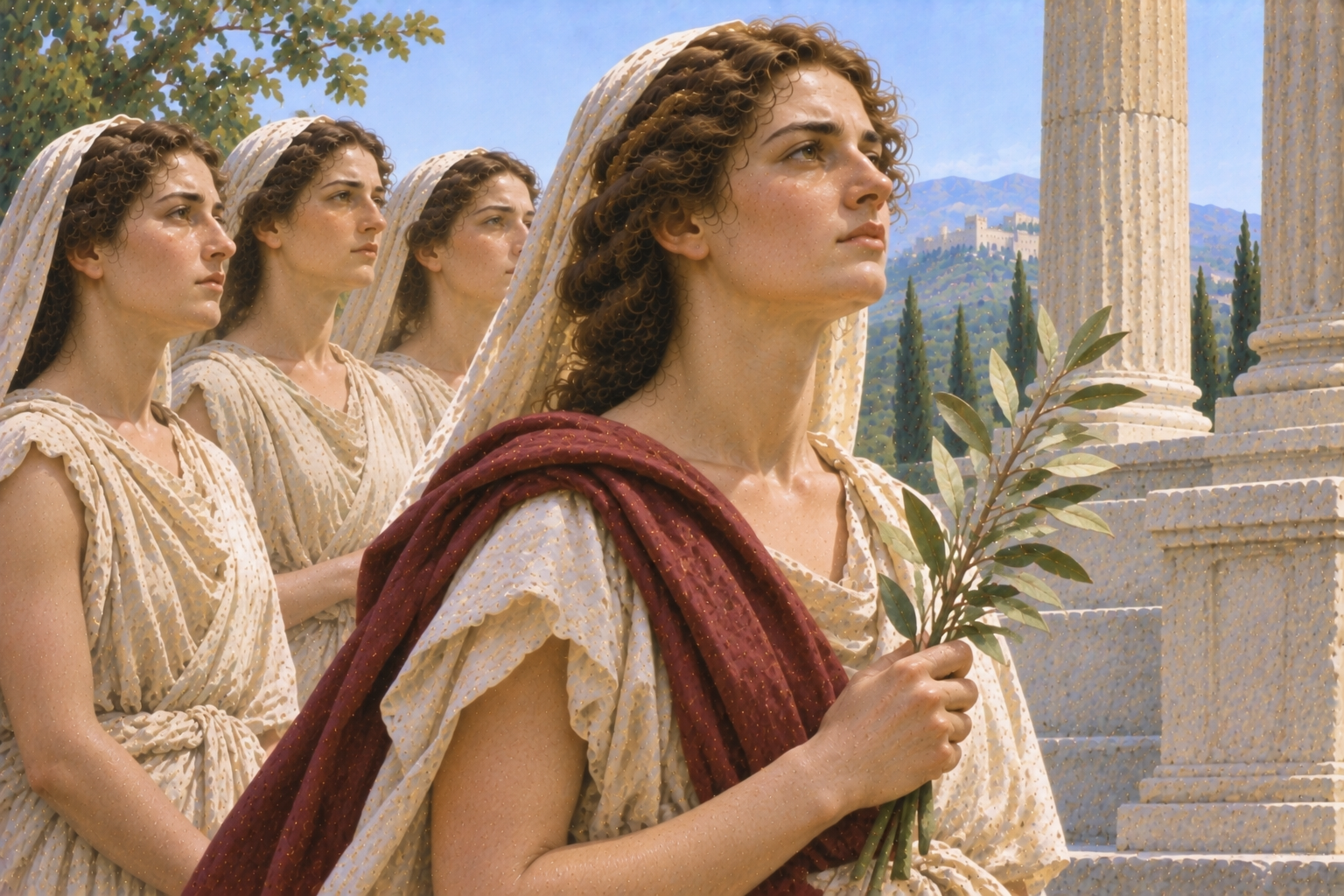
The Language of Supplication and the Drama of Protection
In Suppliant Women, Aeschylus creates dramatic tension through prayers, arguments, threats, and appeals to divine authority. The central conflict unfolds largely through speech rather than physical action. By examining the play's language and dramatic techniques, students can better understand how the Danaids' request for sanctuary becomes a test of religious duty and political responsibility.
The Chorus as a Collective Protagonist
The Danaids form the Chorus, but they are also the central figures of the drama. Their opening prayers establish the danger they face and the protection they seek.
Their collective speech gives the sisters a powerful shared identity. Through repeated appeals, expressions of fear, and invocations of the gods, Aeschylus places their experience at the center of the audience's attention.
Close-reading task: Examine an early choral passage. How do the Danaids combine expressions of vulnerability with demands for recognition and protection?
Repetition and Appeals to Zeus
The Danaids repeatedly invoke Zeus, particularly in connection with their ancestry and their status as suppliants.
Repetition reinforces the seriousness of their appeal. Their prayers remind both the audience and Pelasgus that the question of sanctuary involves divine obligations as well as human decisions.
The recurring invocations also connect the sisters' immediate danger with the earlier suffering of Io.
Close-reading task: Identify two references to Zeus. What does each reference emphasize, and how does the repetition strengthen the women's argument?
The Symbolism of Branches and Altars
The Danaids carry supplication branches and gather at sacred altars. These objects communicate their religious status before their full circumstances are explained.
The branches symbolize an appeal for protection, while the altars establish a sacred setting in which violence against the women would have particular significance.
Their visible presence helps transform a private family conflict into a public religious and political question.
Contrasting Voices: The Danaids and Pelasgus
The Danaids speak urgently because their personal safety is at stake. Pelasgus responds cautiously because he must consider the consequences for Argos.
Their exchanges create dramatic tension through contrasting perspectives. The women emphasize the obligation to protect them; the king considers the possibility of war and the responsibilities of leadership.
Neither perspective can simply be dismissed without weakening the moral complexity of the play.
Close-reading task: Compare a speech by the Danaids with a response from Pelasgus. How do their vocabulary, tone, and priorities differ?
The Egyptian Herald and the Language of Coercion
When the Egyptian herald arrives, his threats sharply contrast with the Danaids' appeals for sanctuary.
The herald's language expresses an intention to compel obedience. Pelasgus' intervention brings the competing claims of force and protection into direct confrontation.
This change in tone makes the danger immediate and tests whether the promise of sanctuary will be upheld.
Dramatic Suspense Without Visible Battle
Much of the play's suspense arises from uncertainty about decisions and their consequences.
The audience waits to learn whether Pelasgus will grant protection, whether the Argive citizens will support him, and whether the Egyptian pursuers will succeed in reclaiming the women.
Aeschylus makes deliberation and confrontation dramatic events in their own right.
The result is a tragedy in which words, promises, and public decisions carry as much weight as physical action.
Mythological Allusion and the Story of Io
References to Io connect the Danaids to Argos and place their present suffering within a larger family history.
These allusions strengthen the sisters' claim of belonging while reminding the audience of divine power, displacement, and inherited conflict.
Students should distinguish the function of these references within the play from the details of the wider mythological tradition.
Questions for Literary Analysis
- How does the Chorus' central role distinguish Suppliant Women from tragedies in which the Chorus primarily observes?
- What dramatic effect results from the repeated invocations of Zeus?
- How do the branches and sacred altars communicate meaning without extensive explanation?
- How does Pelasgus' language differ from that of the Danaids?
- What changes when the Egyptian herald enters and begins threatening the women?
- How does Aeschylus create suspense through decisions and speeches rather than visible combat?
- How do references to Io strengthen the Danaids' appeal to Argos?
Note to the Educator
Encourage students to move beyond identifying literary devices and explain how those devices shape the audience's understanding of the conflict. Comparing the Danaids' prayers, Pelasgus' deliberations, and the herald's threats provides a useful exercise in analyzing tone, characterization, and competing forms of authority.
Because the Danaids speak collectively, students may also examine how choral repetition and shared language create a dramatic protagonist without relying upon a single individual.
This guide accompanies the Richer Resources Publications edition of Suppliant Women, translated by Ian Johnston.
A printable PDF version of this resource is available by email.