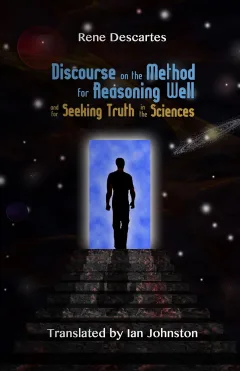
René Descartes — Discourse on the Method
A Student’s Guide
About This Guide
How can we tell whether something is true? René Descartes asks readers to question familiar assumptions and to think carefully about how knowledge is established. This guide will help you follow his six-part account of his education, his method, and his search for a dependable starting point.
Before You Read
Descartes was a seventeenth-century French philosopher and mathematician. His Discourse on the Method appeared in 1637, alongside essays about scientific subjects. It is partly the story of his intellectual development and partly a proposal for conducting investigations.
The work does not ask you to doubt everything forever. Descartes uses doubt as a tool: he hopes that questioning uncertain beliefs will help him find something secure.
The Six Parts at a Glance
Part I: Descartes reflects on his education and the limits of what he learned from books and authorities.
Part II: He offers four rules for thinking clearly and solving problems.
Part III: He proposes temporary rules for living while he reexamines his beliefs.
Part IV: He doubts familiar claims and discovers that his own thinking cannot be denied while he thinks. He then develops further arguments about truth and God.
Part V: He describes ideas about the natural world and living bodies.
Part VI: He considers the practical value of scientific inquiry and why discoveries should be shared.
Important Ideas
- Methodical doubt — Deliberately questioning beliefs that might be mistaken, in search of stronger foundations.
- The four rules — Accept only what is clear; divide difficulties into parts; proceed from simple to complex; review thoroughly so nothing is overlooked.
- The thinking self — Even when he doubts, Descartes cannot deny that he is thinking and therefore exists as a thinker.
- Provisional morality — Descartes believes people still need to make practical decisions while pursuing philosophical certainty.
- Reason and science — He hopes careful reasoning, mathematics, and investigation can improve knowledge of nature and human life.
A Literary Feature: A Philosopher Tells His Story
Rather than simply presenting a list of conclusions, Descartes tells readers how he reached them. Notice how he sometimes sounds modest and personal, while at other moments he makes sweeping claims about knowledge. Ask yourself whether this storytelling style makes his argument more convincing.
What to Notice While Reading
- Where does Descartes question the authority of teachers, books, or custom?
- Which of the four rules could help you with a difficult school assignment?
- When does Descartes move from describing his experience to making a claim about everyone’s ability to reason?
- Which steps in Part IV are certain, and which require additional argument?
Questions to Think About
- Why might someone deliberately doubt beliefs they have always accepted?
- What is the advantage of dividing a difficult problem into smaller parts?
- Why does Descartes need rules for everyday behavior while he questions his beliefs?
- Does knowing that you are thinking prove that the world around you exists? Why or why not?
- What is the difference between trusting an authority and evaluating a reason?
- Can Descartes’ method help with scientific questions, moral choices, or both?
Try This
Choose a claim you encounter in daily life, such as a product advertisement or a social-media assertion. Apply Descartes’ four rules: identify what you can establish clearly, divide the question into smaller parts, examine the simplest evidence first, and review your conclusion for gaps.
Write a short reflection on what the method helped you discover—and what it could not settle.
A Final Thought
Descartes’ most enduring challenge is not that you must accept every conclusion he reaches. It is that you should ask what justifies your confidence in what you believe.
Note to the Reader
This guide accompanies Ian Johnston’s translation of Discourse on the Method for Reasoning Well and for Seeking Truth in the Sciences, published by Richer Resources Publications. Use the guide alongside the text, not in place of it.