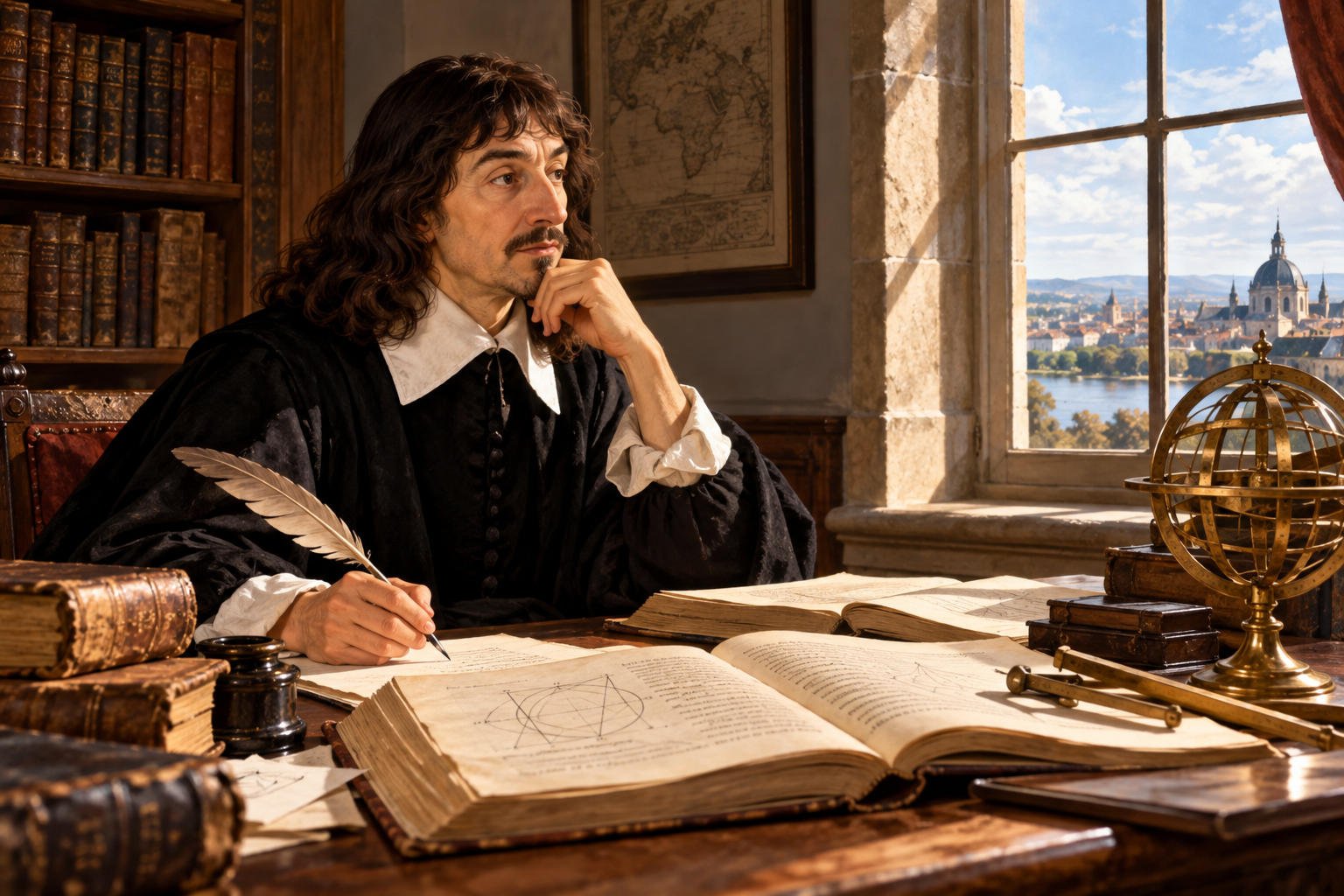
René Descartes — Discourse on the Method
A Teacher’s Guide
Purpose of This Guide
This guide introduces René Descartes’ Discourse on the Method as an intellectual autobiography and an argument for disciplined inquiry. Students should learn to identify the rules of method, explain the role of doubt, and distinguish Descartes’ claims about knowledge from his historical account of scientific investigation.
Historical and Literary Context
First published in French in 1637, the Discourse accompanied three scientific essays on optics, meteorology, and geometry. Descartes writes against the background of scholastic learning and the emerging mathematical sciences. His choice of a first-person narrative and a vernacular language invites readers to assess his reasoning rather than simply defer to established authorities.
The Six Parts at a Glance
Part I describes Descartes’ education and dissatisfaction with inherited learning. Part II sets out four rules for conducting inquiry. Part III presents a provisional morality to guide conduct while beliefs are being examined. Part IV develops radical doubt and the certainty of the thinking self, then advances arguments concerning God and truth. Part V sketches physical explanations and distinguishes human reason from animal mechanisms. Part VI considers scientific research, practical usefulness, and the sharing of discoveries.
Central Concepts
Methodical doubt: withholding assent from claims that can reasonably be questioned as a route to firmer knowledge.
Clear and distinct perception: a proposed standard for recognizing truth, developed within Descartes’ wider argument.
The thinking self: the realization that doubting or thinking confirms the thinker’s existence.
Analysis and order: breaking difficult problems into parts and proceeding from simpler to more complex questions.
Provisional morality: practical rules for living while theoretical investigation continues.
Major Themes
- The limits of education and authority.
- The promise and difficulty of a universal method.
- The relation between personal experience and philosophical argument.
- The search for certainty amid uncertainty.
- The ambition to improve human life through systematic scientific knowledge.
Rhetorical and Philosophical Techniques
Autobiographical framing makes philosophical claims part of a narrated journey. The four rules provide a memorable procedural structure. Thought experiments about dreams and deception test assumptions. Mathematical examples serve as models of ordered reasoning. The work shifts between modest disclaimers and ambitious claims; students should attend to that tension.
Teaching Objectives
Students will summarize the six parts and explain their progression. Students will state and apply the four rules of method. Students will distinguish skepticism used as a method from permanent rejection of knowledge. Students will reconstruct the reasoning behind the thinking self’s certainty. Students will assess the relationship between Descartes’ scientific ambitions and his philosophical foundations.
A Flexible Teaching Sequence
- Ask students what makes a belief trustworthy and how they respond to conflicting authorities.
- Read Parts I–II and have groups apply the four rules to an unfamiliar problem.
- Examine Part III: why does Descartes need practical guidance before completing his inquiry?
- Read Part IV slowly, identifying each step from doubt to the thinking self and then to wider claims.
- Use Parts V–VI to connect philosophical method with scientific practice and public communication.
- Return to the question of whether the Discourse offers a method everyone can use.
Passages Worth Close Reading
The critique of schooling in Part I: what does Descartes value and reject? The four rules in Part II: are they sufficiently precise to guide inquiry? The provisional moral code in Part III: what happens when certainty is unavailable? The account of the thinking self in Part IV: what exactly is established? The defense of publishing research in Part VI: what obligations accompany knowledge?
Core Discussion Questions
- Why does Descartes present his method as a personal story rather than a set of abstract propositions?
- What is gained—and what may be lost—by breaking a complex problem into smaller parts?
- Is doubt a practical starting point for every kind of inquiry?
- Does the certainty of thinking establish anything about the external world?
- How do provisional rules for living fit with the pursuit of indubitable knowledge?
- What does Descartes expect science to accomplish for society?
Classroom Approach
Have students create an argument map of Part IV, marking premises, conclusions, and transitions that require further defense. In a separate exercise, give groups a historical or contemporary research question and ask them to apply the four rules. Encourage students to evaluate the usefulness of the rules without assuming that Descartes’ account is identical to modern scientific method.
Interpretive Cautions
Do not reduce Descartes’ argument to the slogan “I think, therefore I am” without examining the reasoning around it. Distinguish the Discourse from the later, more elaborate Meditations. Avoid presenting methodical doubt as an invitation to reject evidence indiscriminately. His scientific claims, especially concerning living bodies, belong to a seventeenth-century context and should not be mistaken for current consensus.
Note to the Educator
The Discourse rewards a slow reading of its changes in voice: personal recollection, methodological advice, metaphysical argument, and scientific ambition. The central teaching question is not merely whether Descartes is right, but how he attempts to earn a reader’s confidence in the power of reason.