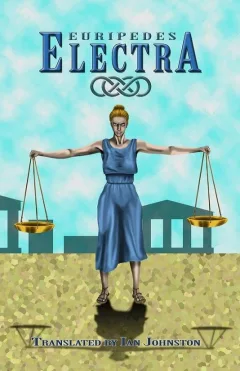
Debating Justice and Responsibility in Electra
About This Resource
Euripides’ Electra invites readers to question whether revenge can repair injustice and whether obedience to family or divine authority can excuse violence. These discussion questions and writing assignments help students move beyond plot summary toward interpretation supported by the text.
The questions may be used for small-group discussion, seminars, individual reflection, or formal essays.
Part I — Character and Motivation
- How does Electra's removal from the royal household influence her view of herself and her family?
- In what ways do Electra and Orestes differ in their attitudes toward revenge?
- How does the farmer's conduct challenge assumptions about nobility and social status?
- Does Clytemnestra offer a convincing explanation for Agamemnon's murder? Why or why not?
- What role does Pylades play in Orestes' return and subsequent actions?
Part II — Justice, Revenge, and Moral Responsibility
- Is the siblings' desire for revenge understandable, justifiable, or both? What is the difference?
- Does Aegisthus' death change the moral situation before Clytemnestra is killed?
- Can a person be responsible for an action carried out under a divine command?
- Does the siblings' remorse suggest that their revenge was wrong, or simply that it was painful?
- Could the cycle of violence have ended differently? Consider what choices were available to the characters.
Part III — Dramatic Technique and Interpretation
- Why does Euripides allow Electra to question conventional signs of recognition?
- How does the messenger's account of Aegisthus' death shape the audience's response?
- What is the dramatic importance of the debate between Electra and Clytemnestra?
- Why might Euripides place so much of the action outside a humble rural dwelling?
- Does the appearance of Castor and Polydeuces provide a satisfying conclusion? Explain.
Part IV — Debate Topics
Debate A: Was the revenge justified?
One group argues that Electra and Orestes fulfilled an obligation to their murdered father. The opposing group argues that their actions continued the family's destructive history.
Debate B: Who demonstrates true nobility?
Compare Electra's husband with the royal characters. Consider whether inherited rank, moral conduct, or both should define nobility.
Debate C: Does divine authority remove personal responsibility?
Examine Orestes' understanding of Apollo's command alongside the suffering and judgment that follow the murders.
For each debate, require participants to acknowledge at least one strong argument from the opposing position.
Part V — Analytical Essay Prompts
Essay 1: Revenge and Justice
Does Euripides present revenge as a form of justice or as a continuation of wrongdoing? Develop an argument using the planning, execution, and aftermath of the murders.
Essay 2: Electra's Character
Analyze Electra as both a victim of injustice and an active participant in violence. How does Euripides complicate the audience's sympathy for her?
Essay 3: Mothers, Fathers, and Conflicting Duties
Explore how Agamemnon's sacrifice of Iphigenia and Clytemnestra's murder of Agamemnon create incompatible obligations for Electra and Orestes.
Essay 4: The Meaning of Nobility
Discuss the significance of Electra's husband. How does his characterization challenge the values associated with wealth, power, and royal birth?
Essay 5: The Ending of the Tragedy
Analyze the appearance of Castor and Polydeuces. Does their intervention resolve the conflict, expose its contradictions, or do both?
Essay 6: Comparing Tragic Interpretations
Compare Euripides' treatment of the revenge story with its treatment in Aeschylus' Oresteia or Sophocles' Electra. Focus on one major difference in characterization, dramatic structure, or moral emphasis.
Guidelines for Analytical Writing
A strong response should:
- Present a clear, arguable interpretation rather than simply retelling the plot.
- Support claims with specific scenes, speeches, or actions.
- Explain how the evidence supports the interpretation.
- Consider at least one competing viewpoint.
- Conclude by showing what the argument reveals about the tragedy as a whole.
Classroom Activity: A Council of Judgment
Assign students the roles of Electra, Orestes, Clytemnestra, Electra's husband, and an independent judge.
Each participant prepares a brief statement addressing whether the revenge was justified. The judge then summarizes the strongest arguments and explains which moral questions remain unresolved.
Students should distinguish between what a character believes and what the play as a whole may be asking its audience to consider.
Note to the Educator
These prompts are designed to support multiple defensible interpretations. Encourage students to engage with conflicting evidence and avoid treating a character's stated motives as automatically equivalent to the playwright's judgment.
A printable PDF version of this resource is available by email.