Understanding the Characters and Conflicting Loyalties in Hippolytus
About This Guide
Euripides’ Hippolytus tells the story of a royal family destroyed by desire, secrecy, false accusation, and divine anger. The tragedy begins with Aphrodite's determination to punish Hippolytus, whose exclusive devotion to Artemis leads him to reject her.
This guide introduces the principal characters and examines how their relationships shape the events of the play.
Principal Characters
Hippolytus — Son of Theseus and an Amazon woman, commonly identified as Hippolyta or Antiope in mythological traditions. He is devoted to Artemis, hunting, and chastity. His contempt for Aphrodite and sexual desire contributes to the divine conflict that destroys him.
Phaedra — Wife of Theseus and stepmother of Hippolytus. Aphrodite causes her to develop a forbidden passion for her stepson. Phaedra struggles to preserve her honor while resisting feelings she regards as shameful.
Theseus — King of Athens, father of Hippolytus, and husband of Phaedra. After discovering Phaedra's accusation, he condemns his son without fully investigating the circumstances.
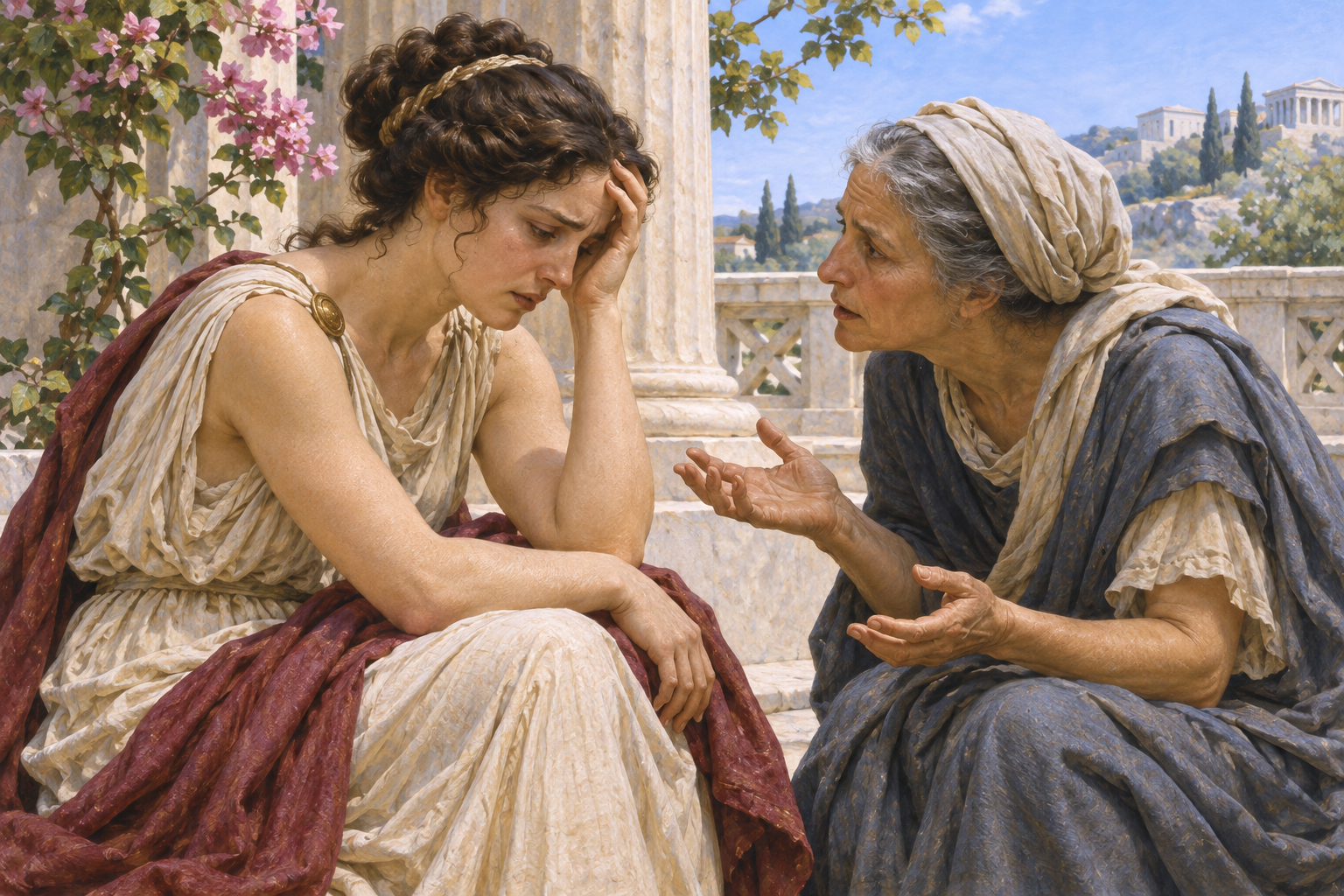
The Nurse — Phaedra's elderly attendant and confidante. She wishes to relieve her mistress's suffering but makes a disastrous decision when she reveals Phaedra's secret to Hippolytus.
Aphrodite — Goddess of love and sexual desire. Angered by Hippolytus' refusal to honor her, she initiates the events that lead to his destruction.
Artemis — Goddess of hunting and chastity, revered by Hippolytus. She appears near the conclusion and reveals the truth to Theseus.
The Chorus — Women of Troezen who respond to Phaedra's suffering and the unfolding tragedy. Their songs and observations provide emotional and moral perspective.
The Servant — An attendant who warns Hippolytus against neglecting Aphrodite. His advice introduces the importance of respecting divine powers.
The Messenger — Reports the catastrophe involving Hippolytus' horses and chariot, allowing the audience to learn of the offstage disaster.
Family Relationships
- Theseus and Hippolytus: Father and son, divided by a false accusation and a failure of trust.
- Theseus and Phaedra: Husband and wife, whose marriage is destroyed by secrecy and misunderstanding.
- Phaedra and Hippolytus: Stepmother and stepson, connected through a forbidden passion imposed by Aphrodite.
- Phaedra and the Nurse: Mistress and attendant, bound by affection and confidence but separated by differing judgments about how to respond to suffering.
Divine Relationships and Conflicts
Hippolytus and Artemis: Hippolytus honors Artemis through chastity and devotion to hunting. Their bond represents his chosen way of life.
Hippolytus and Aphrodite: His rejection of Aphrodite becomes the source of divine retaliation.
Aphrodite and Artemis: The goddesses represent different powers within human life. Their conflict exposes the danger of honoring one divine principle while rejecting another.
Character Analysis: Four Central Conflicts
1. Desire and Self-Control
Phaedra attempts to resist a passion she did not choose. Her struggle raises questions about the difference between experiencing a feeling and acting upon it.
2. Honor and Reputation
Both Phaedra and Hippolytus are deeply concerned with honor, yet their understanding of honorable conduct differs. Their choices show how the desire to preserve reputation can contribute to tragedy.
3. Loyalty and Judgment
The Nurse acts out of concern for Phaedra but violates her confidence. Theseus acts to defend his wife's honor but fails to hear his son's defense fairly.
4. Divine Power and Human Responsibility
Aphrodite initiates the catastrophe, but human decisions shape its course. The play asks how responsibility should be understood when divine influence and personal choice overlap.
Questions for Character Analysis
- How does Hippolytus' devotion to Artemis shape his treatment of others?
- Why does Phaedra fear the discovery of her feelings?
- Is the Nurse motivated by compassion, poor judgment, or both?
- What assumptions lead Theseus to condemn his son?
- How does Artemis' final appearance change our understanding of the characters?
Classroom Activity: Mapping Conflicting Loyalties
Ask students to create a relationship diagram placing Hippolytus, Phaedra, and Theseus at its center.
Connect the Nurse, Aphrodite, and Artemis to the principal characters. Label each connection with a form of loyalty, obligation, desire, or conflict.
Students should then identify three moments when a character's attempt to fulfill one obligation leads to the violation of another.
Note to the Educator
Encourage students to distinguish between feelings, intentions, actions, and consequences. This distinction is especially useful when examining Phaedra's suffering, the Nurse's intervention, Hippolytus' inflexibility, and Theseus' judgment.
Reading the Play
A printable PDF version of this resource is available by email.