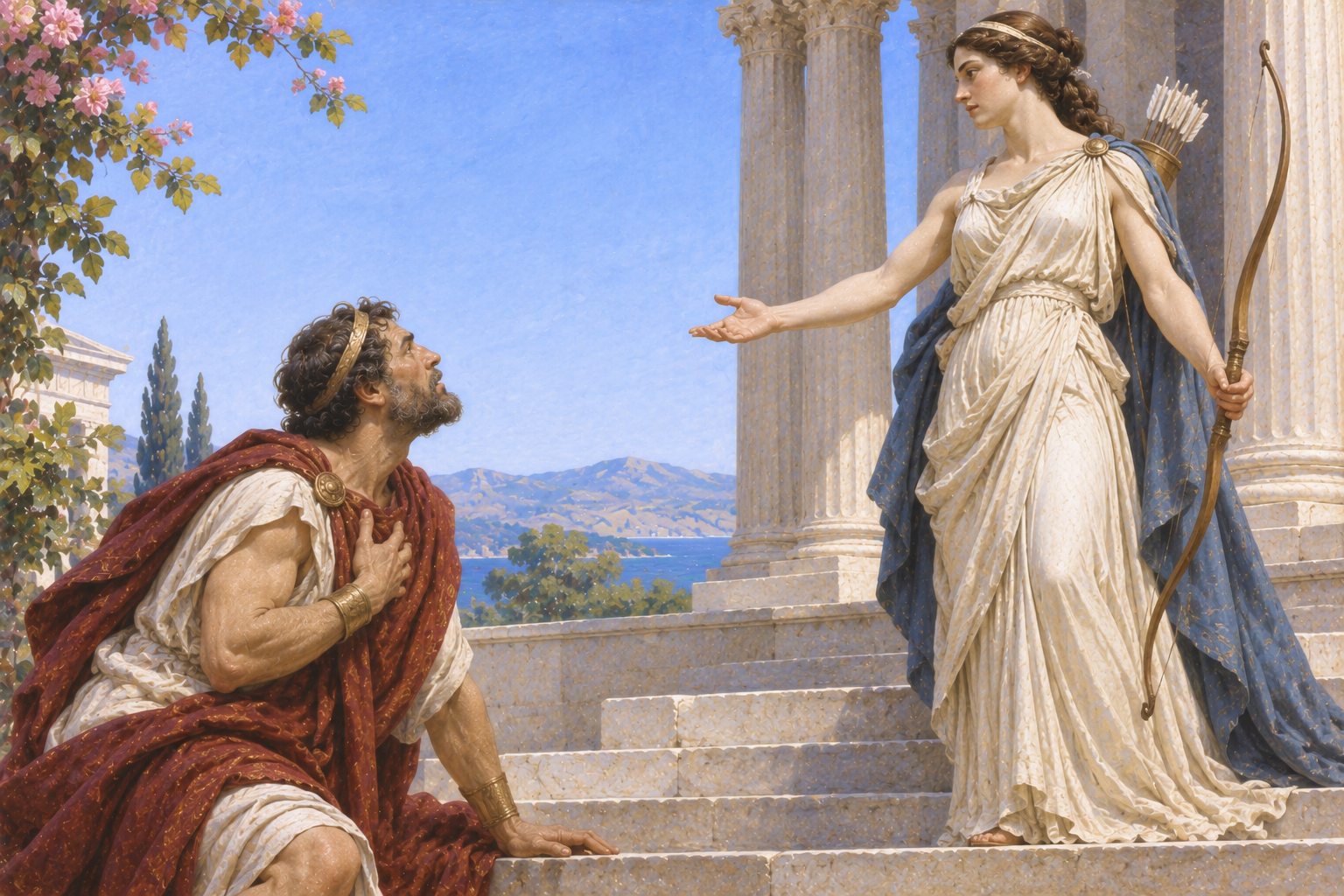
Debating Honor, Justice, and Responsibility in Hippolytus
About This Resource
Euripides’ Hippolytus invites readers to examine how divine intervention, private suffering, and human decisions combine to produce tragedy. The play raises difficult questions about desire, secrecy, reputation, pride, and the responsibility of those who act without complete knowledge.
These questions and writing assignments encourage students to develop interpretations supported by the text rather than rely on simple judgments of right and wrong.
Part I — Character and Motivation
- Why does Hippolytus reject Aphrodite's influence, and what does this reveal about his character?
- How does Phaedra attempt to preserve her honor while struggling with feelings she has not chosen?
- Is the Nurse's decision to reveal Phaedra's secret an act of compassion, poor judgment, or both?
- What assumptions lead Theseus to believe the accusation against Hippolytus?
- How does Hippolytus' devotion to Artemis influence his relationships with other people?
Part II — Justice, Responsibility, and Divine Power
- Is Aphrodite's punishment proportionate to Hippolytus' offense?
- To what extent should Phaedra be held responsible for the suffering that follows her accusation?
- Does the Nurse's intention to help excuse the consequences of her intervention?
- Is Theseus responsible for his son's death even though he believes he is defending an innocent wife?
- How does Artemis' final revelation change the audience's understanding of divine justice?
Part III — Dramatic Technique and Interpretation
- What is the effect of revealing Aphrodite's plan before the human characters understand what is happening?
- How does Hippolytus' oath of silence contribute to the tragedy?
- Why is Phaedra's written accusation such an important dramatic device?
- How does the messenger's description of the chariot accident shape the audience's response?
- Does the final reconciliation between Theseus and Hippolytus offer a satisfying conclusion? Explain.
Part IV — Debate Topics
Debate A: Who bears the greatest responsibility for the tragedy?
One group argues that Aphrodite's deliberate punishment is the primary cause. Another argues that the human characters' choices make them responsible for the outcome.
Debate B: Is Hippolytus admirable or dangerously inflexible?
Consider his devotion to Artemis, rejection of Aphrodite, treatment of women, and adherence to his oath.
Debate C: Does protecting reputation justify concealing the truth?
Examine Phaedra's concern for honor, Hippolytus' silence, and Theseus' reliance on the written accusation.
Each group should acknowledge at least one substantial argument from the opposing position.
Part V — Analytical Essay Prompts
Essay 1: Divine Power and Human Responsibility
Analyze the relationship between Aphrodite's plan and the decisions made by Phaedra, the Nurse, Hippolytus, and Theseus. Does divine influence reduce human responsibility?
Essay 2: The Tragedy of Phaedra
Discuss Phaedra as a character who suffers from an unwanted passion but also makes choices that harm others. How does Euripides shape the audience's sympathy and judgment?
Essay 3: Hippolytus and the Limits of Virtue
Examine whether Hippolytus' commitment to chastity represents moral strength, excessive pride, or a combination of both.
Essay 4: Reputation, Shame, and Silence
Explore how concern for reputation and the withholding of information contribute to the tragedy. Consider the actions of at least three characters.
Essay 5: Theseus and the Failure of Judgment
Analyze Theseus' response to Phaedra's accusation. What does the play suggest about the dangers of certainty without sufficient evidence?
Essay 6: Tragic Recognition and Forgiveness
Discuss the final meeting between Theseus and Hippolytus. Does forgiveness provide meaningful resolution when the consequences of injustice cannot be undone?
Guidelines for Analytical Writing
A strong response should:
- Present a clear interpretation rather than simply summarize the plot.
- Support its claims with specific speeches, scenes, or actions.
- Explain how the evidence supports the argument.
- Consider at least one reasonable alternative interpretation.
- Conclude by showing what the analysis reveals about the tragedy.
Classroom Activity: A Council of Judgment
Assign students the roles of Aphrodite, Phaedra, the Nurse, Hippolytus, Theseus, and an independent judge.
Each participant prepares a short statement explaining their character's motives, actions, and degree of responsibility.
The judge then summarizes the strongest arguments and proposes a reasoned judgment.
Conclude by discussing whether a single character can be held chiefly responsible for a tragedy shaped by both divine power and human choice.
Note to the Educator
These prompts are intended to support multiple defensible interpretations. Encourage students to distinguish intentions from consequences, personal responsibility from divine influence, and the audience's knowledge from the characters' understanding.
Reading the Play
A printable PDF version of this resource is available by email.