Gods, Heroes, and Family History: The Myth Behind Hippolytus
About This Guide
Euripides’ Hippolytus draws upon familiar Greek myths about heroic families, divine rivalries, and the dangerous consequences of offending the gods. Understanding these traditions helps readers recognize why the characters act as they do and how Euripides transforms inherited stories into a tragedy about desire, honor, and mistaken judgment.
1. Theseus: Hero, King, and Father
Theseus was among the most celebrated heroes of Greek mythology. He was associated with Athens and famous for defeating the Minotaur, a creature imprisoned in the labyrinth on Crete.
In many traditions, Theseus was the son of Aegeus, king of Athens, but Poseidon was also identified as his divine father. This connection with Poseidon becomes especially important in Hippolytus, because Theseus possesses the power to call upon the god to fulfill a curse.
Euripides presents Theseus not simply as a legendary hero but as a father whose certainty and anger lead him to condemn an innocent son.
2. Hippolytus and His Amazon Ancestry
Hippolytus is the son of Theseus and an Amazon woman, named Hippolyta or Antiope in different mythological accounts.
The Amazons were a legendary society of warrior women who appear in numerous Greek myths. Hippolytus’ maternal ancestry links him to a world associated with hunting, independence, and martial skill.
In the play, Hippolytus devotes himself to Artemis, goddess of hunting and chastity. He rejects sexual relationships and treats Aphrodite's sphere of influence with contempt.
His devotion is sincere, but Euripides asks whether such devotion becomes dangerous when it leads to disrespect for another divine power.
3. Phaedra and the Royal Family of Crete
Phaedra is the daughter of Minos, king of Crete, and Pasiphae. Her sister Ariadne helped Theseus escape the labyrinth after he killed the Minotaur.
These family connections place Phaedra within a network of myths involving Theseus, Crete, and extraordinary forms of desire.
Pasiphae's passion for a bull, associated in mythology with the birth of the Minotaur, provides a disturbing parallel to the unnatural passion Aphrodite imposes upon Phaedra.
Euripides emphasizes that Phaedra neither welcomes nor deliberately chooses her desire for Hippolytus. Her tragedy develops from her attempts to resist it and preserve her reputation.
4. Aphrodite and Artemis: Competing Divine Powers
Aphrodite governs love and sexual desire, while Artemis is associated with hunting, chastity, and the natural world.
At the beginning of the tragedy, Aphrodite announces that she will punish Hippolytus for refusing to honor her. She uses Phaedra's suffering as part of her plan.
Artemis, whom Hippolytus reveres, appears near the end and reveals the truth about his innocence.
The goddesses do not engage in a direct confrontation. Instead, their competing spheres of power shape the lives of the human characters.
The conflict suggests the danger of rejecting an important aspect of human experience in the belief that another ideal can be followed exclusively.
5. Poseidon and the Fatal Curse
Theseus has received a promise that Poseidon will fulfill three of his wishes or curses.
After discovering Phaedra's accusation against Hippolytus, Theseus calls upon Poseidon to destroy his son.
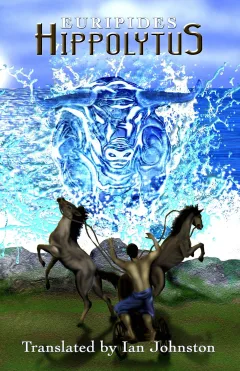
A monstrous bull rises from the sea and terrifies Hippolytus' horses, causing a catastrophic chariot accident.
Poseidon's involvement connects the hero's legendary divine ancestry to the destruction of his own family.
6. Troezen and the Setting of the Tragedy
The action of Hippolytus takes place at Troezen, a city in the northeastern Peloponnese associated with Theseus' family and upbringing.
The setting brings together the royal household, the worship of Artemis and Aphrodite, and the nearby coast where the chariot disaster occurs.
For ancient audiences, these locations would have belonged to a recognizable landscape of myth and religious tradition.
7. Myth and Euripides’ Dramatic Interpretation
Greek myths did not exist in a single fixed version. Poets and playwrights reshaped inherited stories to emphasize different characters and moral questions.
Euripides’ surviving Hippolytus is particularly concerned with Phaedra's efforts to resist her passion, the Nurse's intervention, Hippolytus' oath of silence, and Theseus' failure to investigate an accusation.
The playwright uses mythological material to examine human choices even when divine forces establish the conditions of the tragedy.
Family and Divine Connections at a Glance
- Theseus: Husband of Phaedra and father of Hippolytus; associated with both Aegeus and Poseidon.
- Hippolytus: Son of Theseus and an Amazon woman; devoted to Artemis.
- Phaedra: Wife of Theseus, stepmother of Hippolytus, and daughter of Minos and Pasiphae.
- Ariadne: Phaedra's sister, who helped Theseus escape the Cretan labyrinth.
- Aphrodite: Goddess who punishes Hippolytus by causing Phaedra's forbidden passion.
- Artemis: Goddess honored by Hippolytus, who reveals the truth near the conclusion.
- Poseidon: God of the sea who fulfills Theseus' fatal curse.
Questions for Discussion
- How does Theseus' heroic reputation contrast with his conduct as a father?
- Why is Hippolytus' Amazon ancestry relevant to his characterization?
- What connections exist between Phaedra's family history and her suffering?
- How do Aphrodite and Artemis represent different aspects of human experience?
- Why is Poseidon's relationship with Theseus especially significant to the ending?
Classroom Activity: A Mythological Family and Power Map
Ask students to construct two connected diagrams.
The first should show the family relationships linking Theseus, Hippolytus, Phaedra, Minos, Pasiphae, and Ariadne.
The second should identify the divine powers of Aphrodite, Artemis, and Poseidon, with arrows indicating how each influences the tragedy.
Students should then distinguish relationships and events explicitly established in the play from details supplied by the broader mythological tradition.
Note to the Educator
Remind students that Greek mythology contains differing accounts of family relationships and events. Encourage them to distinguish background traditions from the particular details Euripides uses in Hippolytus. This is especially important when discussing Theseus' parentage, Hippolytus' mother, and Phaedra's Cretan ancestry.
Reading the Play
A printable PDF version of this resource is available by email.