Divine Power and Human Choices in Hippolytus
About This Guide
Euripides’ Hippolytus presents a tragedy in which divine punishment, private suffering, and human mistakes combine to destroy a family. Although Aphrodite announces her plan at the beginning, the characters' decisions remain essential to the unfolding catastrophe.
This guide examines six major themes and provides questions for discussion and close reading.
1. Divine Power and Human Responsibility
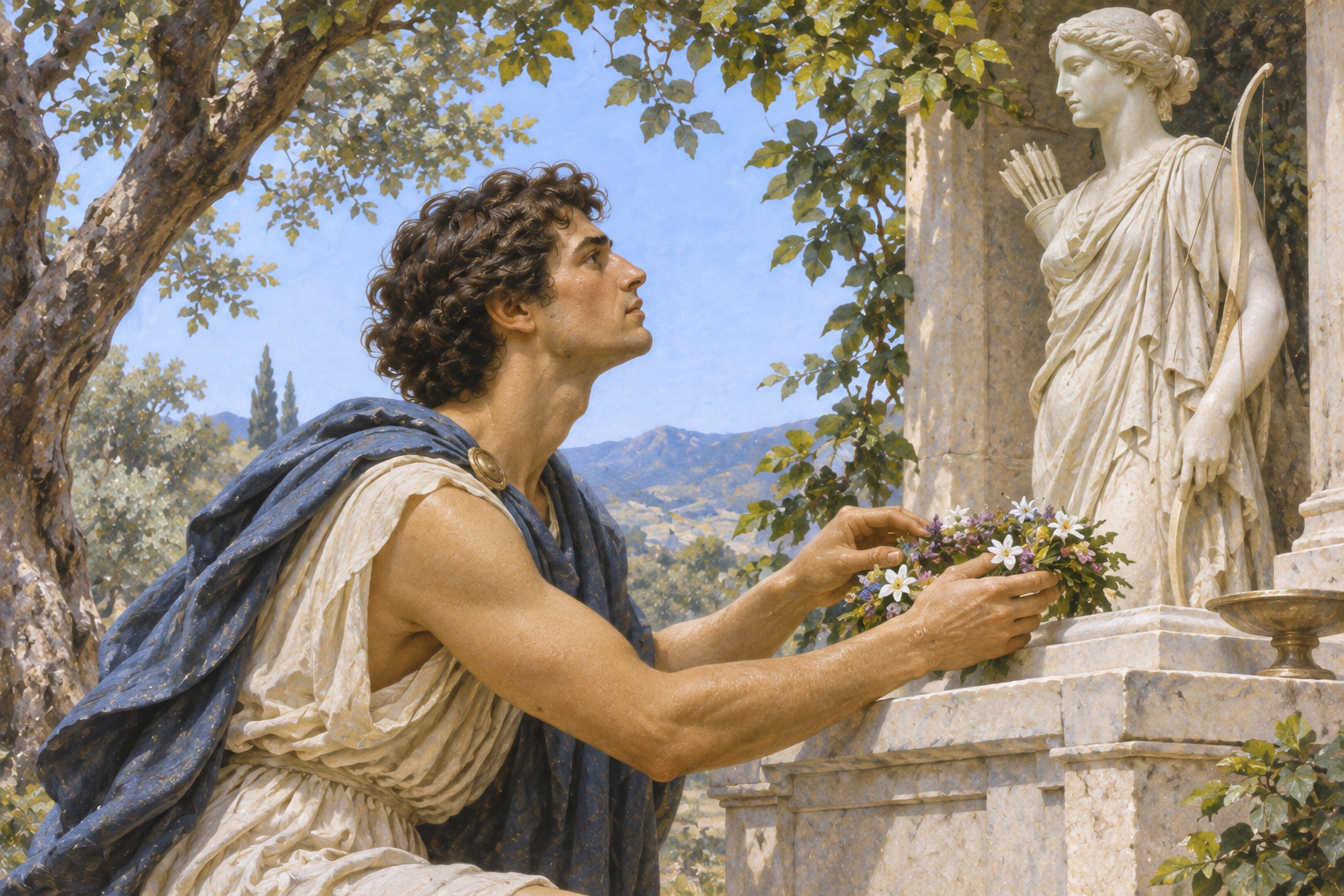
Aphrodite resolves to punish Hippolytus because he rejects her worship and honors Artemis above all other gods. She causes Phaedra to fall in love with her stepson, knowing that both will suffer.
The tragedy therefore begins with divine intervention, but its consequences depend on human actions: the Nurse reveals a secret, Phaedra makes a false accusation, and Theseus condemns his son.
Consider: If a goddess initiates the tragedy, how much responsibility remains with the human characters?
2. Desire and Self-Control
Phaedra experiences a passion she neither seeks nor welcomes. Her struggle reveals the difference between having an unwanted feeling and choosing how to respond to it.
Hippolytus represents the opposite extreme. His devotion to chastity becomes a rejection not only of sexual desire but also of Aphrodite's place in human life.
Euripides challenges both uncontrolled passion and an inflexible refusal to acknowledge it.
Consider: Does the play suggest that self-control requires understanding desire rather than denying its existence?
3. Honor, Shame, and Reputation
Phaedra fears that disclosure of her feelings will disgrace her and damage her children's future. Her concern for honor helps explain her silence and ultimately contributes to her destructive accusation.
Hippolytus also values his reputation for purity. Yet his insistence on his own innocence cannot save him once Theseus believes the accusation.
Consider: When does protecting one's reputation become more important than acting justly?
4. Secrecy, Speech, and Silence
The Nurse promises to help Phaedra but reveals her forbidden passion to Hippolytus. Hippolytus reacts with horror, yet remains bound by an oath not to disclose what he has learned.
Phaedra's written accusation then becomes a powerful form of speech after her death. Theseus accepts it without hearing the full story.
The tragedy shows how both speaking and remaining silent can have terrible consequences.
Consider: Which character's decision to speak—or remain silent—most changes the course of the play?
5. Pride and Inflexibility
Hippolytus' dedication to Artemis is sincere, but his contempt for Aphrodite and his harsh language about women reveal limitations in his judgment.
Theseus displays another form of inflexibility when he assumes that Phaedra's accusation must be true. His certainty prevents him from examining the evidence or listening fairly to his son.
Consider: How does confidence in one's own righteousness make it harder to recognize error?
6. Justice, Suffering, and Tragic Recognition
Theseus invokes a curse against Hippolytus, believing he is punishing a guilty son. The resulting catastrophe exposes the danger of acting on incomplete knowledge.
When Artemis reveals the truth, Theseus recognizes his mistake, but the recognition comes too late to prevent Hippolytus' death.
The ending offers reconciliation between father and son, yet it cannot undo their suffering.
Consider: Is recognition of the truth a form of justice when the consequences of error cannot be reversed?
Themes in Conversation
These themes are closely connected. Divine power creates the conditions for suffering; secrecy and shame obstruct understanding; pride encourages hasty judgment; and the desire to defend honor leads to injustice.
Euripides asks the audience to consider not only who causes the tragedy but also why the characters cannot prevent it.
Discussion Questions
- Does Aphrodite's punishment appear proportionate to Hippolytus' offense?
- How does Phaedra's concern for her reputation shape her decisions?
- Is the Nurse's intervention compassionate, irresponsible, or both?
- Why does Theseus accept the accusation against Hippolytus so quickly?
- What does the final meeting between Theseus and Hippolytus suggest about forgiveness?
Classroom Activity: A Chain of Decisions
Ask students to identify five decisions that contribute to the tragedy, beginning with Aphrodite's plan and ending with Theseus' curse.
For each decision, record the character's motive, the information available at the time, and the consequences.
Then discuss which decisions might reasonably have been different and whether any single change could have prevented the catastrophe.
Note to the Educator
Encourage students to distinguish divine causation from human responsibility and to separate a character's intentions from the consequences of an action. These distinctions are particularly useful when discussing Phaedra, the Nurse, Hippolytus, and Theseus.
Reading the Play
A printable PDF version of this resource is available by email.