Before Corinth: The Myths Behind Euripides’ Medea
About This Guide
Euripides’ Medea begins after a remarkable series of legendary adventures. Jason has obtained the Golden Fleece with Medea's help, and the couple has left her homeland and endured years of danger. Their shared history gives Medea's accusations of betrayal much of their force.
This guide introduces the myths that precede the tragedy and explains how Euripides uses familiar heroic stories to explore marriage, exile, loyalty, and revenge.
1. Jason and the Quest for the Golden Fleece
Jason belonged to the royal family of Iolcus in Thessaly. According to the mythological tradition, his uncle Pelias had taken power, and Jason was sent on a dangerous quest to obtain the Golden Fleece.
The fleece came from a marvelous golden ram and was kept in the distant kingdom of Colchis, near the eastern shore of the Black Sea.
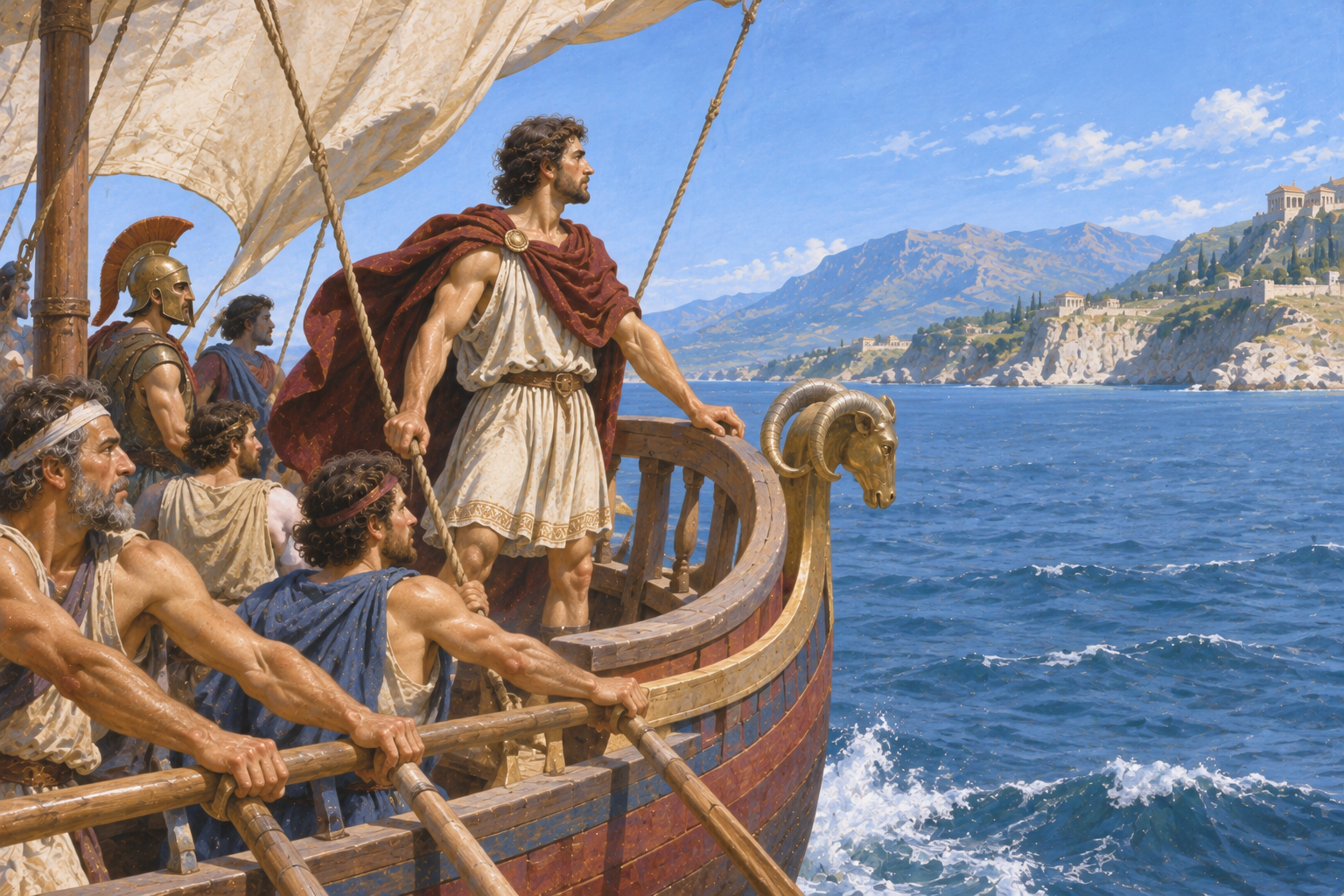
Jason assembled a company of heroes known as the Argonauts, named after their ship, the Argo. Their voyage became one of the great adventures of Greek mythology.
Connection to the play: Jason's heroic reputation rests partly upon a quest he could not have completed without Medea's assistance.
2. Medea: Princess of Colchis
Medea was the daughter of Aeëtes, king of Colchis. In the wider mythological tradition, she was associated with the divine ancestry of Helios, the sun god, and possessed extraordinary knowledge of drugs, herbs, and magical practices.
When Jason arrived in Colchis, Medea fell in love with him and helped him overcome the dangers set before him.
Her assistance came at enormous personal cost. She turned against her father's interests and eventually abandoned her homeland.
Connection to the play: Medea's foreign origins and separation from her family make Jason's abandonment especially devastating.
3. How Medea Helped Jason
King Aeëtes required Jason to perform seemingly impossible tasks before surrendering the Golden Fleece. In familiar versions of the myth, these included yoking fire-breathing bulls, sowing dragon's teeth, and overcoming armed warriors who sprang from the earth.
Medea supplied Jason with protective substances and instructions that allowed him to survive.
She also helped him obtain the fleece, which was guarded by a serpent or dragon.
Connection to the play: Medea repeatedly reminds Jason of the dangers she faced and the help she gave him. Their disagreement concerns not only his new marriage but also the meaning of their entire shared past.
4. Flight from Colchis and the Death of Medea's Brother
After obtaining the fleece, Jason and Medea fled Colchis. Their escape was associated with the death of Medea's brother, commonly named Apsyrtus.
Ancient accounts differ substantially. In some traditions Medea kills her brother during the flight; in others, the circumstances are different.
The Nurse's opening account in Euripides' play recalls Medea's violent break with her family.
Connection to the play: Medea's history includes acts of loyalty to Jason that also involve betrayal and violence against her own relatives.
5. The Death of Pelias
After returning to Greece, Medea became involved in the death of Pelias, Jason's uncle.
According to a well-known version of the myth, she persuaded Pelias' daughters that they could restore their father's youth by cutting him into pieces and boiling him. They followed her instructions, but Pelias died.
The consequences of this episode contributed to Jason and Medea's departure from Iolcus.
Connection to the play: Medea's earlier actions establish both her resourcefulness and the frightening possibilities of her anger and deception.
6. Corinth: The Setting of Euripides' Tragedy
Jason and Medea eventually settled in Corinth, where they had two sons.
By the opening of Euripides' play, Jason has arranged to marry the daughter of Creon, king of Corinth. This decision threatens Medea's marriage, security, and place within the community.
Creon's subsequent order of exile makes her situation even more precarious.
The tragedy begins at the moment when the partnership that made Jason's heroic success possible has broken apart.
7. Medea's Divine Ancestry and the Chariot of Helios
Medea's family was connected with Helios, the sun god, through her father Aeëtes.
At the conclusion of Euripides' tragedy, Medea appears in a chariot provided by Helios. From this elevated position, she confronts Jason and escapes his reach.
The chariot recalls Medea's extraordinary ancestry, but it does not provide a simple moral explanation or justification for her actions.
Connection to the play: The ending raises difficult questions about divine power, human responsibility, and the absence of conventional punishment.
8. Euripides and the Changing Mythological Tradition
Greek myths existed in multiple versions. Poets and playwrights adapted familiar stories for different audiences and purposes.
Euripides concentrates on Medea's betrayal by Jason, her vulnerable position as a foreign woman, her persuasive intelligence, and her terrible decision to murder their children.
The play should therefore be read as a particular dramatic treatment of the myth, not as the only ancient account of Medea's life.
Mythological Connections at a Glance
- Jason: Leader of the Argonauts and seeker of the Golden Fleece.
- Medea: Princess of Colchis who helps Jason and later becomes his wife.
- Aeëtes: King of Colchis and father of Medea.
- Helios: Sun god and Medea's divine ancestor.
- Pelias: Jason's uncle, whose death becomes part of Medea and Jason's earlier history.
- Apsyrtus: Medea's brother, whose death is associated with the flight from Colchis.
- Creon: King of Corinth, whose daughter's marriage to Jason precipitates the tragedy.
- Aegeus: King of Athens, who promises Medea refuge.
Questions for Discussion
- Why is Jason's success in obtaining the Golden Fleece inseparable from Medea's help?
- What has Medea sacrificed by leaving Colchis?
- How does her earlier history complicate the audience's response to her suffering?
- Why does Jason's decision to marry the Corinthian princess threaten Medea's position?
- What is the dramatic significance of Medea's connection with Helios?
- Why is it important to distinguish Euripides' play from other versions of the myth?
Classroom Activity: From Heroic Quest to Domestic Tragedy
Ask students to construct a timeline beginning with Jason's departure aboard the Argo and ending with the opening situation in Corinth.
For each event, identify:
- Jason's objective or decision.
- Medea's role.
- The consequences for their relationship.
- Whether the event is presented directly in the play or belongs chiefly to the preceding mythological tradition.
Conclude by discussing how knowledge of the earlier adventures changes the audience's interpretation of Jason and Medea's conflict.
Note to the Educator
Encourage students to distinguish events explicitly described in Euripides' Medea from details supplied by other ancient mythological traditions. Accounts of Medea's brother, Pelias, and the Argonautic voyage vary across sources. This provides an opportunity to discuss how playwrights reshape inherited stories to explore particular moral and dramatic questions.
Reading the Play
A printable PDF version of this resource is available by email.