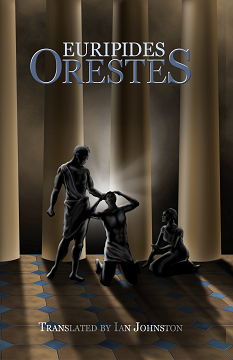
Guilt, Revenge, and the Limits of Justice in Orestes
About This Guide
Euripides’ Orestes begins after Orestes has killed his mother, Clytaemnestra, to avenge the murder of his father, Agamemnon. Instead of restoring peace, the act has left him tormented by guilt, threatened with execution, and dependent upon the loyalty of others.
The play explores the difficult relationship between moral responsibility, family obligation, divine authority, and public judgment.
1. Guilt and Psychological Suffering
Orestes suffers severe mental and physical distress following the murder of his mother. His troubled condition dominates the opening of the play.
Euripides presents the consequences of violence not merely as external punishment but as suffering within the individual.
Consider: Does Orestes' distress make him more sympathetic, or does it reinforce the seriousness of his crime?
2. Revenge and the Cycle of Violence
The murder of Agamemnon leads to the killing of Clytaemnestra. Rather than ending the family's suffering, this act produces further conflict and threats of punishment.
As the play progresses, Orestes and his companions contemplate additional violence against Helen and Hermione.
Consider: Why does revenge repeatedly produce new dangers instead of resolving earlier wrongs?
3. Divine Commands and Human Responsibility
Orestes maintains that Apollo commanded him to avenge Agamemnon. Nevertheless, the citizens of Argos condemn the killing of Clytaemnestra.
The disagreement raises an important question: can a person escape moral responsibility by claiming to have obeyed divine instructions?
Apollo's appearance at the conclusion resolves the immediate crisis but leaves the audience to consider the consequences of the actions already committed.
Consider: Does divine authority settle the question of justice?
4. Family Loyalty and Its Limits
Electra remains devoted to Orestes despite their shared danger. Pylades also demonstrates extraordinary loyalty, refusing to abandon his friend.
Menelaus, however, hesitates to risk his position to defend his nephew and niece.
Euripides contrasts these responses without presenting loyalty as an uncomplicated virtue. Loyalty can sustain people in suffering, but it can also encourage destructive decisions.
Consider: When does loyalty become a failure to challenge wrongdoing?
5. Public Judgment and Political Power
The Argive assembly condemns Orestes and Electra to death.
The play raises questions about the relationship between public opinion, political influence, and justice. The assembly's decision represents collective judgment, but that does not necessarily make it morally unassailable.
Tyndareus' demand for punishment also introduces the distinction between personal revenge and lawful judgment.
Consider: What makes a public decision just rather than merely popular?
6. Desperation and Moral Compromise
When Orestes and Electra face execution, their desperation leads them toward increasingly dangerous choices.
With Pylades, they plan an attack upon Helen and seize Hermione as a hostage in an attempt to force Menelaus to intervene.
Their conduct demonstrates how the fear of punishment can lead individuals to inflict suffering upon others.
Consider: Does desperation lessen responsibility for actions that endanger innocent people?
How the Themes Work Together
The themes of Orestes continually overlap. Family loyalty motivates revenge; revenge produces guilt; guilt and violence lead to public condemnation; and the threat of punishment encourages further violence.
Euripides challenges the audience to recognize that a person may suffer injustice while also committing serious wrongs.
Questions for Discussion
- How does Orestes' suffering affect our understanding of his guilt?
- How do Tyndareus and Orestes differ in their understanding of justice?
- Why does Menelaus hesitate to help the siblings?
- Does Pylades demonstrate admirable friendship or dangerous loyalty?
- How does the threat of execution influence the characters' decisions?
- Does Apollo's final intervention resolve the moral questions raised by the play?
Classroom Activity: A Conflict of Duties
Divide students into groups representing Orestes, Electra, Pylades, Tyndareus, and Menelaus.
Ask each group to identify:
- The character's principal obligation.
- A decision influenced by that obligation.
- The consequences of the decision.
- An alternative action the character might have taken.
Bring the class together to discuss whether conflicting duties make wrongdoing inevitable or whether the characters retain meaningful choices.
Note to the Educator
Encourage students to distinguish explanations of behavior from moral justifications. Orestes' psychological suffering, Electra's loyalty, and Menelaus' political concerns all help explain their actions, but they do not automatically establish that those actions are right.
The play offers a useful opportunity to examine competing moral claims without requiring students to arrive at a single interpretation.
Reading the Play
A printable PDF version of this resource is available by email.