Euripides’ Orestes
Student’s Guide | Classical Reference Library
Richer Resources Editorial Team
About This Guide
In Euripides’ Orestes, a brother and sister have taken revenge for their father’s murder—but instead of finding peace, they face fear, anger, and a death sentence. The play asks whether obeying a god excuses a terrible act, whether a crowd can judge fairly, and how far loyalty should go. This guide will help you follow the story and explore those questions.
Before You Read
Orestes and Electra are the children of Agamemnon, a Greek leader in the Trojan War. While he was away, his wife Clytaemnestra took Aegisthus as a partner. When Agamemnon returned, they murdered him. Orestes and Electra later killed Clytaemnestra to avenge their father. Orestes says Apollo commanded the act. Euripides’ play begins after the killing, when its consequences are becoming clear. It was first performed in Athens in 408 BCE.
The Story at a Glance
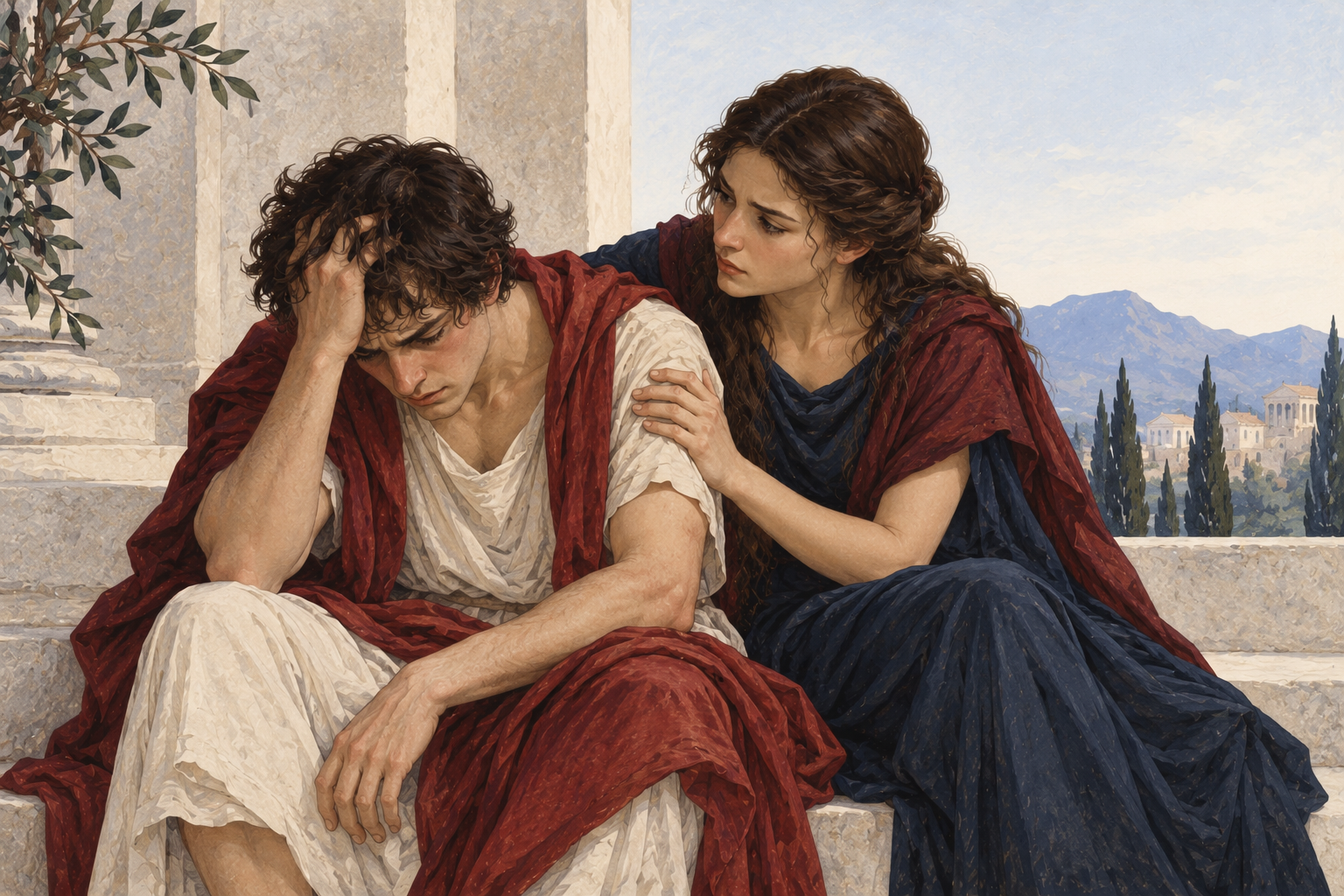
Orestes is suffering terribly after killing his mother. His sister Electra cares for him, but the people of Argos must decide whether the siblings should be punished. Menelaus, their uncle, returns with his wife Helen, yet he is reluctant to defend them. Tyndareus, their grandfather, argues that they must answer for the murder.
The Argive assembly condemns Orestes and Electra to death. Their friend Pylades refuses to abandon them. Together they decide to attack Helen and capture her daughter Hermione, hoping to force Menelaus to help. Helen mysteriously disappears, and a servant describes the terrifying confusion inside the palace. Orestes threatens Hermione as the situation grows more dangerous.
At the last moment Apollo appears. He explains what has happened to Helen and orders a future in which Orestes will stand trial in Athens and marry Hermione, while Electra will marry Pylades. The fighting stops, but difficult questions about justice remain.
Meet the Characters
Orestes — Agamemnon’s son, suffering after killing his mother and struggling to escape punishment.
Electra — His sister, who supports him even when their choices become dangerous.
Pylades — Orestes’ loyal friend, who joins his desperate plans.
Menelaus — Orestes’ uncle, who fears the consequences of helping him.
Helen — Menelaus’ wife, whose past is connected with the Trojan War.
Hermione — Daughter of Menelaus and Helen, taken hostage.
Tyndareus — Orestes’ grandfather, who demands punishment for Clytaemnestra’s death.
Apollo — The god whom Orestes says he obeyed; he appears at the end.
Important Themes
Justice or Revenge? — Orestes believes he avenged his father, but others see the murder of his mother.
Guilt and Consequences — Orestes suffers even though he argues that his action was required.
Family and Friendship — Relatives and friends disagree about what loyalty demands.
Public Opinion — A political assembly decides the siblings’ fate, but its judgment is contested.
Violence That Spreads — An earlier killing leads to threats against people who were not responsible for it.
Gods and Responsibility — Apollo’s commands raise questions about how much choice humans have.
What to Notice as You Read
Notice how Electra describes Orestes before he speaks for himself. How does her account influence your first impression?
Compare Orestes’ defense with Tyndareus’ argument for punishment. Do they agree on what justice means?
Watch Menelaus’ words and actions. Is he cautious, selfish, powerless, or some combination?
Consider why Pylades helps Orestes, even when their plan becomes violent.
Ask what Apollo’s arrival explains—and what it leaves unresolved.
A Literary Feature: The Deus ex Machina
The Latin expression deus ex machina means “god from the machine.” In ancient theater, a god could appear above the stage using special equipment and announce how a crisis would end. Apollo performs this role in Orestes. His instructions stop the immediate violence, but readers may disagree about whether they make the ending feel just. The difference between ending a conflict and solving its moral problems is worth discussing.
Questions to Think About
- Why did Orestes and Electra kill their mother?
- Why is Orestes suffering after the murder?
- What does Tyndareus believe should happen to the siblings?
- Why does Menelaus hesitate to help?
- What does the Argive assembly decide?
- Why do Orestes, Electra, and Pylades turn against Helen and Hermione?
- Does Apollo’s appearance provide a satisfying ending? Why or why not?
After You Finish
Choose one character—Orestes, Electra, Pylades, Menelaus, or Tyndareus. Describe a difficult decision that character makes, explain the reasons offered, and identify one consequence. Use at least two details from the play to support your answer.
A Final Thought
Orestes reminds us that people can believe they are defending justice while causing more harm. Euripides asks us to think not only about why people act, but also about the responsibility they bear for what follows.
Note to the Reader
This guide accompanies the Richer Resources Publications edition of Euripides’ Orestes, translated by Ian Johnston. A printable PDF version of this resource is available by email.