Editor's note: This essay is an abridged version of Ian Johnston's Fate, Freedom, and the Tragic Experience: An Introductory Lecture on Sophocles's Oedipus the King, originally delivered at Malaspina University-College in 2000 and revised in 2004. Johnston placed the lecture in the public domain and authorized its reproduction in whole or in part with acknowledgment. This version preserves Johnston's original text while omitting portions of the lecture concerned primarily with other works and with the broader history and theory of tragedy.
Introduction
Sophocles’s Oedipus the King is one of the world’s most famous plays and, since the time of the Classical Greeks, has helped set the standard for the form of literature we call dramatic tragedy. To understand what makes Oedipus a tragic hero, we need first to consider two ideas that shape the play: fate and freedom.
Fate and Freedom
In Sophocles’s play, fate is an essential part of the world the characters inhabit. A fatalistic vision of experience assumes that the most important forces shaping human life lie outside human control. Human beings do not establish the fundamental rules under which they live, and they cannot finally determine their own good or bad fortune, happiness or sorrow, or death.
But a belief in fate does not mean that human beings have no freedom. This distinction is crucial. The forces governing the world may determine the conditions we face, but how we confront those conditions remains a matter of choice. Human freedom lies in the attitude we adopt and in the actions we take in response to what fate presents us.
This tension between forces beyond human control and the freedom to respond to them lies at the heart of Oedipus’s story.
The Hero
The traditional hero is distinguished from others in the community by a willingness to act, to make decisions, and to take risks in a crisis. In Greek tragedy, and nowhere more clearly than in Oedipus the King, this quality separates the hero from the Chorus. The Chorus recognizes its uncertainty and fear and looks to someone else for leadership. The hero steps forward and assumes the risks of decision.
Oedipus at the Beginning of the Play
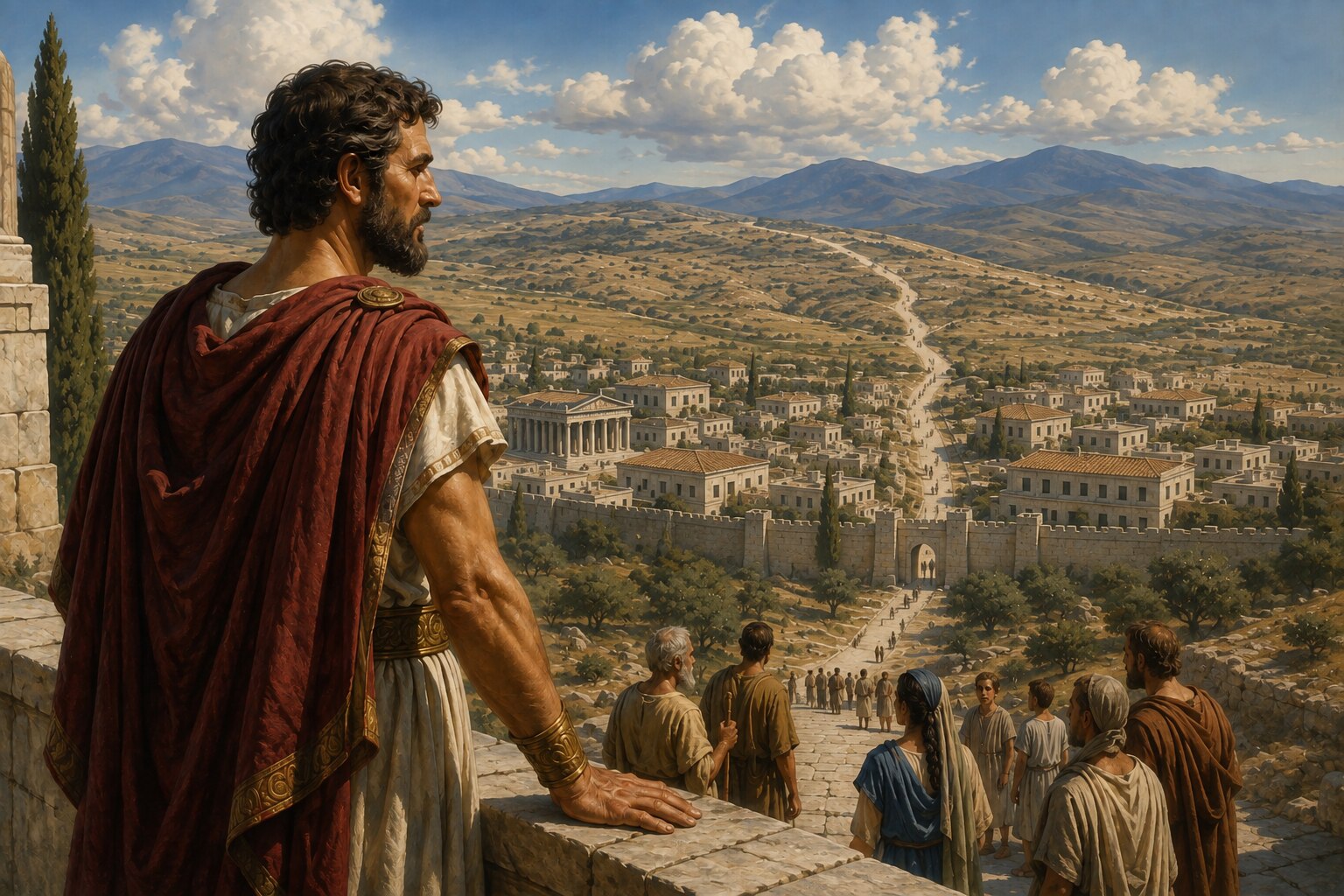
From the opening of the play, Oedipus is presented as a great public figure and a successful ruler. Thebes is suffering from a plague, and its citizens turn naturally to the man who has saved the city before. Their confidence in him is not irrational. Oedipus solved the riddle of the Sphinx when others could not, and his intelligence and decisiveness have already proved themselves.
Oedipus also possesses an enormous sense of his own worth. He accepts responsibility for the crisis immediately and personally. He has already sent to the oracle for guidance before the citizens ask him to act. Once the oracle reveals that the murderer of the former king Laius must be found, Oedipus publicly commits himself to discovering the truth.
His confidence, then, is not merely vanity. It is grounded in achievement. Yet the same quality that makes him capable of leadership also leaves little room for sharing responsibility or accepting another person’s understanding of events. Oedipus will solve the problem himself, openly and decisively.
Oedipus’s Self-Assertion
As the play progresses, Oedipus’s determination to deal with the crisis on his own terms becomes increasingly important. Even when the evidence begins to suggest that he himself may somehow be implicated in Laius’s death, he remains committed to finding the answer.
Oedipus is fiercely self-assertive. He measures himself against his own conception of greatness. His desire to save Thebes and his desire to demonstrate his own excellence are difficult to separate, because in his mind the two are closely connected. He does not conceal his actions or proceed cautiously. To do so would conflict with the identity he has created through his past achievements.
Oedipus and Teiresias
The quarrel between Oedipus and Teiresias reveals this quality clearly. When Teiresias accuses Oedipus of being the source of Thebes’s pollution, Oedipus has no reason, from his own point of view, to believe him. Oedipus knows himself to be innocent of Laius’s murder and has great confidence in his own ability to discover the truth. He therefore concludes that Teiresias must be lying or pursuing some hidden purpose.
It is easy for a first-time reader to condemn Oedipus here as proud or hot-tempered. But that judgment can be too simple. Oedipus has strong reasons for trusting himself. His intelligence and confidence have saved Thebes before. A more cautious man might listen more patiently to Teiresias, but a more cautious man might never have become the hero who defeated the Sphinx and took responsibility for the city in the first place.
This is one of the central paradoxes of Oedipus’s character. The qualities that appear to be his weaknesses are also the qualities that make him capable of greatness. Without his extraordinary confidence and willingness to act, he would resemble the frightened and uncertain Chorus, waiting for someone else to take responsibility.
The Chorus, Jocasta, and the Choice to Continue
The other characters help us measure Oedipus’s stature. The Chorus hesitates and fears the unknown. Jocasta eventually wants the investigation to stop. She urges Oedipus to abandon the search and live without trying to know what lies ahead.
But such advice effectively asks Oedipus to become someone else. To stop seeking the truth would mean abandoning the qualities on which his identity and reputation have been built. He cannot simply decide not to know. His determination to understand what has happened is inseparable from the man he is.
The Irony of Oedipus’s Story: Fate and Free Will
The dramatic power of the play comes from the audience’s knowledge of Oedipus’s fate combined with Oedipus’s apparent freedom at every stage. We know the outcome of the story, yet Oedipus is not visibly compelled to make the choices he makes. He freely begins and continues the investigation that will reveal the truth about himself.
Oedipus has spent much of his life attempting to escape the prophecy that he will kill his father and marry his mother. His efforts to avoid that fate are entirely understandable. From his own perspective, they even seem successful. He therefore has good reason to believe that intelligence, courage, and decisive action can enable a human being to resist what has been foretold.
The audience knows otherwise. That knowledge creates the play’s central irony. We understand why Oedipus believes what he believes and why he trusts his own judgment, even while we know that his understanding of himself is profoundly mistaken.
As the evidence accumulates, Oedipus refuses Jocasta’s pleas to abandon the inquiry. The search for truth becomes an obsession because he must see the matter through. Finding the truth is more important to him than protecting himself from what the truth may reveal.
This produces a deeply unsettling vision of fate. Oedipus is not simply a wicked man being punished for wrongdoing. He is intelligent, successful, courageous, and determined to save his city. Yet he cannot know enough about the forces governing his life to understand what they have prepared for him. Most disturbing of all, the sequence that leads to his discovery has been freely initiated and maintained by Oedipus himself.
Oedipus as a Tragic Hero
Oedipus insists on acting according to his own understanding of events. He initiates the investigation, accepts responsibility for it, and continues even as disaster approaches. When he finally learns the truth, he does not transfer responsibility to someone else. He blinds himself and demands punishment and exile.
In this sense, Oedipus remains remarkably consistent. The revelation destroys his former understanding of his life, but it does not transform him into a passive man. He continues to act. If he must suffer, he will determine the form that suffering takes.
His attitude toward fate is central to his tragic character. He does not willingly accommodate himself to forces greater than himself. He insists upon his freedom to live according to his own conception of what he must be. With that commitment comes narrowness and an enormous ego, but it also brings the willingness to accept the consequences of his choices.
The force of the tragedy therefore comes not simply from Oedipus’s suffering but from the connection between that suffering and his freely chosen actions. Looking forward through the play, we can see moments when Oedipus might act differently. Looking backward from the conclusion, we see a chain of consequences that appears inevitable.
This distinction matters. In ordinary speech we often call any terrible event “tragic.” But an accident is not tragic in the same literary sense. Sophoclean tragedy derives much of its power from the step-by-step relationship between the hero’s character, his decisions, and the disaster that follows.
Beyond the “Tragic Flaw”
One of the most common ways of simplifying Oedipus the King is to turn it into a morality tale: Oedipus is arrogant, therefore his arrogance causes his punishment. Such an interpretation makes the play more comfortable, because it suggests that the catastrophe could have been avoided if Oedipus had simply behaved better.
But that misses much of what makes the tragedy disturbing. Oedipus does make an error, yet his error is inseparable from his greatness. His intelligence, courage, confidence, and willingness to act are precisely the qualities that enable him to save Thebes and to pursue the truth when others hesitate.
The familiar expression “tragic flaw” can therefore be misleading. Aristotle’s term hamartia is more usefully understood here as an error rather than a simple moral defect. Oedipus does not fall because he is merely a bad or sinful man. He falls because an exceptionally capable human being confidently confronts forces he does not and cannot fully understand.
If Oedipus were less brave, less intelligent, less confident, or more willing to compromise, he might avoid his catastrophe. But he would also cease to be the extraordinary figure whose greatness gives the tragedy its power. His error is not simply sin. It is ignorance—an ignorance shared, ultimately, by every human being confronting the mystery of fate.
The End of the Tragedy
Sophoclean tragedy does not end merely with the destruction of the hero. It ends with the community attempting to understand what the hero’s experience has revealed. Oedipus’s fall leaves Thebes—and the audience—with no simple moral lesson. Instead, the community has been given a glimpse of the uncertainty and mystery beneath the ordinary assumptions by which people live.
That is why the conclusion of Oedipus the King resists easy consolation. The greatness of Oedipus lies partly in his willingness to pursue the truth and accept the consequences of his actions. Yet his experience also demonstrates the limits of human knowledge and control.
The play leaves us with a disturbing paradox. Oedipus is both free and fated. His choices matter profoundly, but they take place within conditions he cannot understand or escape. The tragedy arises precisely from the collision between those two truths.
Source acknowledgment: Ian Johnston, “Fate, Freedom, and the Tragic Experience: An Introductory Lecture on Sophocles’s Oedipus the King,” Malaspina University-College, 2000; revised August 2004. Original public-domain text: https://web.viu.ca/johnstoi/introser/oedipus.htm