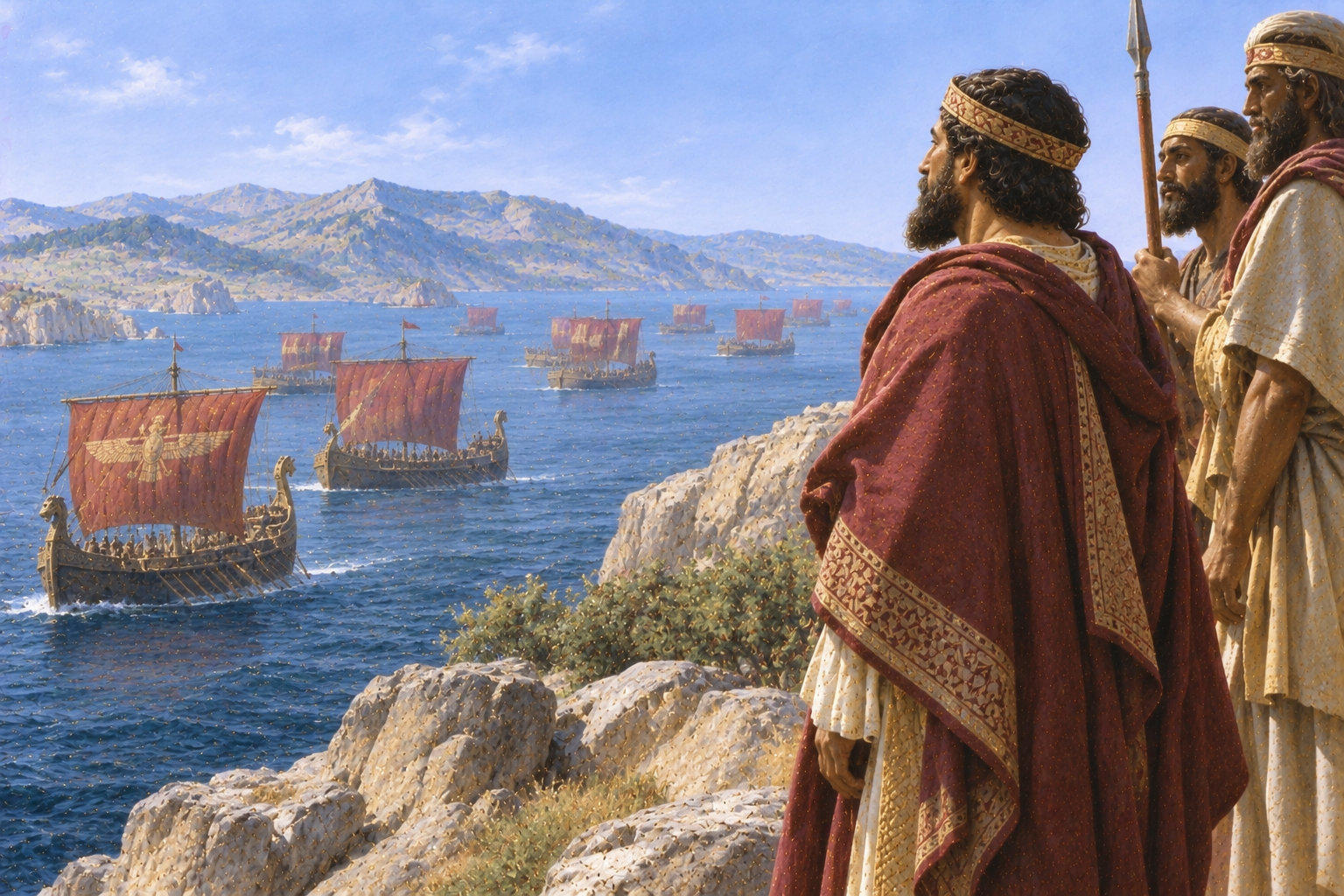
The Persian Empire and the Greek World
When Aeschylus wrote The Persians, the Achaemenid Empire was a vast, sophisticated state extending across much of western Asia and beyond. Its kings governed diverse peoples through provincial administration, roads, tribute, and local institutions. The Greek city-states were politically independent communities, not a single united nation. Their conflicts with Persia involved expansion, resistance, alliances, and competing political interests.
From Marathon to Xerxes’ Invasion
In 490 BCE, Persian forces sent under Darius I were defeated by Athenians and their Plataean allies at Marathon. Darius died in 486 BCE, and his son Xerxes I subsequently led a major invasion of Greece in 480 BCE. Greek defenders resisted at Thermopylae; Persian forces occupied Athens, but a Greek allied fleet defeated the Persian fleet at Salamis. Greek victories at Plataea and Mycale in 479 BCE further weakened the invasion.
The Battle of Salamis, 480 BCE
Salamis was a naval battle fought in the straits near the island of Salamis, west of Athens. Greek forces used the confined waters to their advantage against the larger Persian-led fleet. Ancient accounts differ in details and numbers, so precise fleet sizes and casualty figures remain uncertain. The defeat was a major setback for Xerxes, although the Persian Empire remained powerful afterward.
A Tragedy Performed Only Eight Years Later
The Persians was first performed at Athens in 472 BCE, only eight years after Salamis. It is the earliest complete surviving Greek tragedy and is unusual for taking a recent historical event, rather than a familiar myth, as its subject. Aeschylus had experienced the Persian Wars firsthand, but the play should not be treated as a documentary record of Persian court life.
Why the Persian Perspective Matters
The action takes place at the Persian court, where Atossa and the elders wait for news. A messenger reports the catastrophe; the ghost of Darius condemns Xerxes’ overconfidence; and Xerxes finally arrives to mourn with the Chorus. The defeated side receives the emotional focus. At the same time, the play reflects Athenian assumptions about monarchy, freedom, divine justice, and imperial ambition. Sympathy and patriotic interpretation coexist.
Historical Events and Dramatic Interpretation
The Battle of Salamis and Xerxes’ invasion are historical events. Atossa’s dream, the appearance of Darius’ ghost, and the speeches assigned to the Persian court are elements of Aeschylus’ dramatic construction. Students should distinguish what historians can investigate from what a tragedian uses to give events moral and emotional meaning.
A Brief Chronology
- 490 BCE: Persian defeat at Marathon.
- 486 BCE: Darius I dies; Xerxes succeeds him.
- 480 BCE: Xerxes invades Greece; battles of Thermopylae and Salamis.
- 479 BCE: Greek victories at Plataea and Mycale.
- 472 BCE: First performance of Aeschylus’ The Persians.
Questions for Discussion
- Why is it misleading to describe the Persian Empire simply as a disorganized or uniformly oppressive enemy?
- What advantages might the Greek fleet have had in the narrow waters at Salamis?
- How does a tragedy written eight years after a battle differ from a historical chronicle?
- Why might an Athenian audience respond strongly to Persian grief?
- Which features of the play are historical, and which are dramatic inventions?
- How can a work show sympathy for defeated enemies while celebrating a Greek victory?
Note to the Educator
Ask students to compare the play’s messenger speech with a modern historical account of Salamis. Have them identify factual claims, emotional language, and judgments about leadership. Avoid treating Aeschylus’ portrayal of Persia as an unbiased description of the empire.
This guide accompanies the Richer Resources Publications edition of The Persians, translated by Ian Johnston.
A printable PDF version of this resource is available by email.