The Myths Behind Prometheus' Defiance
Prometheus Bound draws upon Greek traditions about the origins of divine authority, humanity's development, and the conflicts among the gods. Understanding these stories helps students recognize why Prometheus' punishment is more than a personal quarrel with Zeus. It raises questions about the relationship between power, knowledge, justice, and human progress.
The Titans and the Rise of Zeus
In Greek mythology, the Titans belong to an older generation of divine beings. Zeus and his allies eventually overthrow the rule of Cronus and establish a new order among the gods.
Prometheus is himself a Titan, but in Prometheus Bound he recalls helping Zeus gain power. Their subsequent conflict is therefore especially significant: Prometheus is punished by a ruler whose victory he helped secure.
The play presents Zeus as a relatively new sovereign whose authority is enforced through threats and punishment.
Prometheus and the Gift of Fire
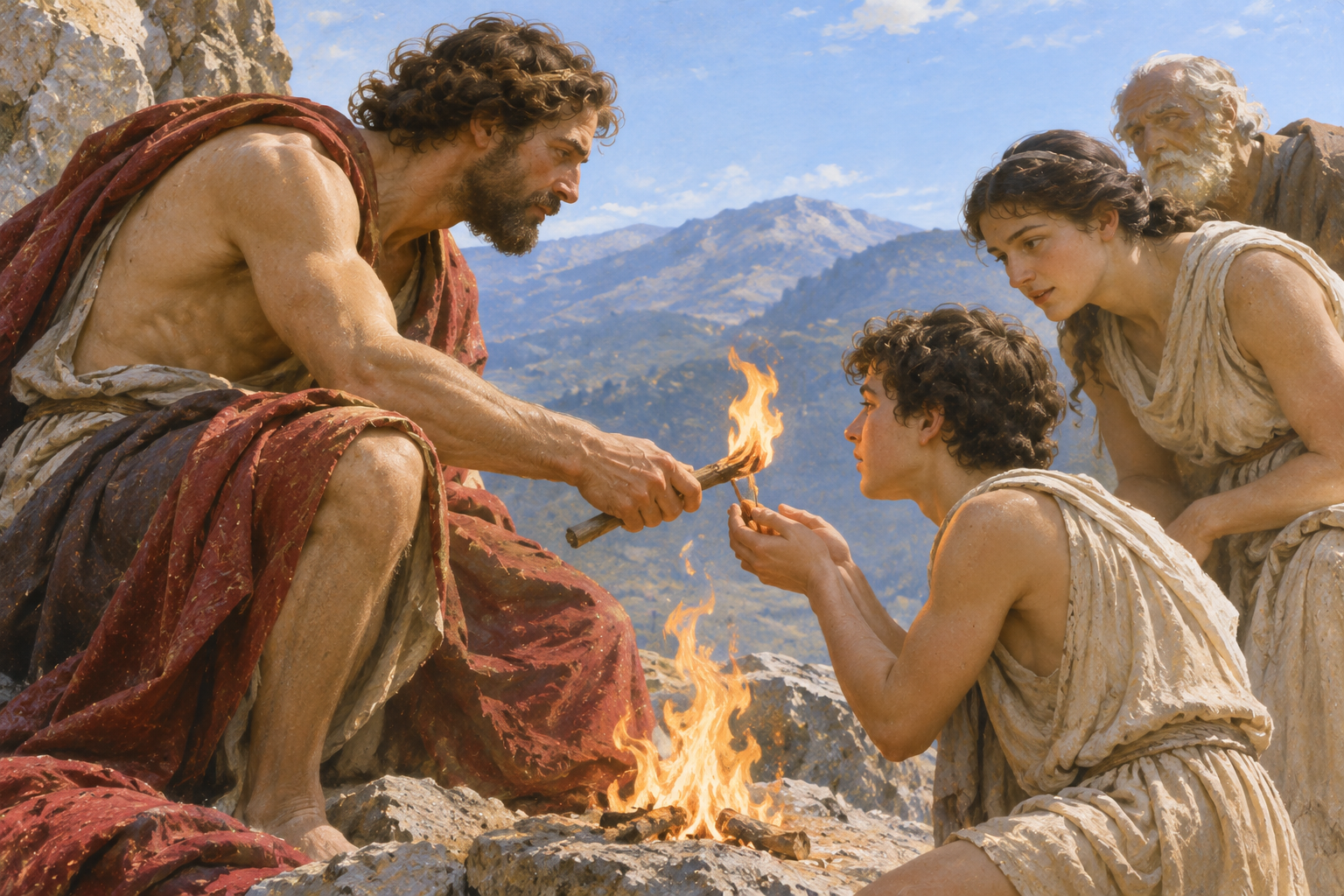
Prometheus is closely associated with the protection and advancement of humanity. In the play, he describes saving mortals from destruction and providing them with fire and numerous practical skills.
Fire represents much more than a means of keeping warm. It makes possible cooking, metalworking, and other activities essential to civilization.
Prometheus also claims to have taught humanity important arts, including building, navigation, medicine, and methods of understanding the natural world. His gifts transform human existence, but they also provoke the anger of Zeus.
Prometheus in Earlier Greek Myth
The poet Hesiod tells related stories about Prometheus' deception of Zeus, the theft of fire, and the punishment that follows. In Hesiod's account, the creation of Pandora is also connected with Zeus' response to Prometheus' actions.
These traditions provide useful background, but students should not assume that every detail appears in Prometheus Bound. The tragedy places particular emphasis on Prometheus' defense of humanity and his resistance to divine authority.
Io and Her Wanderings
Io is a mortal woman whose suffering arises from her connection with Zeus and Hera's jealousy. In the play, she appears as a tormented wanderer, driven across distant lands.
Her encounter with Prometheus introduces another figure harmed by the actions of powerful gods. Prometheus foretells her future journey and the importance of her descendants.
The contrast between the two characters is striking: Prometheus cannot leave his rock, while Io cannot find rest.
Prophecy and the Limits of Zeus' Power
Prometheus possesses knowledge of a future danger to Zeus' rule. Although Zeus can punish and imprison him, he cannot obtain this information without Prometheus' cooperation.
The prophecy introduces an important feature of Greek mythology: even the greatest gods may face limitations associated with destiny and the consequences of their own decisions.
Prometheus' knowledge becomes his principal means of resistance.
Heracles and the Wider Tradition
In the broader mythological tradition, Heracles eventually plays a role in Prometheus' release. Heracles is also a descendant of Io, connecting her story with Prometheus' eventual fate.
The surviving Prometheus Bound does not depict this rescue. Instead, it ends with Prometheus still resisting Zeus and facing further punishment.
Students should distinguish the play's unresolved ending from later events known through other versions of the myth.
Questions for Discussion
- Why is Prometheus' earlier assistance to Zeus important to their conflict?
- How does the gift of fire represent the development of civilization?
- What differences can students identify between Hesiod's account of Prometheus and the tragedy?
- How does Io's suffering expand the play's treatment of divine authority?
- Why does Prometheus' knowledge of the future give him power despite his imprisonment?
- How does knowing the wider mythological tradition affect our response to the unresolved ending?
Note to the Educator
Encourage students to distinguish the mythological traditions surrounding Prometheus from the particular events and interpretations presented in the play. Comparing the accounts of Hesiod with Prometheus Bound can help students recognize how Greek writers adapted familiar stories to explore different questions about divine authority and human experience.
The play is traditionally attributed to Aeschylus, although its authorship remains disputed. This guide accompanies the Richer Resources Publications edition translated by Ian Johnston.
A printable PDF version of this resource is available by email.