The Movement from Revenge to Justice
Across Agamemnon, The Libation Bearers, and The Eumenides, Aeschylus explores how acts of retaliation produce further violence. The trilogy begins in a household divided by murder and ends with a public court in Athens. Its themes and symbols reveal the difficulty of replacing personal vengeance with a shared system of justice.
Revenge and Competing Claims of Justice
Clytemnestra kills Agamemnon in part to avenge the sacrifice of their daughter Iphigenia. Orestes then kills Clytemnestra to avenge his father. Each claims a duty to respond to an earlier wrong. Aeschylus asks whether retaliation can settle guilt when it creates new victims and new demands for punishment.
Family Duty and Inherited Guilt
The House of Atreus carries a history of betrayal and bloodshed. Orestes must choose between avenging his father and honoring the prohibition against killing his mother. The conflict is not merely personal: it exposes obligations that cannot all be fulfilled at once.
Divine Authority and Moral Conflict
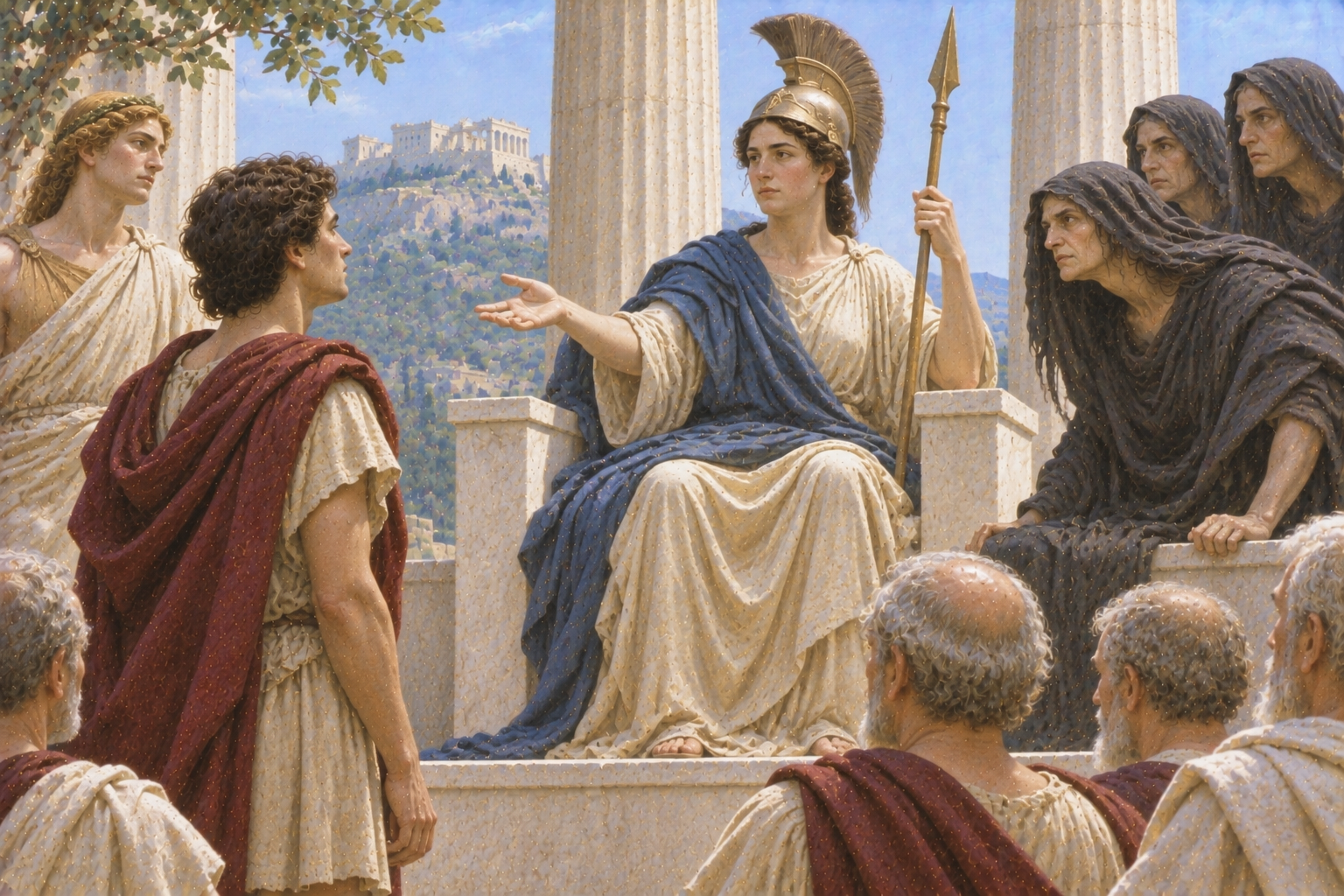
Apollo commands Orestes to avenge Agamemnon, while the Furies pursue him for matricide. Their disagreement reveals competing sacred claims rather than a simple conflict between right and wrong. Athena’s intervention makes judgment and accommodation possible.
Blood as a Recurring Image
Blood signifies both the violence already committed and the obligation to answer it. References to bloodshed connect the generations of the family, making past crimes feel present. Students can trace how blood imagery changes when the action moves from the palace to the courtroom.
Nets, Traps, and Entrapment
In Agamemnon, the imagery of nets and entanglement accompanies the king’s murder. Such imagery suggests that characters are caught by schemes, family history, and consequences they cannot easily escape. The physical trap also reflects the moral trap of reciprocal revenge.
Serpents, Dreams, and Fear
In The Libation Bearers, Clytemnestra’s dream of nursing a serpent anticipates the threat posed by Orestes. The image joins maternal intimacy to danger and revenge. It offers a striking example of how a dream can reveal anxiety and foreshadow an action.
The Furies and Their Transformation
The Furies embody the demand to punish the killing of blood relatives. At the end of The Eumenides, Athena does not destroy them. Instead, she persuades them to accept a respected place within Athens. Their transformation symbolizes the incorporation of older powers into a new civic order.
The Court as a Symbol of Civic Judgment
Athena’s court replaces an endless sequence of private reprisals with a procedure for hearing opposing claims. The verdict does not erase the suffering that preceded it. Rather, the court offers a way for a community to address wrongdoing without perpetuating family violence.
Questions for Discussion
- Why can both Clytemnestra and Orestes describe their violence as just?
- How do blood and net imagery connect action with consequence?
- What does Clytemnestra’s serpent dream suggest about motherhood and revenge?
- Why do Apollo and the Furies disagree about Orestes?
- What is gained when Athena establishes a public court?
- Why is it important that the Furies are honored rather than expelled?
Note to the Educator
Encourage students to follow one image or theme across all three plays rather than treating each tragedy separately. Comparing Clytemnestra’s justification, Orestes’ divided duties, and the Furies’ demands can help students see why the trilogy’s resolution requires more than another act of revenge.
This guide accompanies the Richer Resources Publications edition of The Oresteia, translated by Ian Johnston.
A printable PDF version of this resource is available by email.