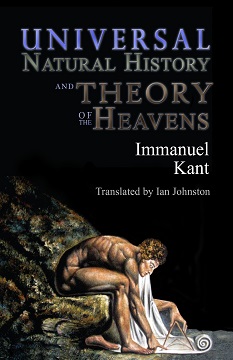
Immanuel Kant — Universal Natural History and Theory of the Heavens
A Teacher’s Guide
Purpose of This Guide
This guide supports teaching Immanuel Kant’s Universal Natural History and Theory of the Heavens as an ambitious eighteenth-century explanation of cosmic development. Students should examine how Kant moves from general physical principles to a history of the heavens, where observation ends and speculation begins, and why the work matters even where its specific claims have been superseded.
Historical and Intellectual Context
Published anonymously in 1755, before Kant’s mature critical philosophy, this work responds to the successes of Newtonian mechanics. Kant proposes that a universe governed by natural laws can possess a history: stars and planetary systems need not be regarded as fixed arrangements. His account draws on the interaction of attraction and repulsion and offers an early version of the nebular hypothesis. The work also connects cosmic order to divine wisdom, rather than presenting natural law and religious belief as simple opposites.
The Argument at a Glance
Kant begins from the structure of the planetary system and the apparent regularities of celestial motions. He imagines matter initially dispersed through space, then gradually collecting and organizing under physical forces. Rotating systems, planets, moons, and other features emerge through processes of development. He extends his vision beyond the solar system to the larger universe, and speculates about inhabited worlds. The movement of the work is from observed patterns, to explanatory mechanism, to increasingly daring conjecture.
Central Concepts
Nebular hypothesis: the proposal that planetary systems develop from diffuse matter rather than appearing in their present form all at once.
Attraction and repulsion: the physical tendencies Kant uses to account for movement and organization.
Cosmic development: the idea that the universe has a history shaped by natural processes.
Analogy: reasoning from known patterns to possible processes not directly observed.
Natural theology: arguments that the order of nature reveals divine wisdom or design.
Major Themes
- Natural law and historical change: stable principles can produce evolving structures.
- Scientific imagination: an explanatory hypothesis can reach beyond direct observation, but must still be evaluated.
- Order and contingency: Kant asks how patterned systems might arise from initially scattered material.
- The scale of the universe: humanity’s perspective is challenged by vast distances and possible other worlds.
- Science and religion: physical explanation and theological interpretation coexist in the text.
Explanatory and Rhetorical Techniques
Kant combines descriptions of observable astronomical regularities with hypothetical reconstructions of processes no one could witness. He uses mechanical analogy, broad generalization, and speculative extension. Ask students to mark the language of certainty, probability, and conjecture. His confident, sweeping vision can make an argument compelling even when particular physical steps remain inadequately demonstrated.
Teaching Objectives
Students will explain the basic nebular hypothesis in Kant’s account; distinguish observation, inference, and speculation; describe how Newtonian principles inform Kant’s argument; evaluate the relationship between physical causes and claims about design; and compare eighteenth-century cosmic theories with modern evidence without assuming they are identical.
A Flexible Teaching Sequence
- Begin with the question: How could a solar system form from matter already in motion? Elicit students’ existing ideas.
- Introduce the astronomical and Newtonian context of 1755, emphasizing what was and was not known.
- Read Kant’s account of dispersed matter and planetary formation; diagram the proposed sequence.
- Examine his discussion of the solar system’s regularities, moons, rings, or comets as tests of explanatory reach.
- Consider passages on divine design and extraterrestrial life, separating physical arguments from theological or imaginative extensions.
- Compare one of Kant’s proposals with a modern account of planetary formation, noting both continuities and decisive differences.
Passages Worth Close Reading
The opening discussion of cosmic order: what requires explanation? The account of matter becoming organized: which forces do the explanatory work? The discussion of Saturn’s rings or comets: how does Kant apply a general hypothesis to a particular case? The passages on inhabited worlds: what evidence supports his speculation? Statements about divine design: how does Kant connect natural causes with a larger purpose?
Core Discussion Questions
- What makes a proposed origin story scientific rather than merely imaginative?
- Why is it significant to explain the solar system as something that developed over time?
- Which claims in Kant’s argument rest on observations, and which go beyond them?
- Can a natural-law explanation coexist with a claim about divine design? How does Kant approach that question?
- Why might a historically important scientific hypothesis remain worth reading after its details have been revised?
- How does the scale of Kant’s universe affect his treatment of human beings?
Classroom Approach
Have students construct a three-column evidence log headed Observation, Inference, and Speculation. For each selected passage, identify what Kant reports, what he concludes, and what additional evidence would be needed. Then compare the log with a modern account of protoplanetary disks. An optional writing exercise asks students to explain why a productive hypothesis can be valuable without being fully correct.
Interpretive Cautions
Do not equate Kant’s nebular hypothesis with the fully developed modern theory of solar-system formation. Avoid attributing modern evidence—such as spacecraft observations or contemporary astrophysical models—to an eighteenth-century writer. Kant’s speculations about extraterrestrial beings are not established observations. Also distinguish this early natural-philosophical work from his later critical writings; the views and methods should not be collapsed into one timeless Kantian system.
Note to the Educator
Ian Johnston’s translation gives students access to a striking example of Enlightenment natural philosophy. The richest teaching opportunity is to study how Kant’s explanatory ambition links mathematics, observation, imagination, and philosophical commitments—and to ask how new evidence changes the standing of an old but influential theory.