Reading Diderot: Questions Without Easy Answers
What makes a person think? Are people free to choose how they behave? Can someone be talented and dishonest at the same time? Denis Diderot explores such questions through conversations rather than straightforward lectures. His speakers challenge, joke with, and sometimes contradict one another. Your task as a reader is not simply to choose a winner, but to examine how each argument works.
Meet Denis Diderot
Denis Diderot (1713–1784) was a French Enlightenment writer and a leading editor of the Encyclopédie, an ambitious effort to collect and share knowledge. He questioned inherited beliefs and was interested in science, art, and society. Both works in this volume use dialogue to test ideas from more than one perspective.
The Two Dialogues
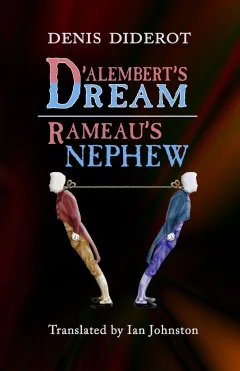
D’Alembert’s Dream: In linked conversations involving Diderot, the mathematician d’Alembert, Julie de Lespinasse, and the physician Bordeu, the speakers ask how matter can become living, feeling, and thinking. Some proposals are imaginative thought experiments, not established scientific conclusions.
Rameau’s Nephew: A narrator known as “I” converses with “He,” the nephew of a famous composer. The nephew speaks frankly, often outrageously, about music, money, flattery, and the behavior required to win support from wealthy people. The dialogue asks whether intelligence and talent are the same as goodness.
Key Ideas to Watch For
Materialism: The view that life and thought should be understood in relation to physical matter and its organization. Ask how the speakers connect the body with sensation and consciousness.
Dialogue and irony: Characters may say things that are exaggerated, inconsistent, or deliberately provocative. A character’s opinion is not automatically Diderot’s opinion.
Morality and self-interest: Rameau’s nephew describes behavior that benefits him even when it seems dishonest. Does describing a practice mean approving of it?
Genius and society: Artistic ability does not guarantee a comfortable life or admirable conduct. Consider the pressures that patronage places on artists.
Questions for Close Reading
- In D’Alembert’s Dream, what examples or comparisons are used to explain how living matter might produce sensation? Which are convincing, and which leave questions unanswered?
- How does Bordeu’s medical perspective change the conversation?
- In Rameau’s Nephew, when does the nephew appear insightful, ridiculous, or both?
- How do the narrator and the nephew disagree about morality, success, and dependence on others?
- What do these dialogues gain by allowing several voices to speak instead of giving one final answer?
Try It Yourself
Make an argument map. Select one claim from D’Alembert’s Dream. Write down the claim, the evidence or analogy offered for it, and one possible objection.
Read a scene aloud. With a partner, perform a brief exchange from Rameau’s Nephew. Then discuss whether humor, sarcasm, or changes in tone alter its meaning.
Write a comparison. In one paragraph, explain how physical conditions in the first work and social conditions in the second may shape human behavior. Use a specific example from each.
A Note on Reading Philosophical Dialogue
You do not have to agree with the speakers. Look for assumptions, examples, contradictions, and unanswered questions. Because editions differ, use the wording and page references in your assigned Richer Resources Publications translation when citing passages.
Before You Finish
Choose one question raised by either dialogue that still matters today. Explain why it matters, how Diderot’s characters approach it, and what you think they overlook.
A printable PDF version of this resource is available by email.