The Royal Family and the God Who Challenges It
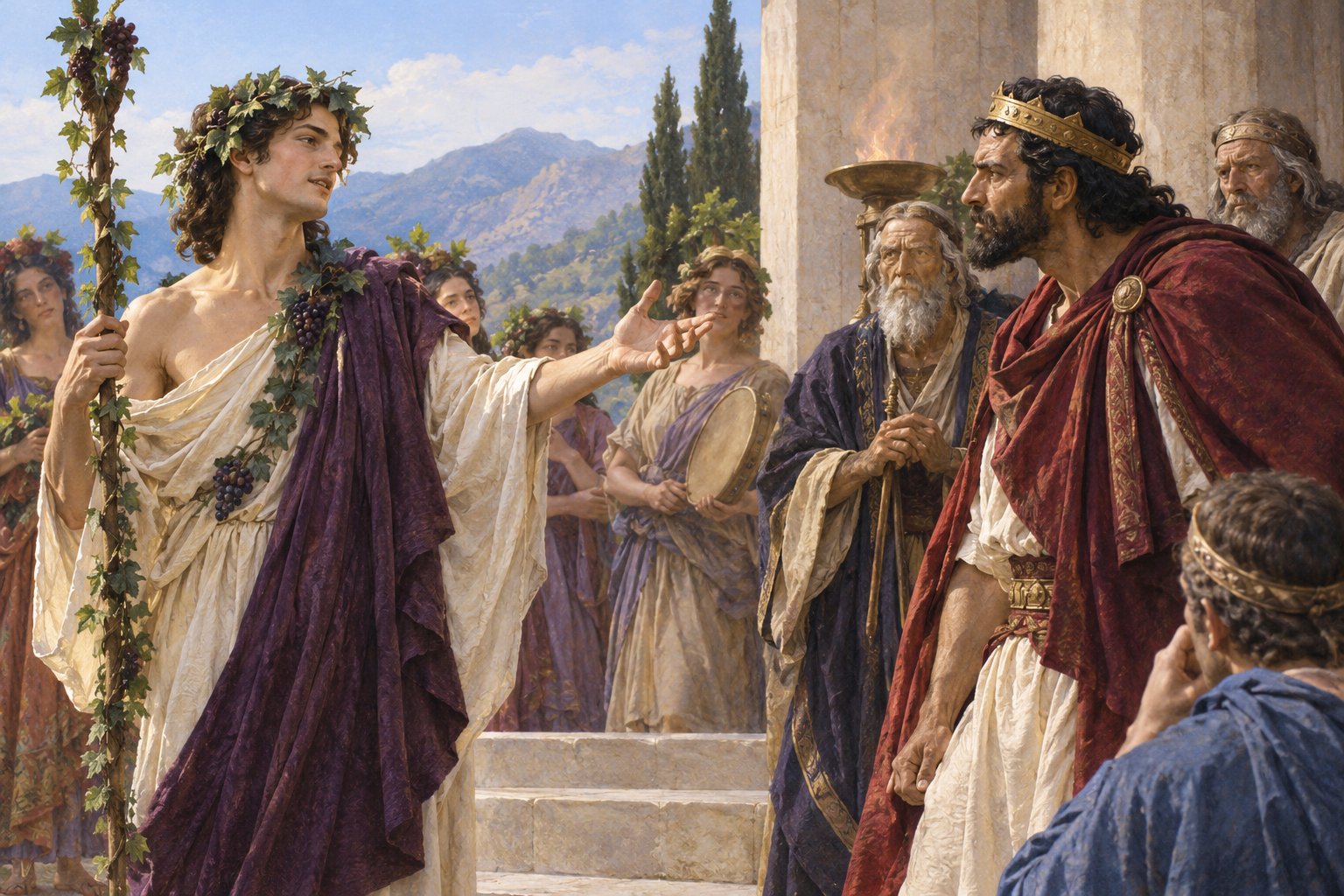
Euripides’ Bacchae begins when Dionysus returns to Thebes to establish recognition of his divine identity. Pentheus, the city’s young king and Dionysus’ cousin, refuses to accept his worship. Their conflict entangles relatives, advisers, and worshippers, ending in the destruction of Pentheus and the suffering of his family.
Dionysus: The God in Disguise
Dionysus is the son of Zeus and Semele, a daughter of Cadmus. He appears as a human stranger while the audience knows his identity. He seeks acknowledgment from Thebes and punishes the family members who have denied his mother’s claim. His control over events makes him formidable, but the severity of his revenge invites questions about divine justice.
Pentheus: King of Thebes
Pentheus, son of Agave and grandson of Cadmus, fears that Dionysian worship threatens public order. He attempts to arrest the stranger and control the women who have gone to Mount Cithaeron. His rigidity is accompanied by fascination: Dionysus persuades him to disguise himself to spy on the worshippers. The resulting reversal exposes the limits of his authority.
Agave: Mother and Unknowing Destroyer
Agave is Pentheus’ mother and one of the women drawn into Dionysian frenzy. On the mountain she participates in killing her own son, believing him to be a wild animal. She returns triumphantly, unaware of what she carries, until Cadmus helps her recognize the truth. Her recognition transforms apparent victory into unbearable grief.
Cadmus: Founder, Grandfather, and Survivor
Cadmus, founder of Thebes, is father to Semele and Agave and grandfather to both Dionysus and Pentheus. He urges respect for Dionysus, partly because recognition of the god would honor his family. Yet his caution cannot protect those he loves. At the end he must confront Agave with the consequences of her actions.
Tiresias: The Prophet Who Counsels Restraint
Tiresias, the blind prophet, joins Cadmus in supporting Dionysus’ worship. He argues against Pentheus’ confidence in his own judgment. Their exchange presents a contrast between the young ruler’s certainty and the older men’s willingness to acknowledge powers beyond political command.
The Chorus and the Messengers
The Chorus consists of women from Asia who follow Dionysus and celebrate his rites. Their songs express devotion to the god, but the violence of the ending complicates any simple celebration. The messengers report events on Mount Cithaeron that the audience does not see, contrasting extraordinary natural harmony with terrifying collective violence.
Key Relationships
- Dionysus and Pentheus: Divine cousin and human king become adversaries over recognition and authority.
- Pentheus and Agave: A mother–son bond is destroyed when Agave cannot recognize her child.
- Cadmus and his family: The founder of Thebes tries to preserve both religious respect and family continuity.
- Cadmus and Tiresias: Two elders offer counsel that Pentheus rejects.
- Dionysus and the Chorus: The god’s followers praise his power, while the outcome tests the meaning of that devotion.
Questions for Discussion
- Why does Dionysus conceal his identity from Pentheus?
- How does Pentheus’ role as king influence his response to the stranger?
- What motivates Cadmus and Tiresias to defend Dionysus’ worship?
- Why is Agave’s recognition scene central to the tragedy?
- How do the Chorus and messengers present different aspects of Dionysian power?
- Does the play invite sympathy for Pentheus even while criticizing his decisions? Explain.
Note to the Educator
Ask students to map the family connections before reading the final scenes. Then compare what each character knows about Dionysus and when that knowledge changes. The play depicts religious frenzy, violence, and the death of a family member; preview sensitive passages and keep discussion focused on literary interpretation rather than treating divine punishment as automatically just.
This guide accompanies the Richer Resources Publications edition of Bacchae, translated by Ian Johnston.
A printable PDF version of this resource is available by email.