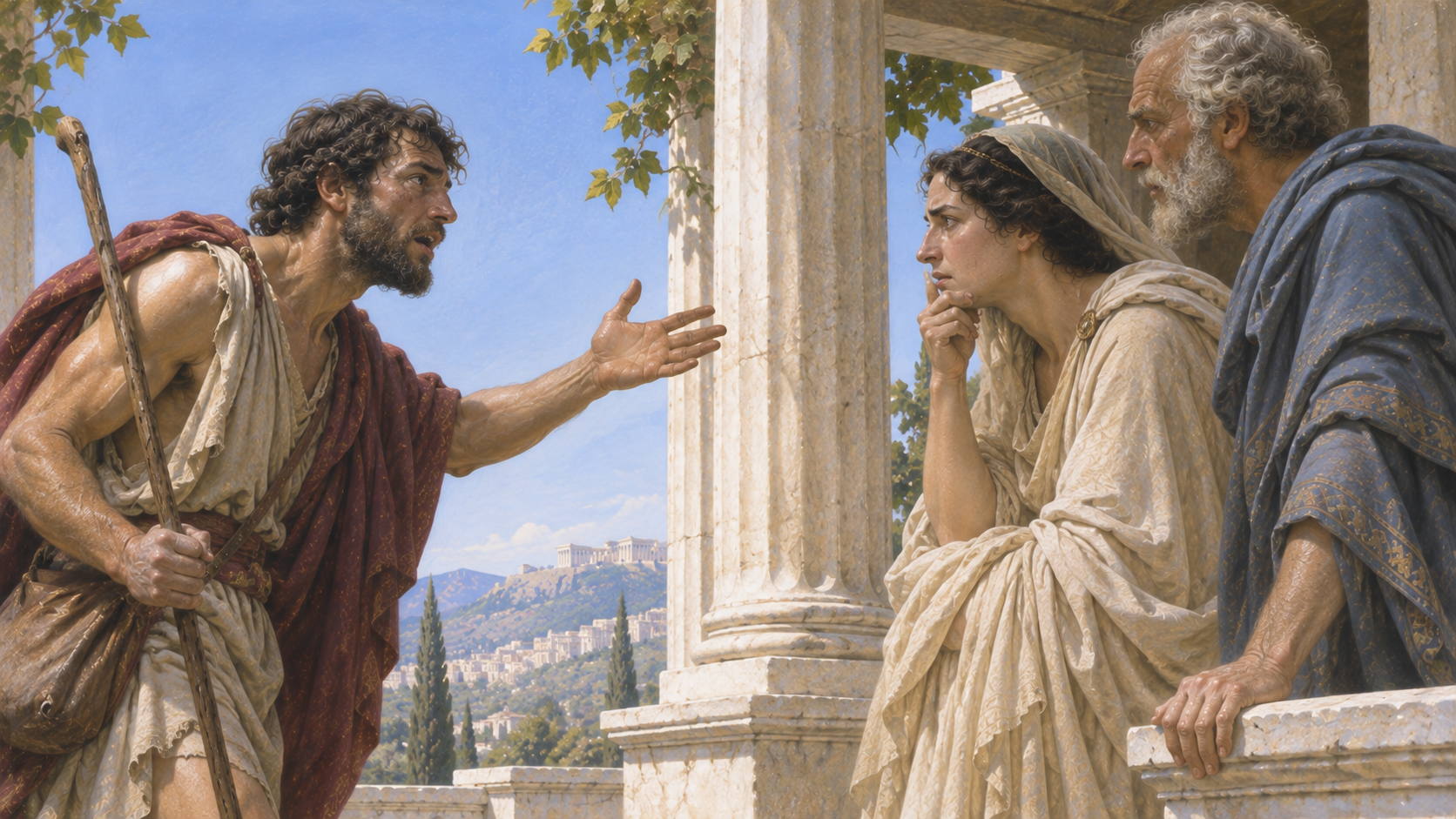
How Euripides Creates Irony, Suspense, and Tragic Recognition
The language of Euripides’ Bacchae does more than convey events. Through contrasting voices, symbolic imagery, messenger speeches, and carefully delayed recognition, the playwright makes the audience aware of truths his characters struggle to understand.
Dramatic Irony and the Limits of Knowledge
The audience learns in the prologue that the apparent stranger is Dionysus. Pentheus does not. When the king interrogates and threatens him, the gap between what the audience knows and what Pentheus believes makes his confidence increasingly precarious. Read their exchanges for moments when Dionysus speaks truthfully but Pentheus misunderstands him.
Contrasting Voices: Pentheus and Dionysus
Pentheus often speaks in commands and accusations, asserting the power of his office. Dionysus answers with composure, questions, and suggestive statements. Compare their diction and tone. How does the apparent prisoner gain control of the conversation?
Images of Nature and the Thyrsus
Ivy, vines, flowing water, and the ritual staff evoke fertility and abundance. Yet the same mountain setting becomes a place of terrifying violence. Trace how Euripides transforms natural imagery from an image of freedom into a sign of danger.
Messenger Speeches and Offstage Action
The messengers recount extraordinary events that the audience cannot witness directly. Their descriptions make the unseen vivid and allow the play to move between calm, wonder, and horror. Examine how each messenger orders details and how the change in tone shapes the audience’s response.
Disguise, Vision, and Reversal
Pentheus wishes to see the Bacchants without being seen. Dionysus dresses him for the expedition, turning the king into a spectacle. His distorted vision anticipates his destruction. Consider the irony of a character who pursues sight but fails to understand.
Recognition and the Language of Grief
Agave initially believes she has returned with a hunting trophy. Cadmus guides her through questions toward the realization that she has killed Pentheus. Notice how the dialogue slows the discovery. The movement from certainty to recognition gives the ending its emotional force.
Six Analytical Questions
- Identify a statement by Dionysus that the audience understands differently from Pentheus. How does it create dramatic irony?
- Compare the tone of Pentheus and Dionysus in one exchange. Which speaker controls the scene, and how?
- Choose two images of nature or ritual and explain how their associations change during the play.
- How does a messenger speech make an offstage event vivid? Discuss the order and detail of the report.
- Why is Pentheus’ disguise a turning point in both plot and characterization?
- How does the language of Agave’s recognition scene shape the audience’s sympathy?
Guided Close-Reading Activities
Activity 1 — Two voices: Annotate a short exchange between Pentheus and Dionysus. Mark commands, questions, evasions, and warnings. Write a paragraph explaining how the balance of power appears in their language.
Activity 2 — Imagery across scenes: Follow one recurring image, such as ivy, the thyrsus, or Mount Cithaeron. Compare its significance in an early and late passage.
Activity 3 — From report to recognition: Compare the second messenger’s account with Agave’s dialogue with Cadmus. Explain how the two passages produce different forms of suspense and grief.
Note to the Educator
Students should select brief passages from the Ian Johnston translation and cite the line numbers in their own edition; no particular wording should be assumed across translations. The messenger account and recognition scene include familial violence and should be previewed.
This resource accompanies the Richer Resources Publications edition of Bacchae, translated by Ian Johnston.
A printable PDF version of this resource is available by email.