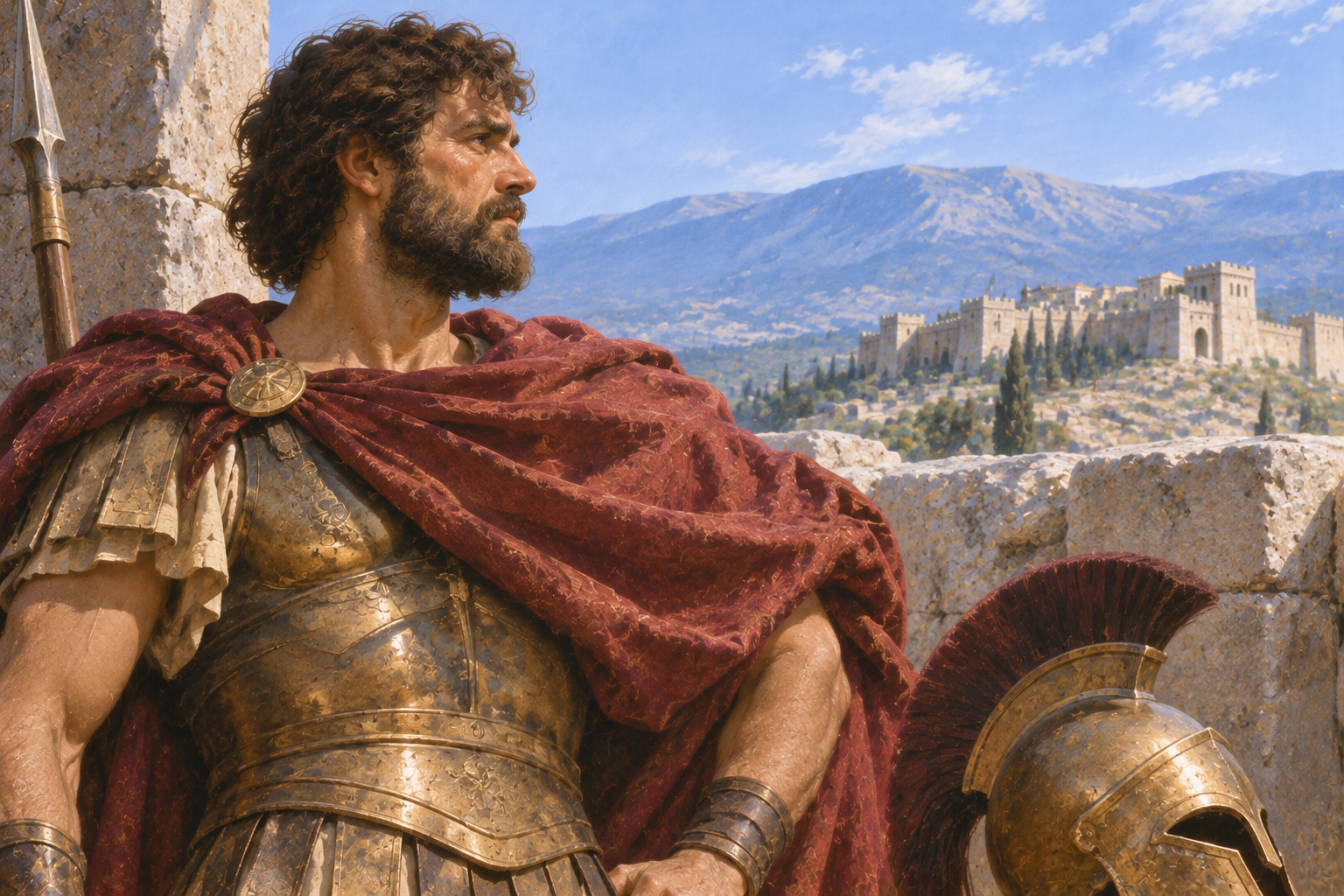
Family, Leadership, and the Defense of Thebes
In Seven Against Thebes, Aeschylus presents a city under siege and a royal family approaching catastrophe. The central conflict involves Eteocles, who defends Thebes, and his brother Polynices, who leads an attacking army. Through their rivalry and the responses of those around them, the play explores the demands of leadership, the consequences of inherited wrongdoing, and the destructive force of family hatred.
Eteocles: The Defender of Thebes
Eteocles rules Thebes and organizes its defense against the invading army. He presents himself as a determined leader responsible for protecting the city and its inhabitants.
His courage and decisiveness are important qualities, but his determination to confront Polynices personally raises questions about judgment and self-control. Students should consider whether Eteocles acts primarily as a responsible ruler, an angry brother, or a man driven by the curse upon his family.
Polynices: The Exiled Brother
Polynices leads the attacking forces against Thebes. Although he does not appear in a speaking role during the central action, the reports of his position and intentions make him essential to the drama.
His decision to attack his native city complicates the audience's response to his claim against Eteocles. Students can examine the tension between a perceived right to rule and the responsibility owed to one's community.
The Scout: The Voice of Military Intelligence
The Scout reports the movements and identities of the seven enemy champions stationed at the city's gates.
His descriptions of their weapons, shields, and threatening declarations create a vivid picture of the danger facing Thebes. He also provides the information Eteocles uses to select defenders.
The Scout's role demonstrates how reported action can create dramatic tension without requiring battles to take place onstage.
The Chorus: The Women of Thebes
The Chorus consists of Theban women frightened by the approaching army. Their prayers and expressions of fear reveal the vulnerability of the city's inhabitants.
Eteocles criticizes their alarm and urges them to maintain order. Their exchanges expose differing responses to danger: the ruler emphasizes discipline and defense, while the women express the human cost of warfare.
Students should consider whether the Chorus' fear represents weakness or a necessary reminder of what is at stake.
The Seven Attacking Champions
The seven champions represent the military threat to Thebes. Each is assigned to a gate, and the descriptions of their shields and conduct help distinguish their personalities.
Tydeus, Capaneus, Eteoclus, Hippomedon, Parthenopaeus, Amphiaraus, and Polynices form the attacking force. Their contrasting characteristics range from violent arrogance to reluctant participation.
Amphiaraus is especially significant because he recognizes the danger and injustice surrounding the expedition, yet participates in it.
The Defenders of the Gates
Eteocles appoints a Theban defender to oppose each attacking champion. His choices reveal his military judgment and his confidence in the city's resistance.
The sequence builds toward the seventh gate, where Eteocles decides to face Polynices himself. At that moment, the defense of Thebes becomes inseparable from the brothers' personal conflict.
The Brothers and the Curse of Oedipus
Eteocles and Polynices inherit the troubled history of their father, Oedipus. Their hostility is associated with a paternal curse that threatens the destruction of both brothers.
The play raises an important question about inherited fate and individual responsibility. Even if the brothers are influenced by a family curse, their choices contribute directly to the catastrophe.
Antigone and Ismene in the Ending
Some transmitted versions of the play include a concluding scene involving Antigone and Ismene and a dispute over the burial of Polynices. Scholars have questioned whether parts of this ending were added after Aeschylus' original production.
If this material appears in the classroom edition, students can consider how it extends the conflict from the brothers' deaths to the duties of surviving family members.
Questions for Discussion
- Does Eteocles place the welfare of Thebes above his personal interests?
- How does Polynices' decision to attack his native city affect our judgment of him?
- What does the Scout contribute to the play's dramatic structure?
- How do the Chorus and Eteocles respond differently to the approaching danger?
- Why is Amphiaraus different from the other attacking champions?
- How does the curse of Oedipus influence the brothers' choices?
- Can Eteocles and Polynices be held responsible for a catastrophe associated with inherited fate?
Note to the Educator
Encourage students to distinguish the public responsibilities of Eteocles from his private hostility toward Polynices. The play offers a useful opportunity to examine how family conflict can threaten an entire community. The contrasting perspectives of the Scout, the Chorus, and the attacking champions also help students understand how Aeschylus develops character through reports, dialogue, and descriptions rather than direct encounters.
This guide accompanies the Richer Resources Publications edition of Seven Against Thebes. If the edition includes the disputed concluding scene, teachers may wish to explain briefly that its textual history remains a subject of scholarly discussion.
A printable PDF version of this resource is available by email.