Leadership, Loyalty, and the Cost of Conflict
In Seven Against Thebes, Aeschylus presents a city threatened by invasion and a ruling family divided by hostility. The conflict between Eteocles and Polynices raises questions about public responsibility, personal ambition, inherited fate, and the destructive consequences of war. These discussion questions and essay prompts encourage students to develop interpretations supported by evidence from the play.
Questions for Classroom Discussion
Leadership and Civic Responsibility
- What qualities make Eteocles an effective defender of Thebes? What weaknesses complicate his leadership?
- Does Eteocles place the welfare of the city above his personal conflict with Polynices?
- How does the Scout's reporting help Eteocles make decisions? What does the play suggest about the importance of reliable information during a crisis?
Family Loyalty and Rivalry
- How does Polynices' decision to attack Thebes affect our judgment of his claim to power?
- Can either brother be regarded as entirely justified in the conflict?
- How does the relationship between Eteocles and Polynices transform a military struggle into a family tragedy?
Fate and Individual Choice
- Does the curse of Oedipus determine the brothers' deaths, or do their own decisions bring about the catastrophe?
- Why does the Chorus urge Eteocles not to confront Polynices personally?
- What does the play suggest about the difficulty of escaping a destructive family inheritance?
War and Its Consequences
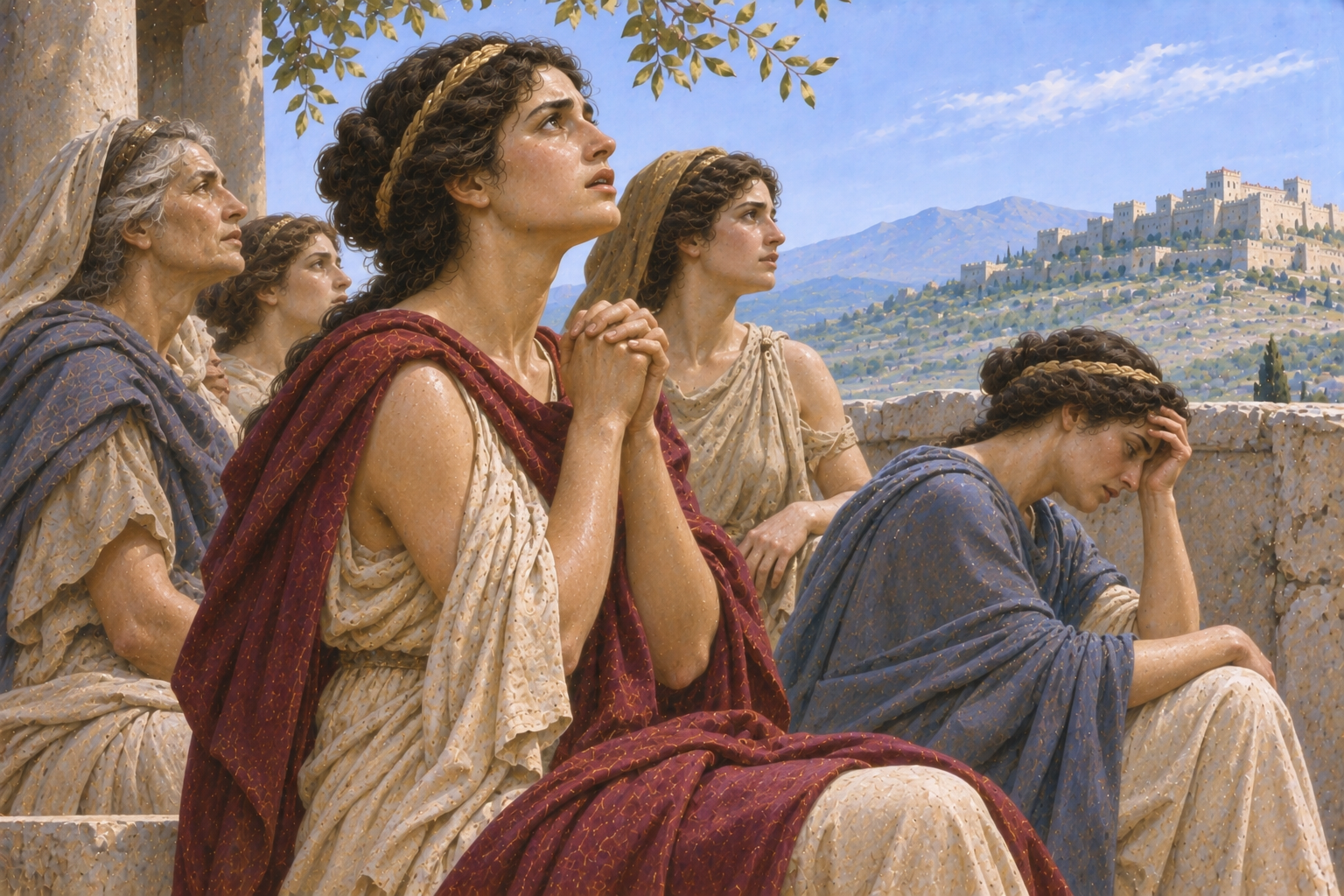
- How does the Chorus of Theban women broaden the audience's understanding of the threatened invasion?
- Why does Aeschylus describe the attacking champions through their shields and conduct rather than presenting them directly?
- Can the survival of Thebes be considered a victory when its ruling brothers destroy one another?
Analytical Essay Prompts
1. Eteocles as Leader and Tragic Figure
Examine Eteocles' conduct as ruler and defender of Thebes. Does his decision to confront Polynices represent courage, personal anger, obedience to fate, or a combination of these motives? Support your argument with specific moments from the play.
2. Fate and Responsibility in the House of Oedipus
Analyze the relationship between the inherited curse and the brothers' individual choices. To what extent does Aeschylus portray the catastrophe as inevitable?
3. The Chorus and the Human Cost of War
Discuss the dramatic importance of the Chorus of Theban women. How do their fears and prayers complicate Eteocles' emphasis on military discipline and civic defense?
4. The Seven Gates and the Structure of Suspense
Explain how the repeated reports of attacking champions build tension. Why does the seventh gate become the decisive turning point in the tragedy?
5. The Meaning of Victory
Thebes survives the attack, but Eteocles and Polynices die. Analyze how this contrast shapes the play's treatment of political success, family destruction, and the cost of conflict.
Developing a Literary Argument
Students should begin with a clear claim that answers the chosen question. Rather than retelling the plot, they should identify relevant speeches, decisions, and dramatic exchanges and explain how these details support their interpretation.
Strong essays should also consider complications. For example, an argument praising Eteocles' leadership might acknowledge the personal motives that influence his final decision.
Because translations vary, students should cite passages according to the edition used in their classrooms.
Note to the Educator
Encourage students to distinguish Eteocles' public duty to defend Thebes from his private conflict with Polynices. The play is especially useful for discussing how a leader's personal decisions can affect an entire community. Students may also compare the military perspective of Eteocles and the Scout with the fears expressed by the Chorus.
These prompts can support classroom seminars, short written responses, or extended analytical essays.
This resource accompanies the Richer Resources Publications edition of Seven Against Thebes, translated by Ian Johnston.
A printable PDF version of this resource is available by email.