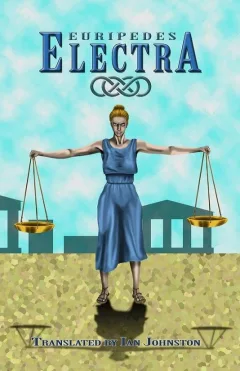
Justice, Revenge, and Moral Responsibility in Electra
About This Guide
In Electra, Euripides revisits the story of Agamemnon's children and their revenge against those responsible for their father's murder. Rather than presenting revenge as a straightforward heroic duty, the tragedy asks whether a seemingly justified act can become morally destructive.
This guide explores five major themes and provides questions to help students consider the competing claims of justice, family loyalty, and personal responsibility.
1. Justice and Revenge
Electra and Orestes believe that their father's murder demands punishment. Yet the killing of Aegisthus and Clytemnestra raises a troubling question: does avenging one murder restore justice, or does it perpetuate violence?
The play distinguishes the desire to correct a wrong from the emotional satisfaction of punishing an enemy. The siblings achieve their revenge, but their victory brings neither peace nor certainty.
Consider: At what point does the pursuit of justice become revenge?
2. Family Loyalty and Conflicting Duties
The tragedy places Orestes and Electra between incompatible family obligations. Their loyalty to their murdered father leads them to turn against their mother.
Clytemnestra also invokes family suffering when she defends her actions, pointing to Agamemnon's sacrifice of their daughter Iphigenia. Her argument does not erase her responsibility, but it prevents the family conflict from being reduced to innocent victims and obvious villains.
Consider: Can loyalty to one family member justify violence against another?
3. Guilt and Moral Responsibility
The siblings anticipate revenge as a necessary act, but their responses afterward expose its emotional and moral cost.
Orestes' distress and Electra's involvement complicate any simple division between the person who carries out a deed and the person who encourages it. The appearance of Castor and Polydeuces at the end further emphasizes the difficulty of judging actions that combine divine commands, human decisions, and terrible consequences.
Consider: Who bears responsibility when several people contribute to a wrongful act?
4. Noble Birth and Moral Character
Electra's marriage to a poor farmer places her far from the royal life into which she was born. Yet her husband behaves with generosity and restraint, while members of the ruling family commit acts of cruelty.
Through this contrast, Euripides questions the assumption that noble ancestry or social position guarantees virtue. Moral worth emerges through conduct rather than wealth or inherited status.
Consider: Why might Euripides make the farmer one of the play's most honorable characters?
5. Suffering, Identity, and the Desire for Recognition
Electra's isolation and reduced circumstances shape her sense of herself. She identifies strongly with the injustice done to her father and to her family, and her suffering becomes closely connected with her desire for revenge.
The reunion with Orestes restores a lost family bond, but it also makes possible the violence that follows. Recognition brings hope without guaranteeing a happy outcome.
Consider: How does Electra's suffering influence both her judgment and her identity?
Themes in Conversation
These themes overlap throughout the tragedy. Family loyalty encourages revenge; revenge creates guilt; social position fails to predict moral character; and the desire to restore a damaged family produces further suffering.
Euripides invites readers to examine not only what the characters do, but also the assumptions they use to justify their choices.
Discussion Questions
- Does the play portray Electra's desire for revenge sympathetically, critically, or both?
- How does Clytemnestra's account of Iphigenia complicate the conflict?
- What is the difference between obeying a command and accepting moral responsibility?
- How does Electra's husband challenge conventional expectations about nobility?
- Does the ending offer justice, punishment, reconciliation, or something less certain?
Classroom Activity: A Question of Justice
Divide students into three groups. Ask one group to argue that the siblings' revenge is justified, a second to argue that it is morally wrong, and a third to examine the strengths and weaknesses of both positions.
Each group should support its reasoning with events and dialogue from the play. Conclude by discussing whether Euripides deliberately leaves some moral questions unresolved.
Note to the Educator
Encourage students to distinguish a character's explanation for an action from the playwright's judgment of that action. This distinction is particularly useful when discussing Clytemnestra's defense, Orestes' obligations, and the final divine intervention.
A printable PDF version of this resource is available by email.