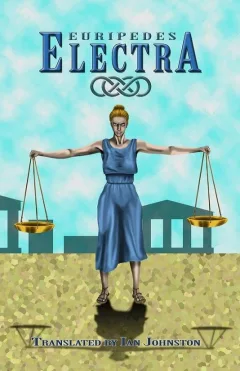
From Recognition to Revenge: The Dramatic Structure of Electra
About This Guide
Euripides’ Electra follows the children of Agamemnon as they seek revenge for their father's murder. Its dramatic structure moves from uncertainty and recognition to planning, violence, and a deeply unsettling resolution.
This guide traces the play's major stages and explains how Euripides uses suspense, reported action, dialogue, and reversals of expectation.
1. Opening Situation: Exile and Dispossession
The play begins outside the modest rural home of Electra and her husband, a poor farmer. Electra has been removed from the royal household and married beneath her social rank to prevent her from producing a son who might threaten Aegisthus.
Orestes, returning secretly from exile with Pylades, approaches the countryside where his sister lives.
Dramatic purpose: The opening establishes the injustice suffered by Agamemnon's children while contrasting royal power with the farmer's decency.
2. The Arrival of Orestes: Suspense and Uncertainty
Orestes initially conceals his identity. Electra speaks with him without recognizing her brother, creating a difference between what the audience knows and what she knows.
Her account of her suffering reveals the depth of her anger and prepares the audience for the revenge plot.
Dramatic purpose: Concealment delays the reunion and allows the audience to observe Electra's feelings before she discovers who is listening.
3. Recognition and Reunion
The Old Man, who helped save Orestes in childhood, recognizes him through a scar. Electra and Orestes are reunited after years of separation.
Euripides complicates familiar recognition conventions by having Electra question whether tokens such as hair, footprints, or clothing could reliably prove a person's identity.
Dramatic purpose: Recognition changes the siblings' circumstances. They are no longer isolated sufferers but partners capable of acting together.
4. Planning the Revenge
The Old Man helps the siblings devise their plan. Orestes will approach Aegisthus during a sacrifice in the countryside, while Electra will lure Clytemnestra to her home with a false report that she has given birth.
The two intended murders are therefore prepared through different forms of deception.
Dramatic purpose: The audience anticipates the violence while watching the characters commit themselves to increasingly troubling choices.
5. The Death of Aegisthus
Aegisthus welcomes Orestes, not knowing his identity. Orestes kills him during the sacrificial preparations.
A messenger reports the killing rather than having the audience witness it directly. The report describes the action and its immediate consequences.
Dramatic purpose: The messenger's account provides a vivid turning point while preserving the distinction between action occurring offstage and its dramatic presentation.
6. The Confrontation with Clytemnestra
Clytemnestra arrives at Electra's home, believing her daughter has recently given birth. Mother and daughter debate the murder of Agamemnon.
Clytemnestra defends herself by invoking Agamemnon's sacrifice of Iphigenia. Electra challenges her mother's explanation and condemns her relationship with Aegisthus.
Dramatic purpose: The debate complicates the audience's moral judgment immediately before the second killing.
7. Matricide and Its Aftermath
Orestes and Electra carry out the murder of Clytemnestra inside the house. Afterward, the siblings confront the horror of what they have done.
Their achievement of revenge does not bring the expected satisfaction. Instead, guilt and distress dominate the aftermath.
Dramatic purpose: The apparent completion of the revenge plot becomes a moral reversal: the characters have achieved their objective but cannot celebrate it.
8. Divine Appearance and Resolution
Castor and Polydeuces appear and announce what must follow. Orestes must leave and face judgment, while Electra is to marry Pylades.
The divine intervention directs the characters toward their futures but does not erase the suffering caused by their actions.
Dramatic purpose: The ending provides an outward resolution while leaving difficult questions about justice, divine commands, and human responsibility.
Important Dramatic Techniques
Dramatic irony: The audience knows Orestes' identity while Electra initially does not.
Recognition: The reunion transforms the siblings' circumstances and enables the revenge.
Messenger speech: The account of Aegisthus' death brings offstage violence into the drama through narration.
Debate: Electra and Clytemnestra present competing interpretations of past events.
Reversal of expectation: Revenge produces anguish rather than peace.
Divine intervention: Castor and Polydeuces establish the characters' future while emphasizing the seriousness of the crimes.
Questions for Analysis
- Why does Euripides delay Electra's recognition of Orestes?
- What is the effect of having Aegisthus' death described by a messenger?
- Why does the debate with Clytemnestra occur just before her murder?
- At what point does the emotional direction of the play change most sharply?
- Does the final divine appearance resolve the tragedy's moral conflicts?
Classroom Activity: Mapping the Dramatic Turning Points
Ask students to create a timeline with eight stages, beginning with Orestes' return and ending with the appearance of Castor and Polydeuces.
For each stage, students should identify what changes, what the audience knows, and how the event affects the siblings' hopes or fears.
Then ask students to select the play's most important turning point and defend their choice with evidence from the text.
Note to the Educator
Encourage students to distinguish between the chronological sequence of events and the order in which Euripides reveals information to the audience. This is particularly useful for examining recognition, suspense, messenger narration, and the play's disturbing reversal after the murders.
A printable PDF version of this resource is available by email.