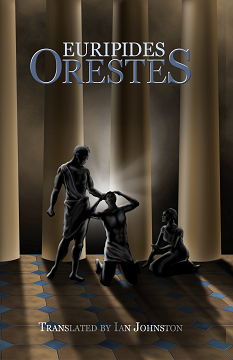
Family Bonds and Divided Loyalties in Orestes
About This Guide
Euripides’ Orestes begins after Orestes and his sister Electra have killed their mother, Clytaemnestra, to avenge the murder of their father, Agamemnon. Rather than restoring justice, their actions have brought suffering, public condemnation, and the threat of execution.
The play examines what happens when family obligations conflict with moral responsibility. This guide introduces the principal characters and explores the relationships that drive the tragedy.
Principal Characters
Orestes — Son of Agamemnon and Clytaemnestra. After killing his mother, he suffers severe mental distress and fears punishment by the people of Argos. He claims that Apollo commanded the murder, but his appeal to divine authority does not resolve the question of responsibility.
Electra — Orestes' sister and devoted supporter. She cares for him during his illness and shares the danger of public condemnation. Her loyalty is unwavering, even when the siblings' plans become increasingly desperate.
Pylades — Orestes' closest friend and companion. He refuses to abandon Orestes and participates in the plan to attack Helen and seize Hermione. His loyalty raises questions about the limits of friendship.
Menelaus — Brother of Agamemnon, husband of Helen, and uncle of Orestes and Electra. Returning from Troy, he is asked to help the siblings but hesitates to challenge the political opposition against them.
Helen — Wife of Menelaus and mother of Hermione. Her departure with Paris helped bring about the Trojan War. In this play she becomes a target of the siblings' anger, although she did not cause their immediate predicament.
Hermione — Daughter of Menelaus and Helen. She becomes a hostage when Orestes and his companions attempt to force Menelaus to intervene.
Tyndareus — Father of Clytaemnestra and Helen, and grandfather of Orestes and Electra. He condemns the murder of his daughter and insists that the siblings should be punished through lawful means.
Apollo — The god whom Orestes identifies as the source of the command to avenge Agamemnon. Apollo appears at the conclusion to announce a resolution to the crisis.
The Chorus — Women of Argos who respond to the siblings' suffering and the developing danger. Their presence helps frame the emotional and moral consequences of the action.
The Phrygian Servant — A member of Helen's household who describes the violent events inside the palace, bringing a mixture of fear and dramatic intensity to the later scenes.
The Family Relationships
Agamemnon and Clytaemnestra: Their marriage ends in murder when Clytaemnestra and Aegisthus kill Agamemnon after his return from Troy.
Orestes and Electra: Brother and sister united by their father's murder, their revenge, and the consequences that follow.
Orestes and Tyndareus: Grandson and grandfather divided by opposing views of justice and family duty.
Orestes and Menelaus: Nephew and uncle whose relationship is tested by Menelaus' unwillingness to risk his own position.
Menelaus, Helen, and Hermione: A family drawn into the siblings' desperate attempt to escape execution.
Orestes and Pylades: A friendship that demonstrates extraordinary devotion but also encourages further violence.
Four Central Conflicts
1. Family Loyalty Versus Justice
Orestes believes he fulfilled his duty to his murdered father. Tyndareus argues that killing one's mother cannot be justified as lawful revenge.
2. Friendship Versus Moral Responsibility
Pylades supports Orestes without hesitation. Students must consider whether true friendship sometimes requires opposing a friend's destructive decisions.
3. Private Revenge Versus Public Judgment
The Argive assembly condemns Orestes and Electra. Its decision raises questions about whether collective judgment is necessarily fair or wise.
4. Divine Commands Versus Human Choice
Orestes invokes Apollo's command, while the play repeatedly confronts the suffering produced by human actions. Apollo's eventual appearance ends the immediate crisis without eliminating its moral difficulties.
Questions for Discussion
- How does Electra's care for Orestes influence our understanding of their relationship?
- Why does Tyndareus condemn Orestes despite their family connection?
- Is Menelaus' hesitation understandable, or does it represent a failure of family loyalty?
- When does Pylades' friendship become dangerous?
- Why do Helen and Hermione become targets of the siblings' anger?
- Does Apollo's intervention resolve the question of Orestes' responsibility?
Classroom Activity: Mapping the House of Atreus
Ask students to create a relationship diagram connecting Agamemnon, Clytaemnestra, Orestes, Electra, Menelaus, Helen, Hermione, Tyndareus, and Pylades.
Use different lines or symbols to identify family ties, friendship, marriage, conflict, and obligations.
Then ask students to select three relationships and explain how loyalty or resentment affects a major decision in the play.
Note to the Educator
Encourage students to distinguish a character's motives from the consequences of that character's actions. Orestes is especially useful for examining how conflicting obligations can lead people to defend conduct that others regard as unjust.
The relationship diagram can also help students understand the complicated family history without requiring detailed knowledge of every version of the House of Atreus myth.
Reading the Play
A printable PDF version of this resource is available by email.