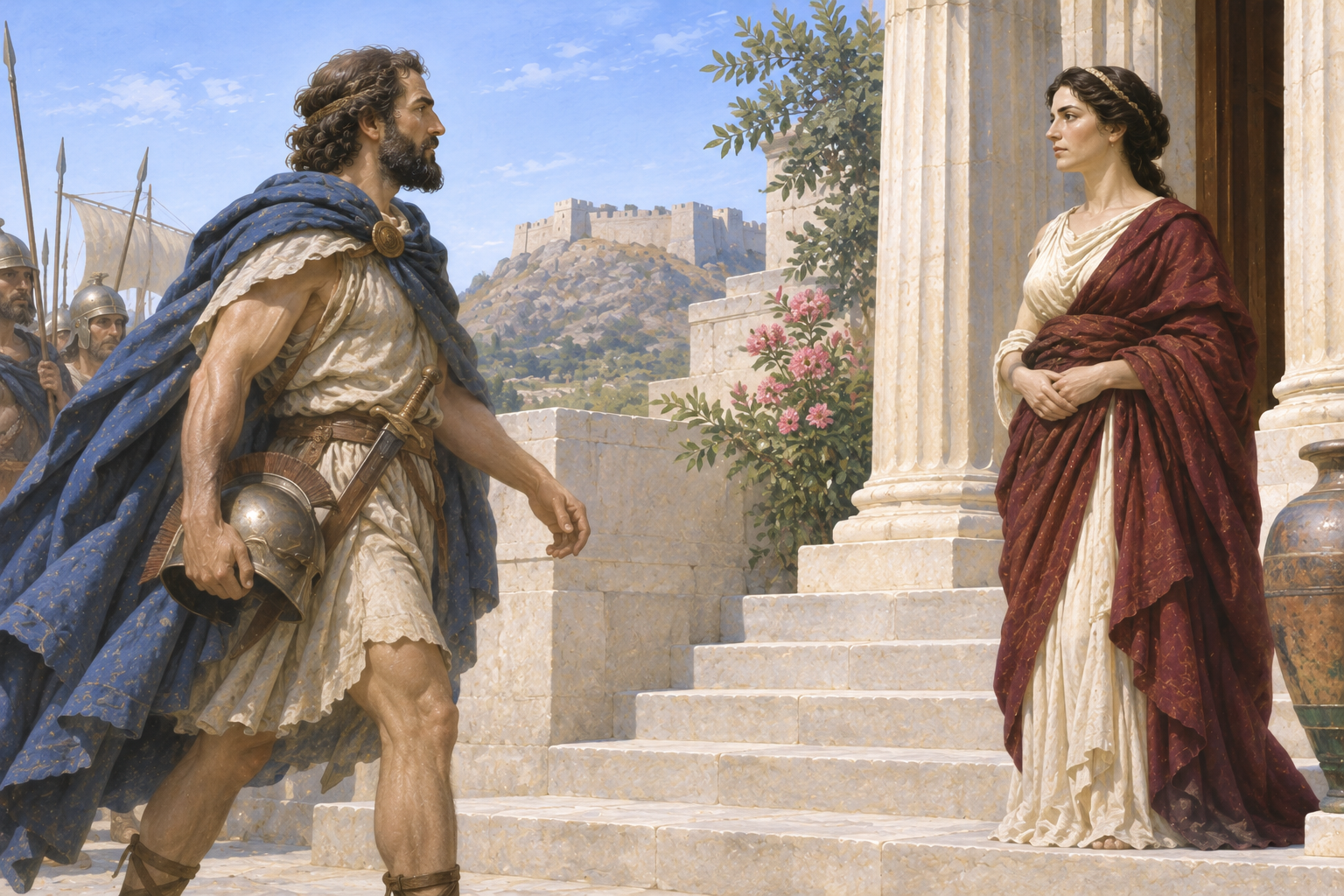
Before the Trial: The House of Atreus and the Myths Behind Orestes
About This Guide
Euripides’ Orestes begins after a series of murders within one of Greek mythology's most troubled royal families. Orestes and Electra have killed their mother, Clytaemnestra, to avenge the death of their father, Agamemnon.
Understanding the family's earlier history helps explain why the characters disagree so sharply about justice, revenge, and their obligations to one another.
1. The House of Atreus
Orestes belongs to the House of Atreus, a royal family associated with generations of rivalry, betrayal, and bloodshed.
In the wider mythological tradition, Atreus and his brother Thyestes struggled for power. Atreus committed a terrible act of revenge against Thyestes, creating a legacy of violence that later generations inherited.
Agamemnon and Menelaus were sons of Atreus. Agamemnon became king of Mycenae or Argos in different traditions, while Menelaus became king of Sparta.
Connection to the play: Orestes' suffering forms part of a much longer history of family members attempting to avenge earlier wrongs.
2. Helen and the Trojan War
Menelaus married Helen, daughter of Tyndareus in the traditional account. Her departure for Troy with Paris led to the expedition of Greek forces against the city.
Agamemnon, Menelaus' brother, commanded the Greek army.
The war lasted ten years in the familiar epic tradition and caused immense suffering among Greeks and Trojans.
Connection to the play: Helen's return to Greece makes her a prominent figure in Orestes, while Menelaus' position as Agamemnon's brother creates expectations of family assistance.
3. Iphigenia and the Cost of War
Before the Greek fleet sailed for Troy, Agamemnon was required, in a well-known version of the myth, to sacrifice his daughter Iphigenia to obtain favorable winds.
Ancient accounts differ concerning whether Iphigenia died or was rescued by Artemis.
The episode became an important source of hostility between Agamemnon and Clytaemnestra.
Connection to the play: The sacrifice forms part of the family's history of violence and helps explain why Clytaemnestra's murder of Agamemnon could be understood differently by different characters and audiences.
4. Agamemnon's Return and Murder
After Troy fell, Agamemnon returned home. Clytaemnestra and her lover Aegisthus killed him.
In the wider mythological tradition, their motives include Clytaemnestra's anger over Iphigenia and her relationship with Aegisthus.
Agamemnon's death left Orestes and Electra with the question of whether they were obligated to avenge their father.
Connection to the play: The murder provides the immediate justification Orestes offers for his subsequent actions.
5. Orestes and Electra Take Revenge
Orestes eventually returned and, with Electra's support, killed Aegisthus and Clytaemnestra.
In Euripides' Orestes, the siblings have already carried out this revenge before the drama begins.
Orestes maintains that Apollo commanded him to avenge Agamemnon, yet the killing of his mother remains a profound moral and religious offense.
Connection to the play: The tragedy begins not with revenge itself but with its consequences.
6. The Furies and the Meaning of Guilt
The Furies, also called the Erinyes, were divine powers associated with the punishment of serious wrongdoing, especially offenses against family members.
After killing his mother, Orestes believes these powers are pursuing him.
Euripides presents his anguish through episodes of terror, illness, and disturbed perception.
Connection to the play: The Furies connect the mythological idea of divine punishment with Orestes' visible psychological suffering.
7. Tyndareus and the Question of Justice
Tyndareus is the father of Clytaemnestra and Helen and the grandfather of Orestes and Electra.
He condemns the killing of Clytaemnestra and argues that wrongdoing should be addressed through lawful judgment rather than private revenge.
Connection to the play: His position challenges Orestes' claim that avenging his father justified killing his mother.
8. Different Ancient Treatments of Orestes
Greek poets and playwrights told the story of Orestes in different ways.
Aeschylus' Oresteia explores the movement from blood revenge toward civic judgment. Sophocles' Electra and Euripides' Electra present other dramatic treatments of the siblings' revenge.
Euripides' Orestes concentrates on the period after Clytaemnestra's death, emphasizing psychological distress, political judgment, desperate choices, and divine intervention.
These works should be understood as distinct treatments of a shared mythological tradition.
Family Connections at a Glance
- Atreus: Father of Agamemnon and Menelaus.
- Agamemnon: Father of Orestes and Electra; murdered after returning from Troy.
- Clytaemnestra: Mother of Orestes and Electra; killed by her children.
- Orestes: Son who avenges Agamemnon and then faces condemnation.
- Electra: Daughter who supports Orestes.
- Menelaus: Agamemnon's brother and husband of Helen.
- Helen: Sister of Clytaemnestra and mother of Hermione.
- Hermione: Daughter of Helen and Menelaus.
- Tyndareus: Father of Clytaemnestra and Helen; grandfather of Orestes and Electra.
- Apollo: God whose command Orestes invokes to explain his revenge.
Questions for Discussion
- How does the earlier history of the House of Atreus shape the events of Orestes?
- Why might Clytaemnestra and Orestes each claim that their violence was justified?
- How does the sacrifice of Iphigenia complicate judgments about Agamemnon and Clytaemnestra?
- Why is Menelaus' relationship to Agamemnon important to the siblings' expectations?
- What do the Furies represent in Orestes' experience?
- How does Euripides' treatment of the myth differ in emphasis from a story focused chiefly on the original murders?
Classroom Activity: A Family History of Revenge
Ask students to construct a timeline beginning with the conflict between Atreus and Thyestes and ending with the opening situation of Euripides' Orestes.
For each major event, identify:
- The person responsible.
- The grievance or motive.
- The person harmed.
- The consequences for the next generation.
Conclude by discussing whether the repeated acts of revenge arise from unavoidable family obligations or from decisions that might have been made differently.
Note to the Educator
Encourage students to distinguish the events explicitly discussed in Euripides' Orestes from details supplied by the wider mythological tradition. Ancient versions vary, especially concerning Iphigenia and the earlier history of the House of Atreus.
The most productive classroom discussions will examine how inherited stories influence the characters' choices without treating family history as an excuse for every action.
Reading the Play
A printable PDF version of this resource is available by email.